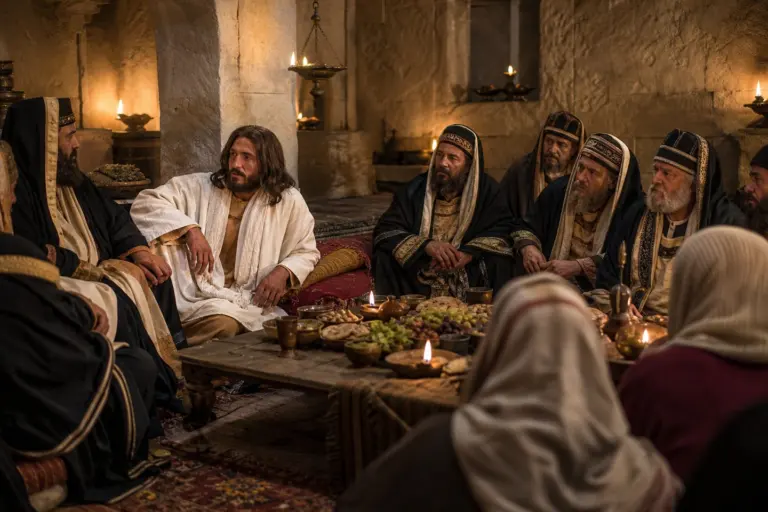
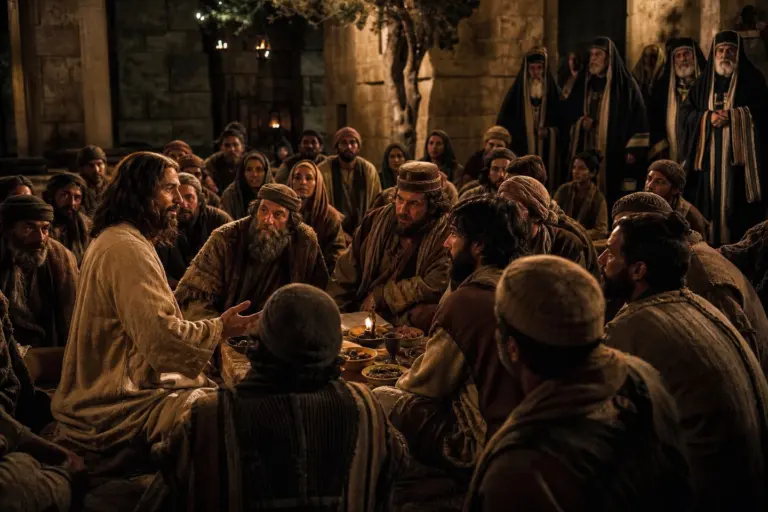
The Parable of the Sower is the first parable Jesus ever told, and He told it under threat. The seed is the Word of God. The four soils are four conditions of the human heart, and only one of them bears fruit. In this study we walk through Matthew 13 verse by verse, see why Jesus suddenly began speaking in stories, and end with the question the parable has been asking every hearer for two thousand years: which soil are you?

Watch this teaching in full above, and read on as we open it together.
Why Jesus Began Teaching in Parables
Something changed in Matthew 13, and to understand it we have to look at what had just happened. The Sanhedrin was hot on Jesus’ trail. Their spies were following Him everywhere, listening to every word, looking for anything they could use against Him in a religious court. Matthew 12 records the escalation: His disciples accused of harvesting on the Sabbath for rubbing heads of wheat in their hands, a man’s hand healed on the Sabbath and the outrage that followed, the accusation that He healed by the power of Satan, the demand that He perform a sign on command. His answer to that demand tells us how He read their hearts: a wicked and adulterous generation seeks after a sign, and no sign would be given it except the sign of the prophet Jonah.
By the end of that chapter, even His family was trying to reach Him, hoping to take Him home before something terrible happened. They could not get close.
So Jesus made a move. We might call it a counterterrorism move against the temple deep state: He disguised His teaching inside innocuous agricultural stories. To a spy standing in the crowd, the Parable of the Sower was a harmless farming tale, a riddle at best, nothing to carry back to the temple, nothing to build a case on. To a carnival seeker who came for miracles and free bread, it did not make much sense either. But to the one who came hungry to know the kingdom of heaven, the story opened and kept opening.
That is what a parable is. It is not a fable and it is not a myth. It is a vehicle for a spiritual message, and Jesus created them on the fly, fitted exactly to what stood in front of His eyes. The parables are part concealment and part illustration, and we are the beneficiaries of both. We open that turning point fully in Why Jesus Taught in Parables: The Key to Every Story He Told, the companion study to this one.
The Scene at Capernaum
Matthew sets the stage simply:
On the same day Jesus went out of the house and sat by the sea. And great multitudes were gathered together to Him, so that He got into a boat and sat; and the whole multitude stood on the shore.
Matthew 13:1-2 (NKJV)
“On the same day” means the same day as all of it: the accusations, the confrontations, the family intervention that could not get through. And notice where He goes. At Capernaum, Jesus chose a little bay so the crowd could stretch out along the shore, then rowed out in one of Peter’s boats and dropped anchor. Sitting in that boat, He used the physics of acoustics, bouncing His voice off the water, teaching in comfort and reaching everyone on the shore whichever way He turned His head. The Creator of sound knew exactly what water does with a voice.
The Parable Itself
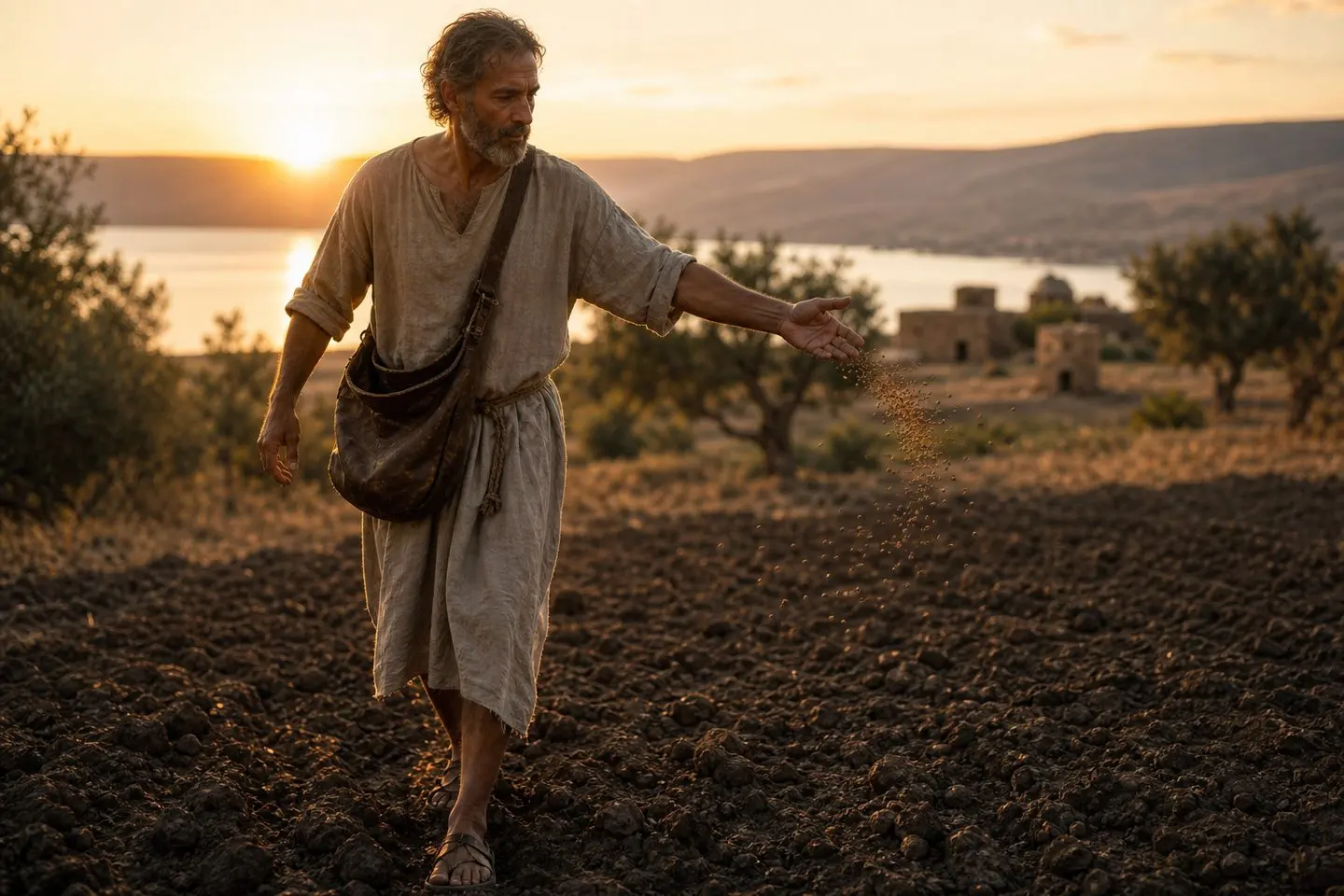
Then He spoke many things to them in parables, saying: “Behold, a sower went out to sow. And as he sowed, some seed fell by the wayside; and the birds came and devoured them. Some fell on stony places, where they did not have much earth; and they immediately sprang up because they had no depth of earth. But when the sun was up they were scorched, and because they had no root they withered away. And some fell among thorns, and the thorns sprang up and choked them. But others fell on good ground and yielded a crop: some a hundredfold, some sixty, some thirty. He who has ears to hear, let him hear!”
Matthew 13:3-9 (NKJV)
Picture how a sower actually worked in those days. He carried a one strap bag with a large pouch, like a mailbag, filled with seed. He would reach in, grab a fistful, and sweep his arm in a great arc, opening his hand slowly so the seed sprayed out across the field. He did not place seed carefully into prepared holes. He broadcast it, generously, everywhere.
The sower is God, and what He is sowing is the knowledge of the kingdom of heaven, the coming Messiah, and the chance at salvation. The seed goes out over every kind of ground. What happens next depends entirely on the ground, and each one of these soils reflects the condition of a hearer’s heart. Four soils were standing in that multitude listening to Him. The same four soils are reading this now.
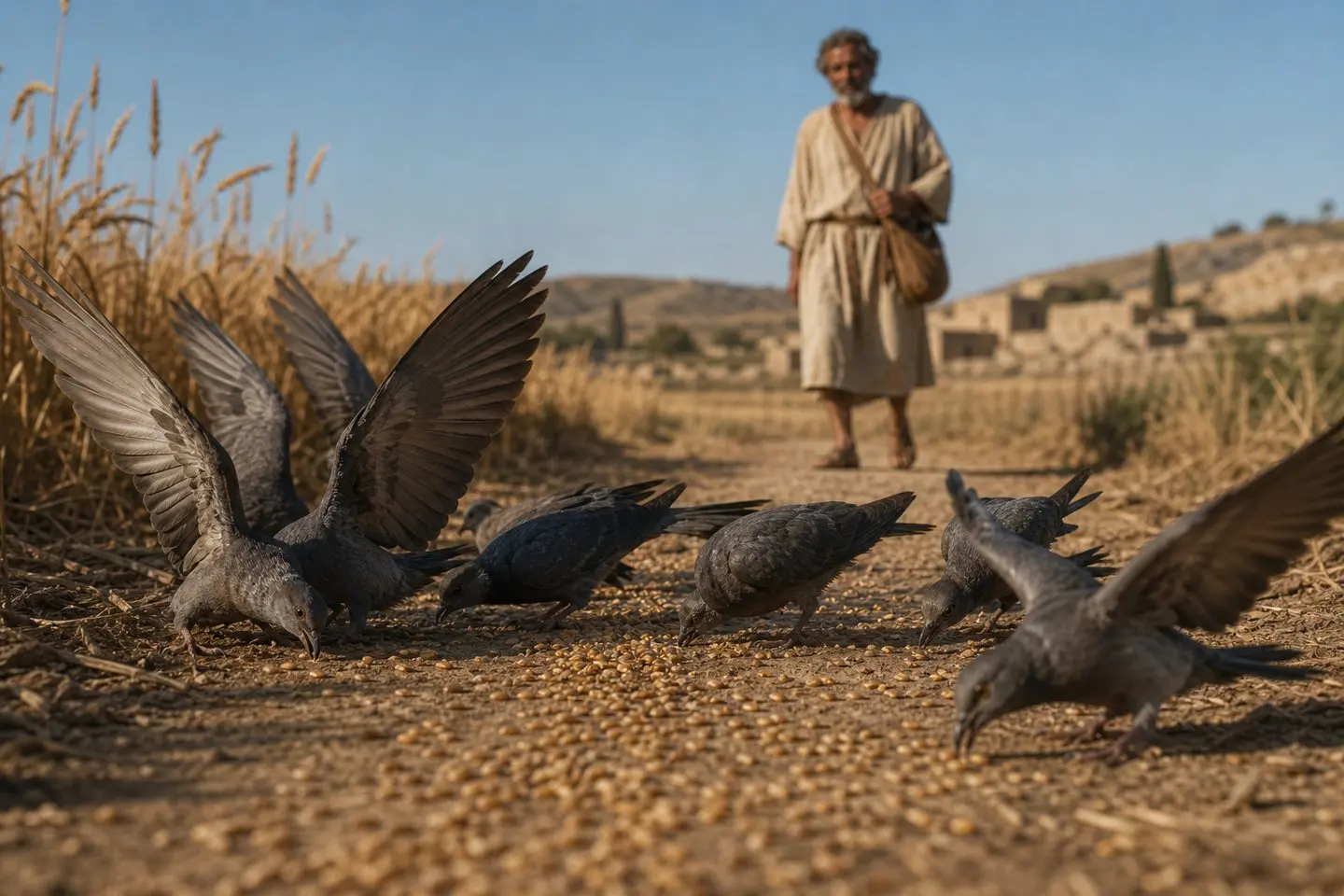
The Wayside: The Hardened Heart
The wayside was probably a footpath worn across the field for decades, packed down tight by habit. Nothing grows there because nothing can get in. The seed sits on the surface, and the birds come.
But He is not talking about birds eating seed. When Jesus explains the parable to His disciples, He says plainly:
When anyone hears the word of the kingdom, and does not understand it, then the wicked one comes and snatches away what was sown in his heart. This is he who received seed by the wayside.
Matthew 13:19 (NKJV)
The birds represent evil. A completely hardened heart is not neutral ground; it is ground the enemy controls. Some in that multitude had hearts so hard that none of this would get anywhere near them, and the wicked one would take back even the little that landed.
The Stony Places: The Fair Weather Faith
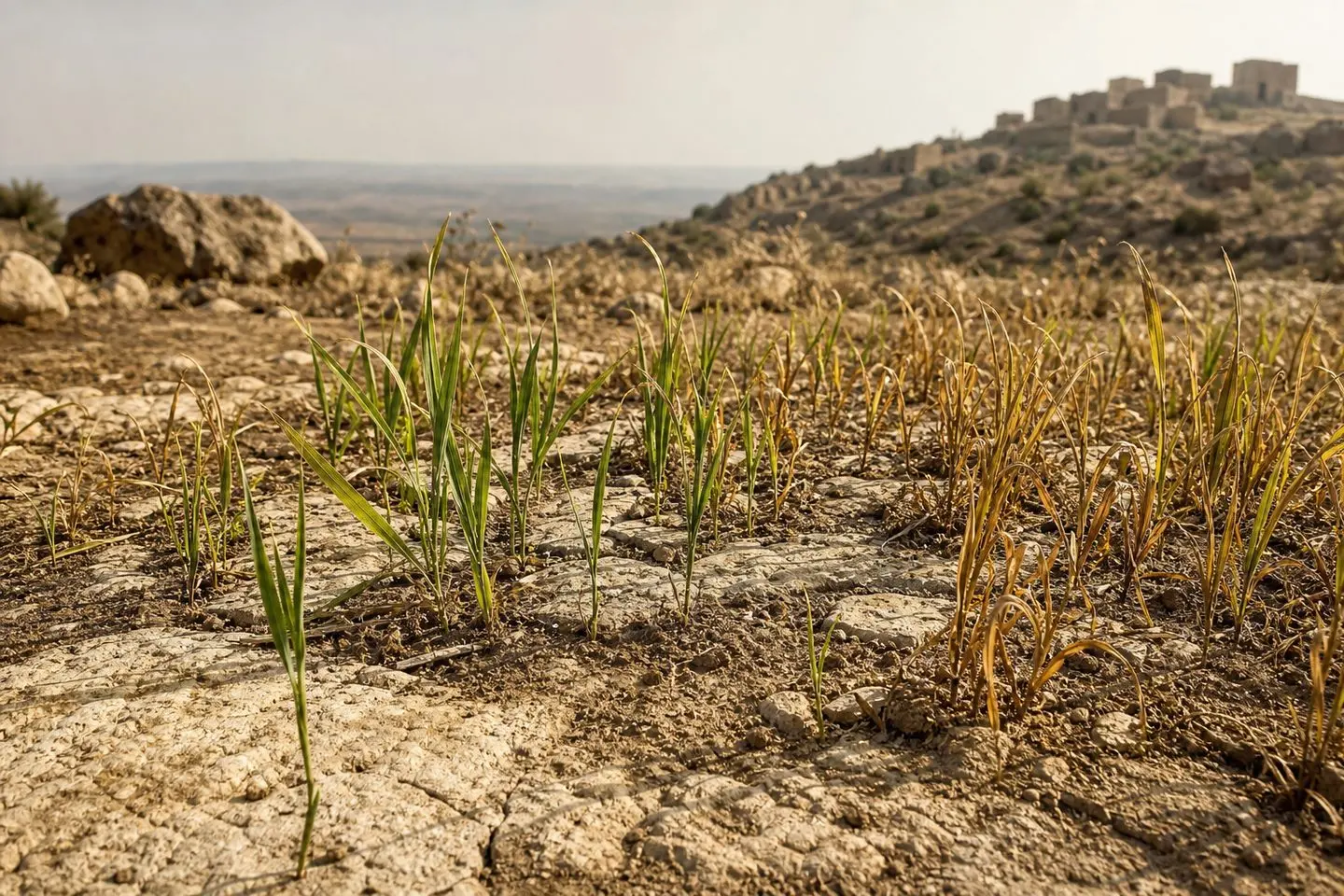
The second soil is shallow. Seed springs up fast there precisely because it has no depth, and it dies just as fast when the sun rises.
But he who received the seed on stony places, this is he who hears the word and immediately receives it with joy; yet he has no root in himself, but endures only for a while. For when tribulation or persecution arises because of the word, immediately he stumbles.
Matthew 13:20-21 (NKJV)
We all know people like this. They get gloriously excited about following Jesus. They love the emotional services, they love telling everyone they are a Christian, and it is all joy and energy, until something negative happens. And if you are a Christian, something negative pretty much always happens. That is a test of your faith. The fair weather believer hits that test and says: wait, I did not sign up for this. I was praying and following Jesus and I thought good things came with that. I did not know hard things were part of the deal. I am out.
No root, no depth, no crop. It is not that the seed was bad. The soil had no room for roots.
The Thorns: The Heart of Our Culture
The third soil may be the most familiar one in our time, because it is the heart our culture produces on purpose.
Now he who received seed among the thorns is he who hears the word, and the cares of this world and the deceitfulness of riches choke the word, and he becomes unfruitful.
Matthew 13:22 (NKJV)
All the cares of this world. All the things you want to do, the pleasures you want to taste, the assets you want to gather. None of it looks like rebellion against God. It just grows, quietly, until it chokes out a real faith. We see it in people who compartmentalize: I will give God an hour, maybe an hour and a half on Sunday, and then I am back to my thing. That is not a faith that is going to get you much, and it is the faith of most Christians.
Notice the phrase Jesus chooses: the deceitfulness of riches. There is no inherent problem with being wealthy. The problem is what wealth whispers. When you are wealthy you no longer have to make the compromises other people make. You can throw money at problems, buy influence, and surround yourself with people who say yes. That equates to a feeling of power, and the power starts to make you feel important, and then wise. Pretty soon your wealth matters more to you than your relationship with God, and you are in an entirely different situation than you ever intended.
I say this as somebody who sold real estate in Manhattan for a long time, where buying almost anything requires real affluence. I saw unbelievable money. I did not see happy people. And follow what happens to lottery winners: almost universally, the windfall destroys them, their families, and their friendships. The sharks come out, the promises pour in, and it all gets taken away. If you are fortunate enough to be wealthy, it is by God’s hand and it should be a blessing. It almost never is, because the thorns grow fast in that soil.
This is what R.C. Sproul called a second things first culture. First things first would mean this: God created you for relationship with Him, your time on this earth is short compared to the rest of your existence, and with the free will He gave you, you must decide what that relationship will be, because it decides your eternity. The worldly hearer runs that order in reverse, and the Word gets choked.
The Good Ground: The Seeking Heart
But he who received seed on the good ground is he who hears the word and understands it, who indeed bears fruit and produces: some a hundredfold, some sixty, some thirty.
Matthew 13:23 (NKJV)
The good ground is the heart that came to that shoreline wanting to know: about the mystery of the kingdom, about the Messiah, about the opportunity for salvation. Whatever Jesus says, that heart takes it and probes it deeply. For the seeking heart, a parable is like a nuclear onion. You keep peeling it and peeling it, and it keeps giving more insight, layer after layer, for a lifetime.
And you never know what God will do with a heart like that. Think about Saul of Tarsus: an absolutely murderous man, headed entirely the wrong direction, until he met Jesus Christ on the road to Damascus. You would have to say Saul delivered a crop a hundredfold. No one wrote more books of the Bible. He planted churches and worked constantly in an environment soaked in adversity. That is what a hundredfold looks like grown from one encounter with the Word.
Notice too that the yields differ: a hundredfold, sixty, thirty. It does not really matter what size the crop is. What matters is that there is one.

Why Jesus Explained It Only to Some
The disciples came to Him with the question we would have asked:
Why do You speak to them in parables?
Matthew 13:10 (NKJV)
You can almost hear the subtext: it is already hard enough to understand You, and now You are going to talk in riddles? This was the first time they had ever heard Him teach this way, and it must have rocked them. His answer:
Because it has been given to you to know the mysteries of the kingdom of heaven, but to them it has not been given. For whoever has, to him more will be given, and he will have abundance; but whoever does not have, even what he has will be taken away from him.
Matthew 13:11-12 (NKJV)
Now that does not sound like a fair doctrine at first hearing, and it is not a doctrine to be overlaid across the whole of the faith we call the good news. It is about this parable and about the condition of hearts. Whoever has the good soil heart, the seeking heart, to him more will be given, and abundantly. But the other three soils? Even what they have will be taken away. Look at our billionaire class, almost universally atheist, believing they are gods because of their money and their power, chasing brain implants and software immortality precisely because they know it is all going to be taken away. They cannot take it with them. A closed heart loses even what it holds.
Then Jesus reaches back five hundred years and shows that none of this took heaven by surprise:
Hearing you will hear and shall not understand, and seeing you will see and not perceive; for the hearts of this people have grown dull. Their ears are hard of hearing, and their eyes they have closed, lest they should see with their eyes and hear with their ears, lest they should understand with their hearts and turn, so that I should heal them.
Matthew 13:14-15, quoting Isaiah 6:9-10 (NKJV)
The King James renders it that their hearts “waxed gross.” Isaiah spoke those words five centuries before Jesus’ ministry began, and Jesus stood in a boat at Capernaum fulfilling them. It was also a prediction reaching forward: the nation of Israel, the nation of every disciple in that boat’s shadow, would reject its own Messiah. The hidden nature of God’s purpose for man’s salvation is what Scripture keeps calling the mystery. And to His disciples, then and now, He says:
But blessed are your eyes for they see, and your ears for they hear; for assuredly, I say to you that many prophets and righteous men desired to see what you see, and did not see it, and to hear what you hear, and did not hear it.
Matthew 13:16-17 (NKJV)
Isaiah himself never got to see the Messiah he foretold. We hold in our hands what prophets longed for.
Which Soil Are You?
So the parable ends where it aimed all along: not at first century Judea, but at us. He who has ears to hear, let him hear. That means if you get it, do not let it sit. Investigate it deeply and analytically. Ponder it. Pray over it. It will keep giving.
And if you are wondering whether you have the good soil heart, Jesus gave you the test: you should see things happen. When you become a believer and follow Jesus Christ, you should see a change in yourself. You should see that you are bearing fruit, and that it is good fruit. A hundredfold, sixty, thirty, the size of the crop is not the point. The fruit is the point.
The hard path can be broken up. The stones can be cleared. The thorns can be pulled. Soil is not destiny; it is diagnosis. The same generous Sower is still sweeping His arm across every kind of ground, which is the whole reason this teaching, hidden from spies two thousand years ago, is wide open to you today. We continue through Jesus’ parables of the kingdom in The Wheat and the Tares and the Hidden Treasure, told from the very same boat in this very same chapter, and in The Pearl of Great Price and the Dragnet, where the worth of the kingdom is counted. And for the story Jesus told about what love of neighbor actually looks like, walk the Jericho road with us in The Parable of the Good Samaritan.

A Prayer for the Right Soil
We close with an evening prayer attributed to George Washington, an ardent Christian and a remarkably selfless statesman. He had the right soil. Let us put it that way. Hear how a man of that stature examined his own heart as a hearer of the Word:
I have heard Thy holy word, but with such deadness of spirit that I have been an unprofitable and forgetful hearer… But O God, who art rich in mercy and plenteous in redemption, mark not, I beseech Thee, what I have done amiss; remember that I am but dust… Open the eyes of my understanding, and help me thoroughly to examine myself concerning my knowledge, faith, and repentance. Increase my faith, and direct me to the true object, Jesus Christ, the way, the truth, and the life.
Evening prayer attributed to George Washington
An unprofitable and forgetful hearer: Washington prayed against the very soils Jesus warned about, and asked God for the good ground. Two thousand years after a boat rocked gently in a Capernaum bay, that is still the prayer. Lord, make us good soil.
Further Reading
For deeper verse by verse study of Matthew 13, David Guzik's commentary at Enduring Word is an excellent companion, and GotQuestions offers a concise summary of the parable's interpretation.
Chuck's own study over the years has leaned most on six teachers. If you want to keep going after this parable, their work is where he would send you:
- John MacArthur at Grace to You
- James Burton Coffman, whose Coffman Commentaries are free at StudyLight
- Charles Stanley at In Touch Ministries
- Robert Deffinbaugh at Bible.org
- Chuck Swindoll at Insight for Living
- David Guzik at Enduring Word
How this study was written: it comes from Chuck Frank’s own teaching on this passage. It was put into writing with the help of AI editing tools, then reviewed by Chuck for faithfulness to his message and to Scripture.