
Jesus told three parables in one sermon, and He told them to answer an insult. The Pharisees and the scribes were grumbling: this Man receives sinners and eats with them. What they meant as condemnation is the very reason we love Jesus Christ. He received sinners, and every one of us was a sinner in rebellion when He offered us salvation. Luke 15 is His answer: a lost sheep, a lost coin, and two lost sons.
What does the parable of the prodigal son mean? It means that God the Father watches for every returning sinner and runs to restore him completely: robe, ring, sandals, and inheritance. Told together with the lost sheep and the lost coin, it reveals the joy of heaven over one repenting sinner, and it warns that self-righteousness can keep a heart outside the celebration.
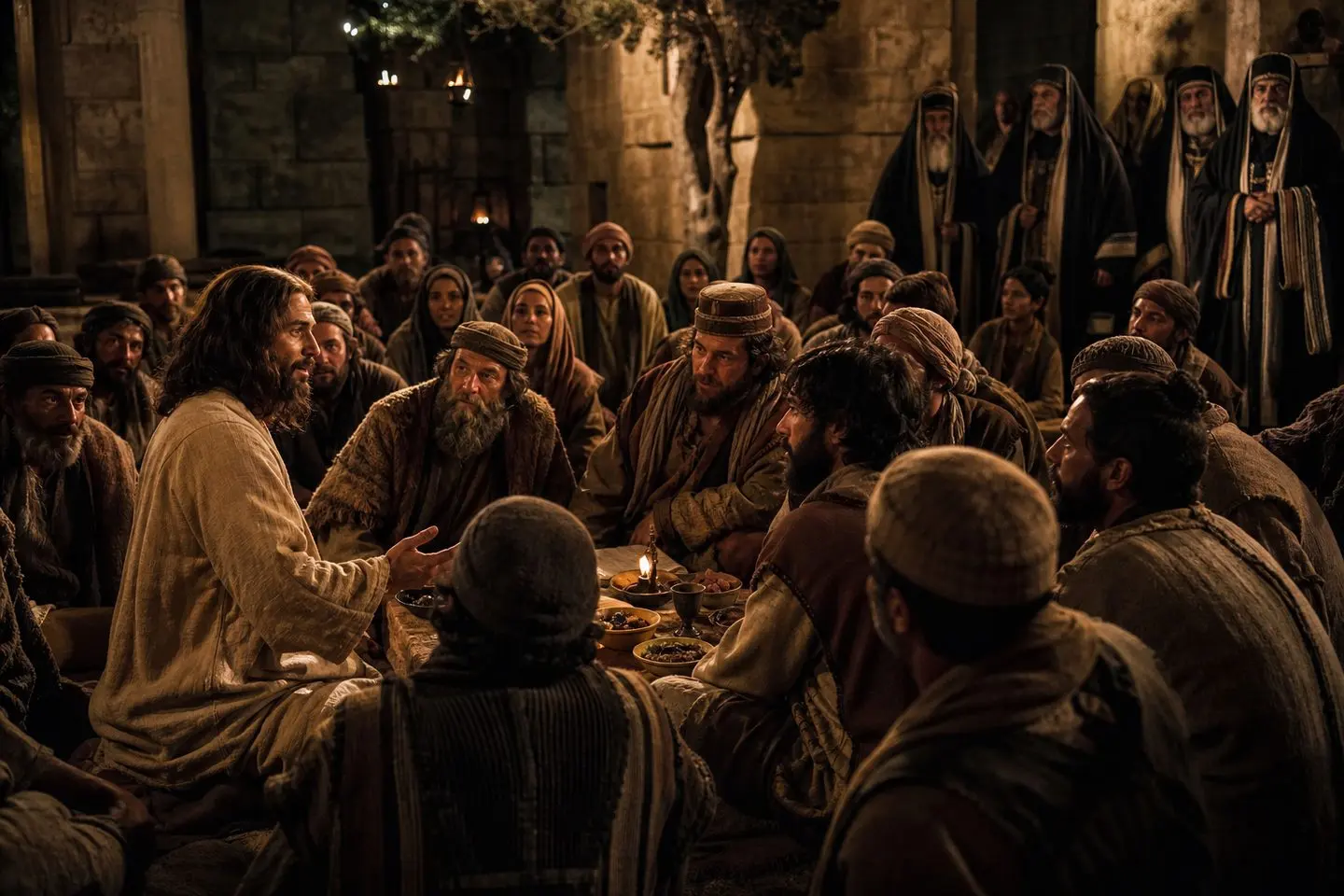
Watch this teaching in full above, and read on as we open all three parables together.
One Sermon, Three Parables: The Scene in Luke 15
Jesus was speaking to tax collectors and the people the Jewish leaders had written off as sinners. The rules said: you do not talk to them, you do not eat with them, you do not pray with them. And here was this Man with huge groups of them all the time, praying with them, healing them, eating with them. That is why the Pharisees decided His miracles were being done by the hand of Satan, and it is the same rules-first religion Jesus exposed on the Jericho road in The Parable of the Good Samaritan.
Then all the tax collectors and the sinners drew near to Him to hear Him. And the Pharisees and scribes complained, saying, “This Man receives sinners and eats with them.”
Luke 15:1-2 (NKJV)
All of this happens as Jesus moves toward Jerusalem, knowing He is heading toward His death, with the temple deep state hunting for some way to arrest Him and stop the multitudes following Him everywhere. If He were a politician, He would have said, make me king: I have thousands of followers, and by the way, I do miracles. Kingship was not His mission, and He could not have been less interested. Instead He answered with stories that conceal the kingdom from hard hearts while opening it to hungry ones, a strategy we unpack in Why Did Jesus Teach in Parables?
The mega theme of Luke 15 is the lost. The majority of people are going to be lost to the opportunity of salvation, yet, just as in The Parable of the Great Banquet in the chapter just before this one, people turn the offer down through hardness of heart or through second things first living, putting everything else ahead of their relationship with God. So in this one sermon Jesus shows four ways to become lost. The sheep is lost by wandering away. The coin is lost through someone else’s carelessness, no fault of its own. The younger son is lost by willfulness, arrogance, and disobedience. And the older son is lost by self-righteousness, selfishness, and pride.
The Parable of the Lost Sheep
What man of you, having a hundred sheep, if he loses one of them, does not leave the ninety-nine in the wilderness, and go after the one which is lost until he finds it? And when he has found it, he lays it on his shoulders, rejoicing. And when he comes home, he calls together his friends and neighbors, saying to them, “Rejoice with me, for I have found my sheep which was lost!” I say to you that likewise there will be more joy in heaven over one sinner who repents than over ninety-nine just persons who need no repentance.
Luke 15:4-7 (NKJV)
Let us get the representations down. The man with a hundred sheep is Jesus Christ, the good shepherd. The wandering sheep are millions of backsliding believers. Finding the lost sheep is Jesus seeking to save sinners. Lifting the sheep to his shoulders is uplifting the fallen. And the rejoicing is the rejoicing of Jesus, the Father, the Holy Spirit, and a whole host in heaven.
Sheep are an interesting animal: absolutely and utterly defenseless. No teeth to bite with, no defensive instincts, no sense of direction. A dog or even a cat can find its way home; a sheep walks away, pays no attention, and is lost. Then the only thing it knows to do is bleat, which attracts every predator in earshot. And by the way, sheep represent us.
Every herdsman in that crowd knew the picture. Sheep go looking for something to eat, wander into a thicket of thorns, and the thorns hook into that curly wool until every movement pricks them. That is why shepherds carry the long staff with the question mark top: reach the hook in, loop it around the sheep’s neck, and pull it out without climbing into the thorns yourself. To the spies and the Pharisees all this was ridiculous, a child’s story, nothing to take to court. But the rich soil hearts would carry it home and turn it over with a believing friend: what do you think all this means?
The shepherd who leaves the ninety-nine is Jesus leaving heaven itself, coming down as Emmanuel, God with us, to seek us and to save us. Then comes the line He repeats in every one of these parables: more joy in heaven over one sinner who repents. Scripture tells us we are surrounded by a great host of angels and believing people who love us, just on the other side of the veil. We cannot see them, but they see every single thing we do, and when one lost sinner is restored and redeemed, they go crazy with joy.

The Parable of the Lost Coin
Or what woman, having ten silver coins, if she loses one coin, does not light a lamp, sweep the house, and search carefully until she finds it? And when she has found it, she calls her friends and neighbors together, saying, “Rejoice with me, for I have found the piece which I lost!” Likewise, I say to you, there is joy in the presence of the angels of God over one sinner who repents.
Luke 15:8-10 (NKJV)
The woman represents the church. Jesus, because He is God, already knows that after His death churches will spring up and spread over all the earth. He never traveled more than thirty miles from home, yet He can see this going worldwide, and He wants the church to know its function. The lost coin is the person who comes to the church and then falls away. The lighted lamp is the Word of God. And the broom is the church’s concern for the virtue and morality of the flock.
Notice that a coin cannot lose itself; it is lost by the woman’s carelessness. The person who walks into your church is a fallen sinner through no fault of his own. He received that from Adam, and it is his flesh that impairs him. So the church’s main tool is the lighted lamp. If the Word of God is being offered, people will come and people will be healed, and most will not fall away. For years I had a job that kept me traveling the world on weekends, and I would find a church wherever I was. Ninety-five percent of the time, the pastor never opened a Bible: cultural talks, political talks, humorous stories, but not the Word of God.
And then the broom. When someone starts to disengage and drift, the church has to find out what the problem is, reach out, and let that person know how important they are. Most churches shrug: people come and people go. Jesus says no, that is not the mission. Light the lamp, move the furniture, get the broom, and sweep everything until the coin is found. When the Word of God is preached unadulterated and unapologetically, things happen, because the church is the temple of the Holy Spirit. Every person who backslides away is someone whose intrinsic gifts are lost to the richness of Christendom. The solution is the Word of God and the husbandry of the church, and frankly, we do not see a lot of it.

The Parable of the Prodigal Son: Two Lost Sons
I like to call this one the parable of the lost sons, plural, partly to irritate everybody. We Christians fixate on the younger son who demanded his inheritance, wasted it, and came home. That is only half the story. The other half is the older brother, and Jesus aimed him straight at the Pharisees.
Give Me My Portion
Then He said: “A certain man had two sons. And the younger of them said to his father, ‘Father, give me the portion of goods that falls to me.’ So he divided to them his livelihood. And not many days after, the younger son gathered all together, journeyed to a far country, and there wasted his possessions with prodigal living.”
Luke 15:11-13 (NKJV)
Twice in three verses, Jewish heads exploded. First, no younger son in that culture had any call to demand the portion that falls to him. Second, this father actually divides his livelihood between both sons while he is still living, a third to the younger, two thirds to the older. Unthinkable. But Jesus is teaching them how God operates. God gives us all free will. We can get our back up and make demands in front of Him, and He will say: have at it, and I will be here on the other side when you reap the consequences, doing everything to help you. But your rebelliousness is going to create bills that come due. Some you can pay off quickly, and some you will be paying off the rest of your life. That is part of your curriculum.
Notice that “prodigal living” is a scrubbed term; the majority of translations say riotous living. This sheep ended up in a far country with a big bag of money, whoring and drinking, and like a fool and his money being quickly separated, it all happened to him. He had no way to defend himself: no godly wisdom, only fleshly desire and willfulness.
The Famine and the Pig Pen
Then he spent it all, and a severe famine arose in that land. Without godly wisdom there is no nudge from the Holy Spirit saying: do not spend everything you have every month, because an emergency is coming. We know that lesson today, when the majority of Americans cannot put their hands on even a few hundred dollars in an emergency and are gapping their budgets with credit cards. And famine is an interesting word, because I believe there are two critical famines going on right now, and one of them is a famine of the Word of God. There are people seeking it: look at the young people flocking in huge numbers to the traditional Latin mass, just to feel grounded in some tradition. The church hierarchy does not get it, and I think a church split is coming, because those young people are the future.
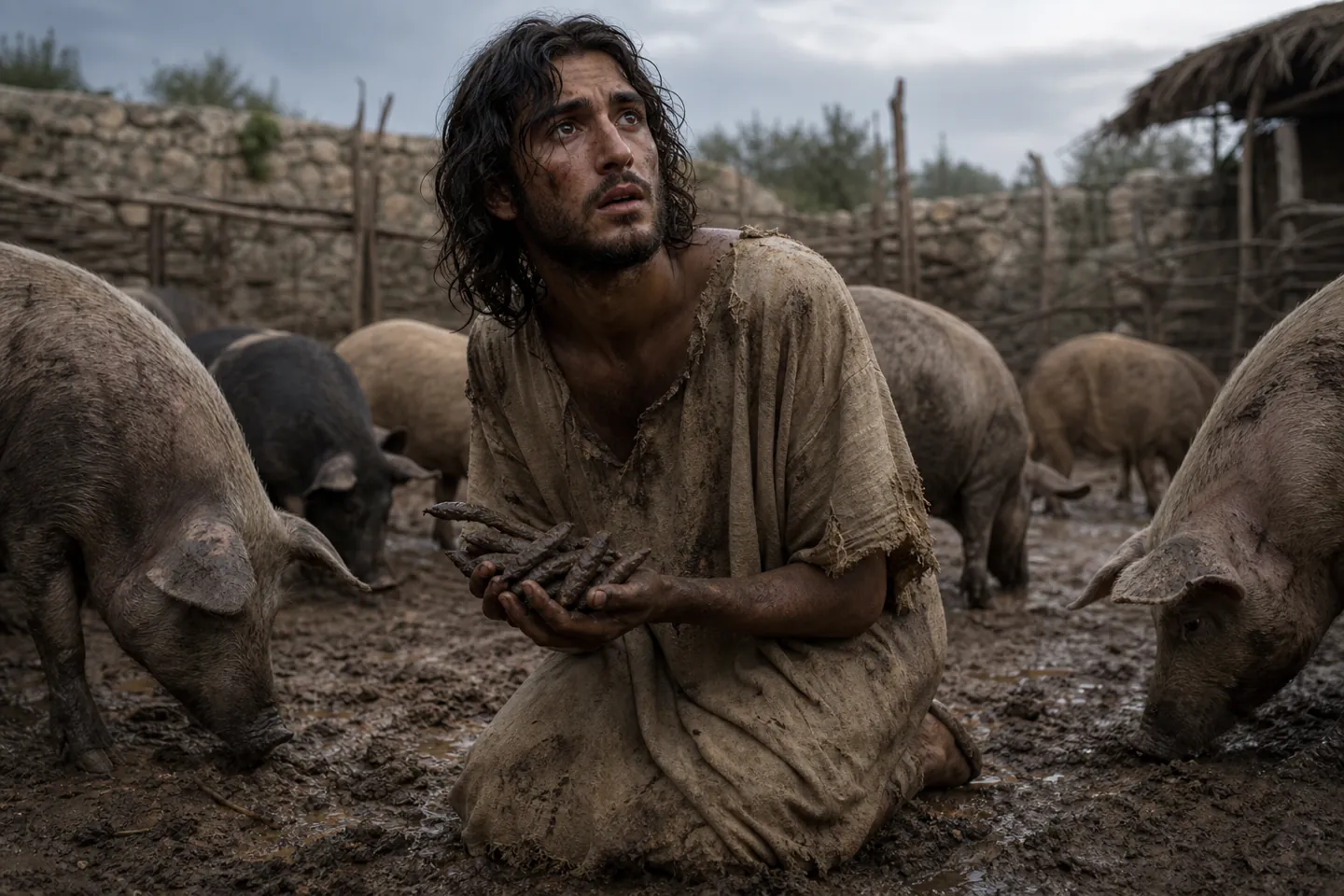
Then the story hits bottom, and Jewish heads explode a third time: this Jewish prince is sent into the fields to feed swine, and would gladly fill his stomach with the pods the pigs are eating. We are the Netflix group; it is hard to shock us. These hearers were not like that, and they listened with rapt attention to the worst situation they could imagine. Then the loneliest line in the parable: no one gave him anything. When you walk away from your network and your foundation in rebellion, the world ultimately does not care. You may have some fast friends while the bag of money lasts; when it is gone, they could not care less.
My grandmother told me, when I was about fifteen, that if I got to the end of my life able to count on one hand the people who truly cared and would step up if I were in need, I would be a very lucky person. I thought this old broad had lost her mind; I had fifteen friends right then. Now that I have jumped over the seventy line, I can tell you she was one hundred percent right.
When He Came to Himself
But when he came to himself, he said, “How many of my father’s hired servants have bread enough and to spare, and I perish with hunger! I will arise and go to my father, and will say to him, ‘Father, I have sinned against heaven and before you, and I am no longer worthy to be called your son. Make me like one of your hired servants.'”
Luke 15:17-19 (NKJV)
There is no turning around from a giant mistake unless you shine the light of truth on yourself, and our culture does not do that. Our culture says: it is really my father’s fault for giving me the money, or my brother’s fault for never getting next to me with advice, or the pig farmer’s fault for not caring. Always pointing away from ourselves. This young man says instead: what a fool I am. My father’s servants live better than I do now, and I am starving to death. The truth lets him form a plan, and godly wisdom demands an action: I will arise and go to my father.
Notice his confession: I have sinned against heaven and before you. Whatever comfort we reach for when we indulge a sin, in that moment we trust it more than God, so there is no point rationalizing that it will not hurt anybody. The sin is against God. And when the son asks to be made like a hired servant, he is every one of us: put me in the back row of heaven, but please allow me in, because my best is as filthy rags. Jesus is telling them, and us: this is why I had to leave heaven. Because of Adam, none of you are worthy on your own. I came to pay all of your sin debt.
The Father Who Ran
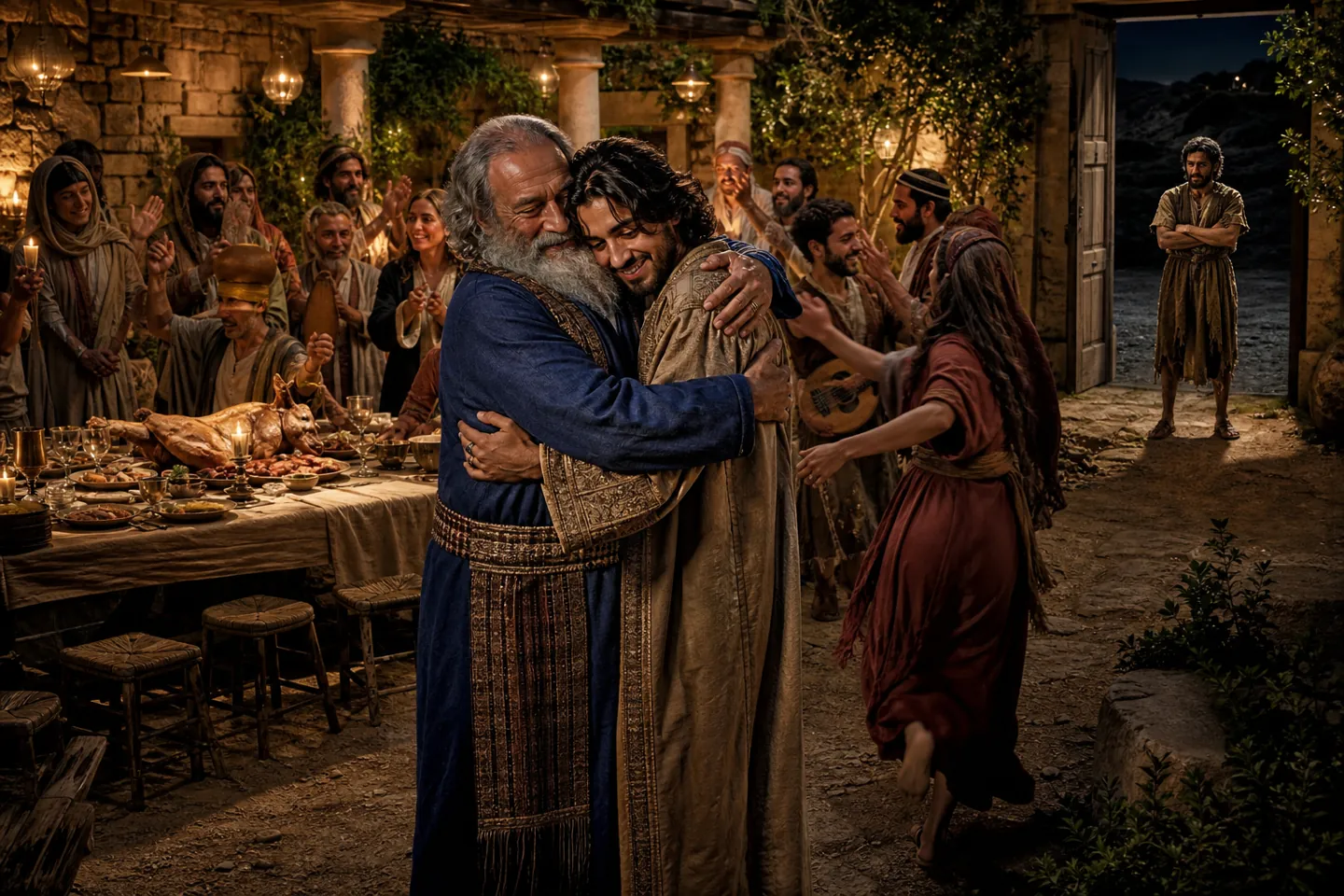
And he arose and came to his father. But when he was still a great way off, his father saw him and had compassion, and ran and fell on his neck and kissed him. And the son said to him, “Father, I have sinned against heaven and in your sight, and am no longer worthy to be called your son.” But the father said to his servants, “Bring out the best robe and put it on him, and put a ring on his hand and sandals on his feet. And bring the fatted calf here and kill it, and let us eat and be merry; for this my son was dead and is alive again; he was lost and is found.”
Luke 15:20-24 (NKJV)
When he was still a great way off, his father saw him. What does that tell you? The father has been looking every single day in the direction his boy walked away. Constantly looking, constantly. Jesus is telling us God watches each individual just like that. In that culture the expected speech was: you are dead to me. Not this father, and not the omniscient Father of the universe. He had compassion, and he ran. A man of means did not run: hitch up that garment and your white legs show and you look ridiculous, and in that culture optics were everything. He did not care. He scooped his son up and kissed him before the confession was even finished. Then the best robe, sandals, and a signet ring carrying the family seal: the father is restoring him one hundred percent, inheritance included, paying it back all over again. This my son was dead and is alive again. And once more, heaven rejoices.
The Older Brother: The Lost Son We Ignore
Now we come to the son who represents the Pharisees. The older son, coming in from the field, hears music and dancing and does something very telling: he asks a servant what these things mean. He does not go to his father. Ever since the inheritance was divided, that relationship has surely been troubled; he is closer to the servant than to his father. If he loved his brother, he would join the feast. If he trusted his father, he would trust his father’s decision. He does neither.
But he was angry and would not go in. Therefore his father came out and pleaded with him. So he answered and said to his father, “Lo, these many years I have been serving you; I never transgressed your commandment at any time; and yet you never gave me a young goat, that I might make merry with my friends. But as soon as this son of yours came, who has devoured your livelihood with harlots, you killed the fatted calf for him.”
Luke 15:28-30 (NKJV)
Hear the resentment: lo, these many years I have been serving you. That is not the spirit of a son; that is an employee filing a grievance. There are people in the church who end up here, constantly serving but no longer in the right spirit, feeling used, treating it as a chore. And listen to “this son of yours.” He will not say “my brother.” He has decided that he is right and his father is morally wrong, so his anger is justified. That is the pharisaic position exactly: we have rules, you do not follow them, therefore you are morally repugnant and we are justified in whatever we do to you. We know this heart today: someone loses a child and goes from being a Christian to hating God, holding on to that anger, refusing to trust Him again.
But the father comes out and pleads. Even with this son, even in that rebellion, God keeps coming to us.
Son, you are always with me, and all that I have is yours. It was right that we should make merry and be glad, for your brother was dead and is alive again, and was lost and is found.
Luke 15:31-32 (NKJV)
And that is the end of the parable. There is no resolution, no “okay, Dad, you are right, I will come join you.” The father says join us for the celebration: basically, join us in heaven. And the older brother’s heart is so hardened that he never goes in. He stays outside, justified in his anger, and excludes himself from heaven.

Understanding the Kingdom: One God, Three Rescues
Put the three parables back together and you see the sermon whole. The shepherd is Jesus Christ, who left heaven to seek wandering sheep like us. The woman with the lamp and the broom is the Holy Spirit at work through the church, searching for the fallen. The father is God in heaven, watching the road, running to meet the returning sinner, and pleading even with the self-righteous. Four ways to be lost, one relentless triune pursuit, and over every recovery the same refrain: joy in the presence of the angels of God. Jesus keeps pressing this teaching in the very next chapter, where the subject turns to money and shrewdness, and we walk through it in The Parable of the Unjust Steward.
A Prayer to the Father Who Watches the Road
We close with a prayer built from the words of Benjamin Franklin. Franklin did not write it as it stands, but these are all his words, and they belong with this parable: they approach the Father the way the returning son learned to, in childlike confidence.
Come then in childlike confidence to our blessed and glorious Father, not as a formality, nor merely as a duty, but because you need His almighty arm to protect and sustain you, to guard and shield you in the midst of the evils of the world, and finally to save you. Our glorious Father can see dangers that we cannot see and avert calamities that we have no power to stay… Let us join with all the ransomed of our God and the heavenly hosts in ascribing the blessing, the glory, and the honor to Him through our Lord Jesus the Christ forever and ever. Amen and amen.
Prayer assembled from the words of Benjamin Franklin
The Father who can see dangers we cannot see is the father who saw his son while he was still a great way off. He is watching the road still. Amen and amen.
Further Reading
For deeper verse by verse study of Luke 15, David Guzik's commentary at Enduring Word is an excellent companion, and GotQuestions offers a concise summary of the parable of the prodigal son.
Chuck's own study over the years has leaned most on six teachers. If you want to keep going after this parable, their work is where he would send you:
- John MacArthur at Grace to You
- James Burton Coffman, whose Coffman Commentaries are free at StudyLight
- Charles Stanley at In Touch Ministries
- Robert Deffinbaugh at Bible.org
- Chuck Swindoll at Insight for Living
- David Guzik at Enduring Word
How this study was written: it comes from Chuck Frank’s own teaching on this passage. It was put into writing with the help of AI editing tools, then reviewed by Chuck for faithfulness to his message and to Scripture.