
Ten men received the same miracle, and only one came back. The story of the ten lepers in Luke 17:11-19 is about gratitude and salvation: ten lepers cried out to Jesus for mercy, He healed all ten as they walked to show themselves to the priests, and only one, a despised Samaritan, returned to fall at His feet and give thanks. To that one man Jesus said something He never got to say to the other nine. In this study we walk through Luke 17, meet the parable Chuck names the perfect servant, and sit with the question Jesus is still asking two thousand years later: where are the nine?

Watch this teaching in full above, and read on as we open it together.
- The Chapter I Almost Skipped
- Traps, Millstones, and Forgiving Seven Times a Day
- The Parable of the Perfect Servant (Luke 17:7-10)
- Ten Lepers, Standing Afar Off
- Healed as They Went
- The One Who Came Back Was a Samaritan
- Where Are the Nine?
- A Kingdom That Does Not Come With Observation
- Where Is Your Gratitude?
- A Prayer That Gives Thanks in Everything
The Chapter I Almost Skipped
I will start with a confession. Pat asked me earlier in the week which parables we were doing next, and I told him the two in Luke 18. Then I sat down to work, and the Holy Spirit said: hey, pay attention, you are jumping over a whole chapter. I argued that there are no parables in that chapter. Sure enough, there are two. One of them does not even have a name, so I am naming it: the parable of the perfect servant. The other is the ten lepers healed. And I am so glad we did not miss them, because they come right on the heels of the rich man and Lazarus, for reasons.
I used to read the parables as standalone one-offs, and they work that way. But contextually they are one journey: Jesus heading back to Jerusalem with the deep state of the temple on His trail. Every spy sent to trip Him up came back empty-handed, which is why He switched to teaching in parables in the first place, so now the priests want the twelve. In this same span Jesus raises Lazarus at Bethany, the miracle that sets off the final dominoes toward the cross, then withdraws through the border country of Samaria and Galilee.
That is the setting for four warnings Jesus packs into this chapter: the sin of tempting others (verses 1-2), the sin of an unforgiving spirit (verses 3-4), the sin of belittling the power of faith (verses 5-6), and the sin of believing we merit salvation (verses 7-10).
Traps, Millstones, and Forgiving Seven Times a Day
Jesus opens by telling His disciples that offenses are sure to come, and our English translations soften what Luke wrote. This week I opened a box and found the Amplified Bible I gave my grandmother in 1988, the year I came to Christ, and its rendering is exactly right: temptations, snares, traps set to entice to sin, are sure to come. The Greek word behind “offenses” does not mean hurt feelings. It means the trigger of a trap, the stick that springs the jaws shut. You have no idea until it is too late. The priests are all over these men wherever they go, and nothing is new under the sun: honey traps and setups were coming for the apostles.
And His millstone warning about offending one of these little ones is not about children here. It is about the twelve: infants in the faith, young enough in their Christianity to be easily trapped. Then He gives them the discipline that protects a community of believers:
Take heed to yourselves. If your brother sins against you, rebuke him; and if he repents, forgive him. And if he sins against you seven times in a day, and seven times in a day returns to you, saying, ‘I repent,’ you shall forgive him.
Luke 17:3-4 (NKJV)
That does not sit with our flesh at all. Somebody sins against us and we tend to suck it up and quietly decide we do not like that person anymore. Jesus says rebuke him immediately, and if he repents, forgive him, even seven times in one day. And Christians cannot withhold forgiveness while we wait for an apology, because withholding puts the sinner in control of the Christian, and that can never happen. You cannot do this work unless you forgive.
The apostles hear all this and are overwhelmed:
And the apostles said to the Lord, “Increase our faith.” So the Lord said, “If you have faith as a mustard seed, you can say to this mulberry tree, ‘Be pulled up by the roots and be planted in the sea,’ and it would obey you.”
Luke 17:5-6 (NKJV)
They are asking for a super faith, because forgiving like that is not humanly possible. So Jesus answers with something outrageous on purpose: a fully grown tree uprooting itself and planting itself in the sea. Never going to happen in a million years. That is how hard unlimited forgiveness is in the flesh. It can only be done as believers, by His power.
The Parable of the Perfect Servant (Luke 17:7-10)
Now comes the parable nobody names, so I am naming it: the parable of the perfect servant.
And which of you, having a servant plowing or tending sheep, will say to him when he has come in from the field, ‘Come at once and sit down to eat’? But will he not rather say to him, ‘Prepare something for my supper, and gird yourself and serve me till I have eaten and drunk, and afterward you will eat and drink’? Does he thank that servant because he did the things that were commanded him? I think not. So likewise you, when you have done all those things which you are commanded, say, ‘We are unprofitable servants. We have done what was our duty to do.’
Luke 17:7-10 (NKJV)
We listen to that and think: whoa, this man worked the field all day, and now he has to clean himself up, put a towel around his waist, and serve his master dinner before he touches his own food? Yes. That is his job as a servant. Does the master thank him for doing the things that were commanded? I think not.
Jesus is teaching the twelve what their work is going to be, and He is heading off the pride before it starts. They just asked for a super faith, and a super faith puffs up the flesh: I can forgive people seventy times seven; regular people cannot do that. So He hands them the posture that keeps a servant sane: we are unprofitable servants; we have done our duty. No extra credit for doing your job. No pat on the head.
That is hard for them, and harder for our culture. Since the pandemic, plenty of young people think being an employee means showing up at approximately the right time, and showing up is it. No: you learn your job, you perform your job, you improve at your job. In the kingdom it is the same. Forgiveness is part of the job. Speaking the truth is part of the job. Do not look for rewards. Just do your job.
Underneath it sits the fourth warning: none of this earns salvation. The servant who does everything commanded has not put God in his debt. Keep that in your pocket, because the ten lepers are about to show us the other side of it.

Ten Lepers, Standing Afar Off
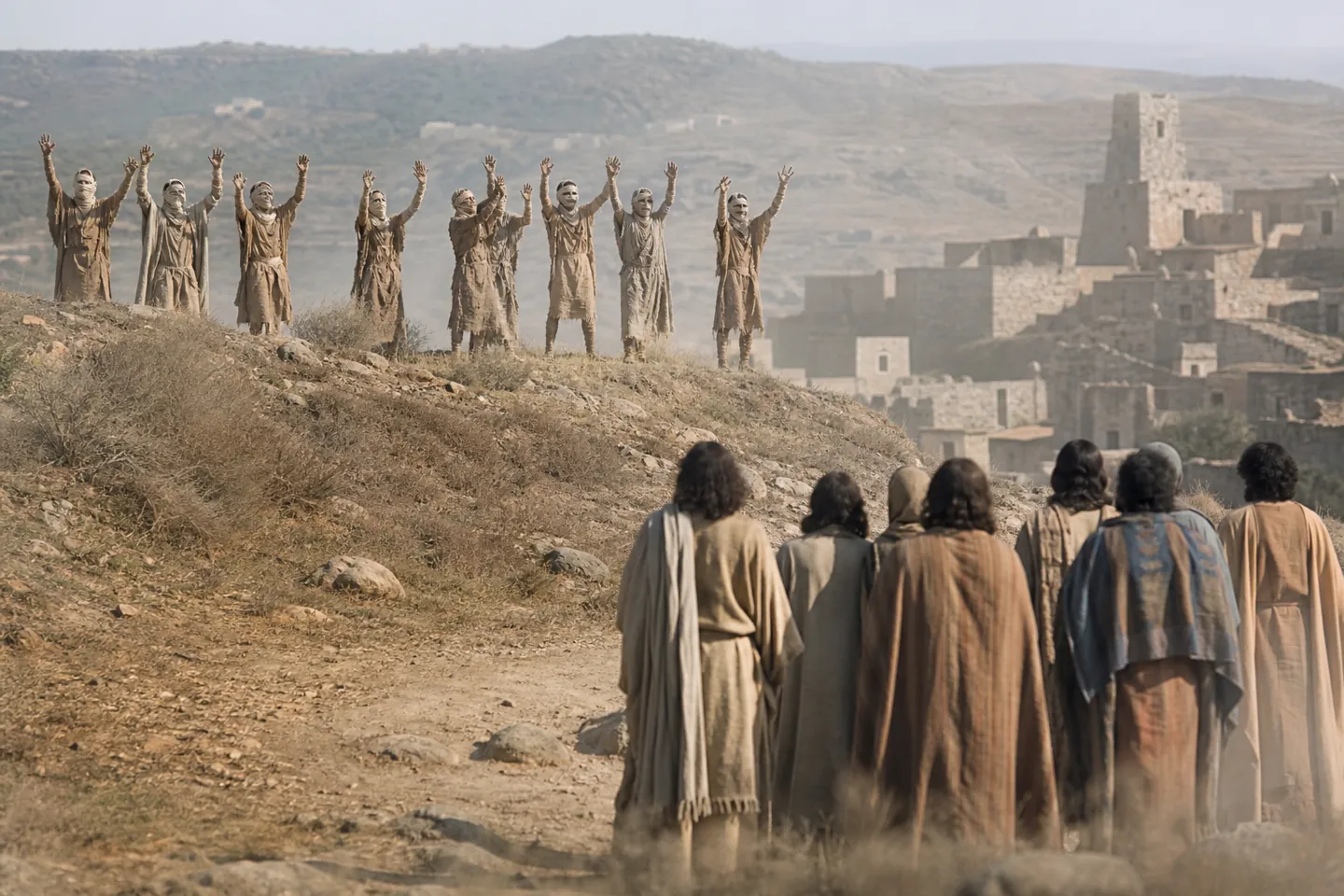
Now it happened as He went to Jerusalem that He passed through the midst of Samaria and Galilee. Then as He entered a certain village, there met Him ten men who were lepers, who stood afar off. And they lifted up their voices and said, “Jesus, Master, have mercy on us!”
Luke 17:11-13 (NKJV)
Why are the ten lepers standing afar off? Leprosy was a contagious, horrific disease. It disfigured, it was painful, and it wrecked the vocal cords, so a leper could barely phonate; everything came out as a rasping whisper. And the worst part was not medical. The priests had determined that leprosy was delivered on you by God for some specific and extra terrible sin. So these ten were not just sick. They were branded as super sinners, cursed by God, totally ostracized from family, synagogue, and society. Hold all of that in mind and hear the scene again: ten ruined voices, lifted together anyway, begging the Master for mercy.
Healed as They Went
So when He saw them, He said to them, “Go, show yourselves to the priests.” And so it was that as they went, they were cleansed.
Luke 17:14 (NKJV)
This is a whole new miracle technique: walk to a place, and in transit the miracle will happen. And it is a loaded request. A healed leper could not rejoin civil society until he presented himself to the priests and demonstrated to their satisfaction that the leprosy was gone and God’s curse was off him. Going to the priests was the legal doorway back into life. But notice the order of events. When Jesus said go, all ten were still full of leprosy. They had to take a leap of faith, turn, and start walking toward the temple as lepers. And as they walked, the leprosy left them.

The One Who Came Back Was a Samaritan
And one of them, when he saw that he was healed, returned, and with a loud voice glorified God, and fell down on his face at His feet, giving Him thanks. And he was a Samaritan.
Luke 17:15-16 (NKJV)
Luke saves the detail for the very end of the sentence: the one who returned was a Samaritan. Samaritans, half Jewish and half Gentile, were counted as Gentiles, hated for having bred with the nations, walled off in their own region, not to be spoken to or treated kindly at all. And remember who is standing around listening: Pharisees, everywhere Jesus goes, hunting Him and His men. Jesus honoring a Samaritan in front of them would have blown their heads up. It is the same holy shock He built into the Parable of the Good Samaritan: the hero of the story is the man His audience despised.
And notice something tender underneath the shock. What were nine Jews doing traveling with a Samaritan in the first place? Their misery had stripped away the prejudice; ostracized together, they needed one another to survive. Then the healing comes, and watch what happens. The nine book it for the temple: we are healed, the priests will clear us, we get our lives back. And, presumably, back to hating Samaritans. Only the Samaritan turns around, comes back with a loud voice glorifying God, and falls on his face at the feet of Jesus.

Where Are the Nine?
So Jesus answered and said, “Were there not ten cleansed? But where are the nine? Were there not any found who returned to give glory to God except this foreigner?” And He said to him, “Arise, go your way. Your faith has made you well.”
Luke 17:17-19 (NKJV)
That word “foreigner” is not decoration. Archaeologists recovered a limestone block from the Jerusalem temple, carved with a warning that no foreigner could pass beyond that point, under penalty of death. That was the sign Israel posted for men like this Samaritan. And Jesus, with Pharisees listening, points at this foreigner and says, in effect: the man your temple would execute at the door is the only one who came back to give glory to God.
Then He gives the Samaritan something the other nine never received. All ten were cleansed of leprosy, but to this man, on his face at Jesus’ feet, He grants more than clean skin. His faith, expressed in his gratitude, has made him well: whole, saved, secure. The nine got their healing and could not be bothered. They wanted to get back to their lives. Sounds like people we know, right? They received the miracle, and they are still going to end up in hell. That is strong, hard teaching, and I did not write it.
Now do the math with me, because the math is the sermon. Ten lepers got a miracle. Nine totally forgot God the moment they got their good thing. One came back. That is ninety percent lost. Everywhere I look in our culture, the loss looks like eighty percent; here is a story showing us ninety. And this is a parable, but it is not fiction. Luke sets it on a real road, in Samaria, with ten real men. That is what makes the number land.

A Kingdom That Does Not Come With Observation
The Pharisees, still circling, ask Jesus when the kingdom of God will come. What they want is a sign, a schedule, so they can carry on as sinners until the last moment and slip in right before the doors shut.
Now when He was asked by the Pharisees when the kingdom of God would come, He answered them and said, “The kingdom of God does not come with observation; nor will they say, ‘See here!’ or ‘See there!’ For indeed, the kingdom of God is within you.”
Luke 17:20-21 (NKJV)
Remember that Luke is a physician, and look at his word for observation: in the Greek it is a clinical term, watching closely for symptoms the way a doctor watches for heart disease. The kingdom does not come by scanning the horizon, because God is watching the status of your heart, and these men have hardening of the heart; the parable of the four soils already told us so. Even the famous phrase “within you” is a poor translation; the sense is “in your midst.” If their hearts were not rock hard, they would know they were standing in the presence of the Son of God.
Then He turns to the disciples, and to us. Days are coming when people will say, look here, look there, this could be the Messiah. Do not go after them. We will see the beginnings of that, and it may even involve AI, because people empowered by AI are going to appear to perform miracles. The only sign we get is the last one, lightning flashing across the heavens, and by then it is too late. But first, He says, He must suffer many things and be rejected by this generation. And by the next, and the next. It gets worse with every generation, and Jesus suffers all of it. Think of the Paris Olympics opening ceremony, a blasphemous goof on the Last Supper broadcast around the world. He is watching that. He suffers that.
And as it was in the days of Noah, so it will be also in the days of the Son of Man: They ate, they drank, they married wives, they were given in marriage, until the day that Noah entered the ark, and the flood came and destroyed them all.
Luke 17:26-27 (NKJV)
Picture Noah: building an enormous wooden vessel in the middle of nowhere, with no water it could ever be launched into, while the whole world came out to eat, drink, and laugh at the most committed lunatic they had ever seen. Then he filled it with animals. Then he closed the door. Then it started to rain. That is who we have to be. I went to my county school board meeting to speak out against pornographic books in elementary schools, and the room did not love me for it. Does not matter. That is back to this study: you are doing your job. That is your job.
And hear the warning inside the Noah picture. There is nothing wrong with eating, drinking, marrying, living a great life, if you have settled your relationship with Jesus Christ first. Jesus is describing a second things first world: He comes when things are good, when everybody has work and money and plans, and when they have forgotten, like those nine lepers, that everything they have flows from the beneficence of God Almighty.
Where Is Your Gratitude?
That is the thread tying the perfect servant to the ten lepers. Call it perfect servant syndrome: I did my job, I built my life, and living well is its own reward. No, it is not. The best reward is knowing you have a living, thriving relationship with Jesus Christ, that your salvation is secure, and that you are working on the salvation of the people around you. Nine men walked away from the Healer with His gift in their bodies and no room for Him in their hearts. One man decided the Giver mattered more than the gift, and he went home with both.
So the question this study leaves on the table is simple: where is your gratitude? What we all have to do is exactly what the Samaritan did: fall on our faces at Jesus’ feet. I have people in my own family who are embarrassed that I do this, the website, the teaching, all of it, and all I want is for them to know Jesus. They are too busy, like all those people eating and drinking in Noah’s day. So we keep thanking, and we keep praying, because Jesus stays right on this theme: in the very next chapter He tells the Parable of the Unjust Judge, a story He gave so that men would always pray and not lose heart.
A Prayer That Gives Thanks in Everything
I want to close with Ben Franklin, because our historians have rewritten that man as an unbeliever, and it is an absolute lie. When the constitutional process was drowning in argument, it was Franklin who reminded Washington: when the war was upon us and we were sure we would all hang, we prayed all the time; now all we do is argue. Start every session with prayer, and when we get jammed up, stop and pray. He put everything on the line because he trusted that God wanted this country, and that Constitution, to survive. Lies like the ones told about him are part of the rejection Jesus keeps suffering, generation after generation. So we will let a grateful founder’s faith glorify Him instead, with the prayer I put together for this study, woven from the Scriptures:
Dear God, let us live then under the continual impression that men ought always to pray and not to faint; that it is the divine will that men pray everywhere; that we should pray without ceasing, rejoicing evermore, and in everything give thanks… Our glorious Father can see dangers that we cannot see and avert calamities that we have no power to stay. He is our everlasting trust, our stronghold, the rock of our defense. In the name then of our Lord Jesus the Christ, our only Savior, let us come to our Father who always hears us, who will be with us in every trial, in all our sufferings, and in crossing the cold river, where He will receive us to Himself, to be with Him forever and ever. Amen and amen.
Chuck’s closing prayer, woven from Scripture (Luke 18:1; 1 Thessalonians 5:17-18; James 5:16)
In everything give thanks. That is this whole study in four words. Ten lepers received a miracle, and one gave thanks. Lord, make us the one.
Further Reading
For deeper verse by verse study of Luke 17, David Guzik's commentary at Enduring Word is an excellent companion, and GotQuestions offers a concise summary of the story of the ten lepers.
Chuck's own study over the years has leaned most on six teachers. If you want to keep going after this parable, their work is where he would send you:
- John MacArthur at Grace to You
- James Burton Coffman, whose Coffman Commentaries are free at StudyLight
- Charles Stanley at In Touch Ministries
- Robert Deffinbaugh at Bible.org
- Chuck Swindoll at Insight for Living
- David Guzik at Enduring Word
How this study was written: it comes from Chuck Frank’s own teaching on this passage. It was put into writing with the help of AI editing tools, then reviewed by Chuck for faithfulness to his message and to Scripture.


