
You know the expression: you’re playing with fire. Hold on to it, because this study ends there. As Jesus walks toward Jerusalem His parables are getting edgy, tough, with no wiggle room left in them, and none cuts deeper than the Rich Man and Lazarus. In Luke 16:19-31 He pulls back the curtain on what happens the second you die, and He does it to the faces of the men already plotting His murder.
The Rich Man and Lazarus means this: the moment you die, your soul goes immediately to one of two places, comfort with God or conscious torment, and that destination is fixed forever. The rich man is not condemned for his wealth but for a heart that did not care, and no warning will move a heart that refuses Scripture.
Watch this teaching in full above, and read on as we open it together.
A Parable Aimed Straight at the Pharisees
Remember why Jesus switched to parables. The Pharisees had been sending out spies to catch Him saying something they could bring Him to court on, and the spies kept returning to the deep state leaders at the temple empty handed: he tells agricultural stories, child stuff, we got nothing. We walked through that strategy in Why Did Jesus Teach in Parables? So now the Pharisees come out themselves, certain they are far too smart to be tricked, and Jesus directs this parable straight at them.
He sets up a dichotomy that confronts everything their community believes: an outrageously rich man and an outrageously poor, destitute beggar. Then He does something He has never done in a parable: He gives a character a proper name. Hold on to that name too. It is prophetic.
Purple, Fine Linen, and a Beggar at the Gate
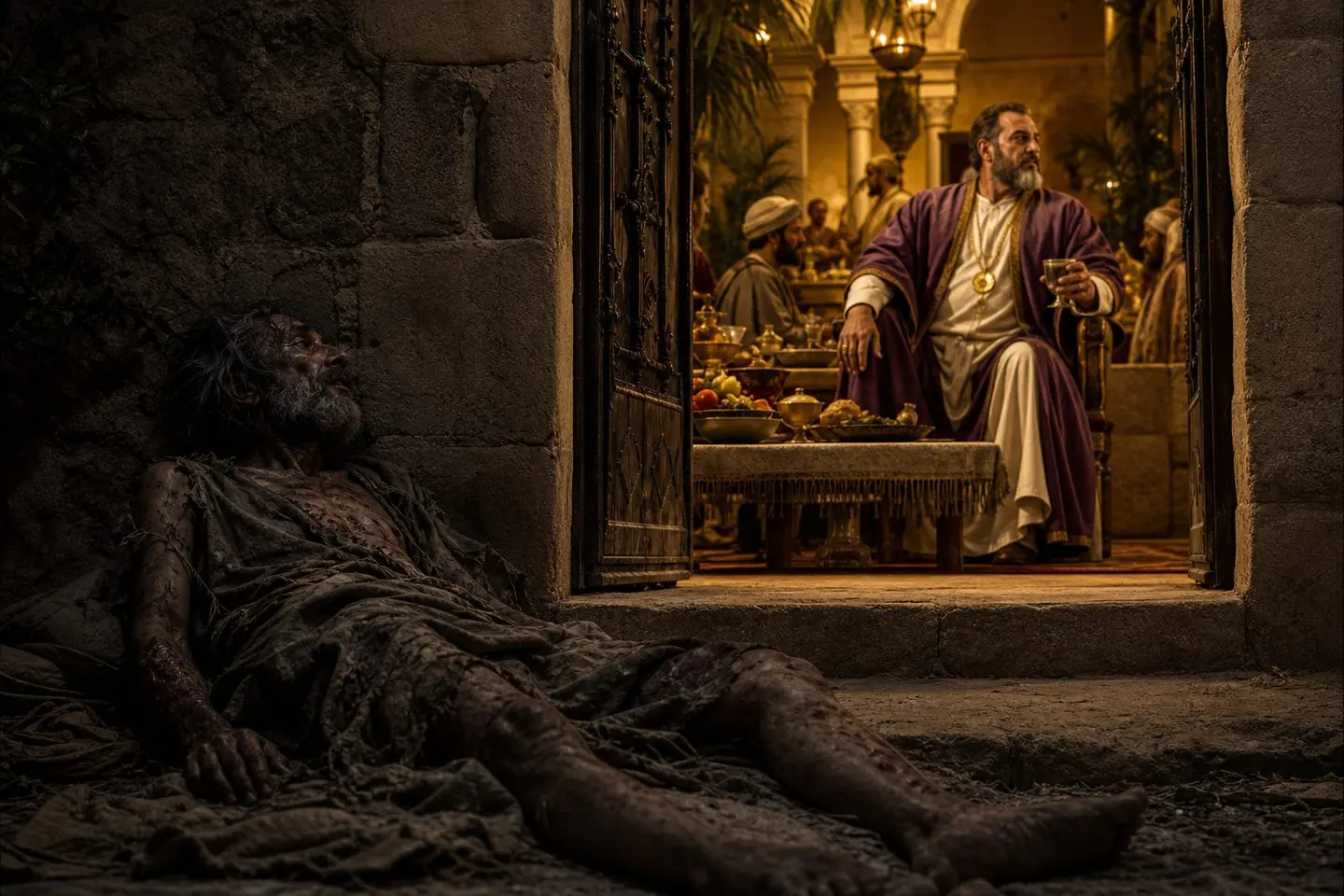
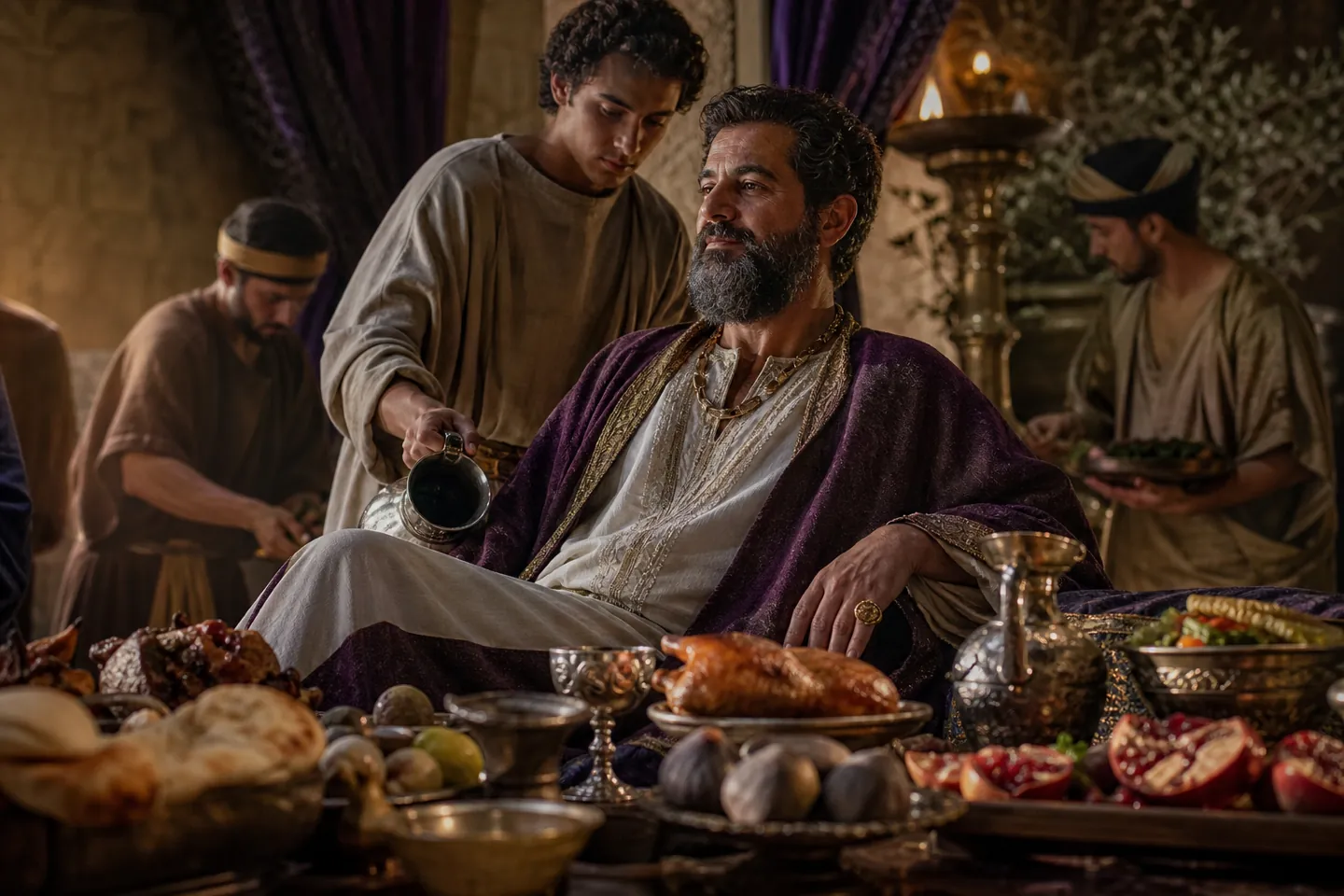
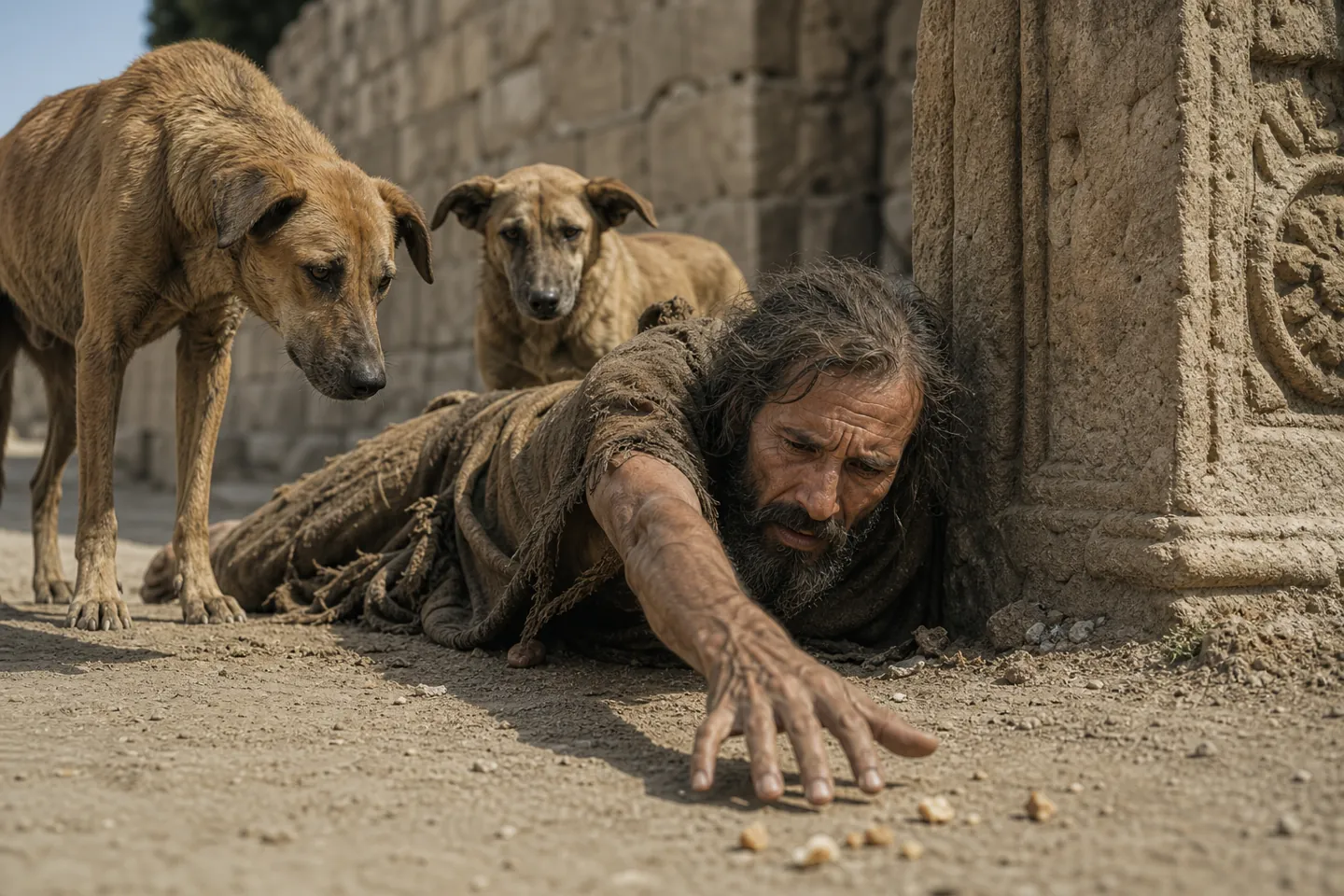
There was a certain rich man who was clothed in purple and fine linen and fared sumptuously every day. But there was a certain beggar named Lazarus, full of sores, who was laid at his gate, desiring to be fed with the crumbs which fell from the rich man’s table. Moreover the dogs came and licked his sores.
Luke 16:19-21 (NKJV)
Everyone listening knew who this rich man was: a Jew, and most probably a Pharisee, because you had to be connected to be that well off. His fine linen came from far away, and the purple deserves a moment. That dye is mentioned 77 times in the Old Testament, and it came from a tiny ocean snail called the Murex: divers with no masks or snorkels swam to the sea floor, gathered the snails one at a time, and went down again and again until there was enough to extract the dye. Incredibly expensive, hard to get, and it never faded; an observant Jew wore a single thread of it on the hem of his garment, and this man is robed in it. Add sumptuous fare at every meal, something different, something exotic, something incredible, and the Pharisees get it: a top of the line lifestyle.
But there was a certain beggar named Lazarus. The name is the nickname for Eleazar, God help me, and it is prophetic. Three days from this telling, Jesus will walk to Bethany, where His friend Lazarus will have lain dead four days. The rabbis taught that the soul hangs around the body for four days after death. They just made that up, and Jesus waited until day four so there would be no confusion when He called Lazarus out of that tomb. In this parable He is about to dismantle the made-up doctrine entirely.
The Lazarus of the parable is so full of infection he can do nothing for himself. People who did not want to watch him die in the street laid him at the rich man’s gate, hoping the crumbs from that table might reach him. Then Jesus puts the capper on it: the dogs came and licked his sores. These are not your cute little house pets. These are feral dogs, foul and full of parasites, interested in this man only for his wounds. Jesus is laying it on thick on purpose. One man has everything he could possibly want; the other is at the edge of death. Now watch what happens to each.
Carried by Angels: Two Deaths, Two Destinations
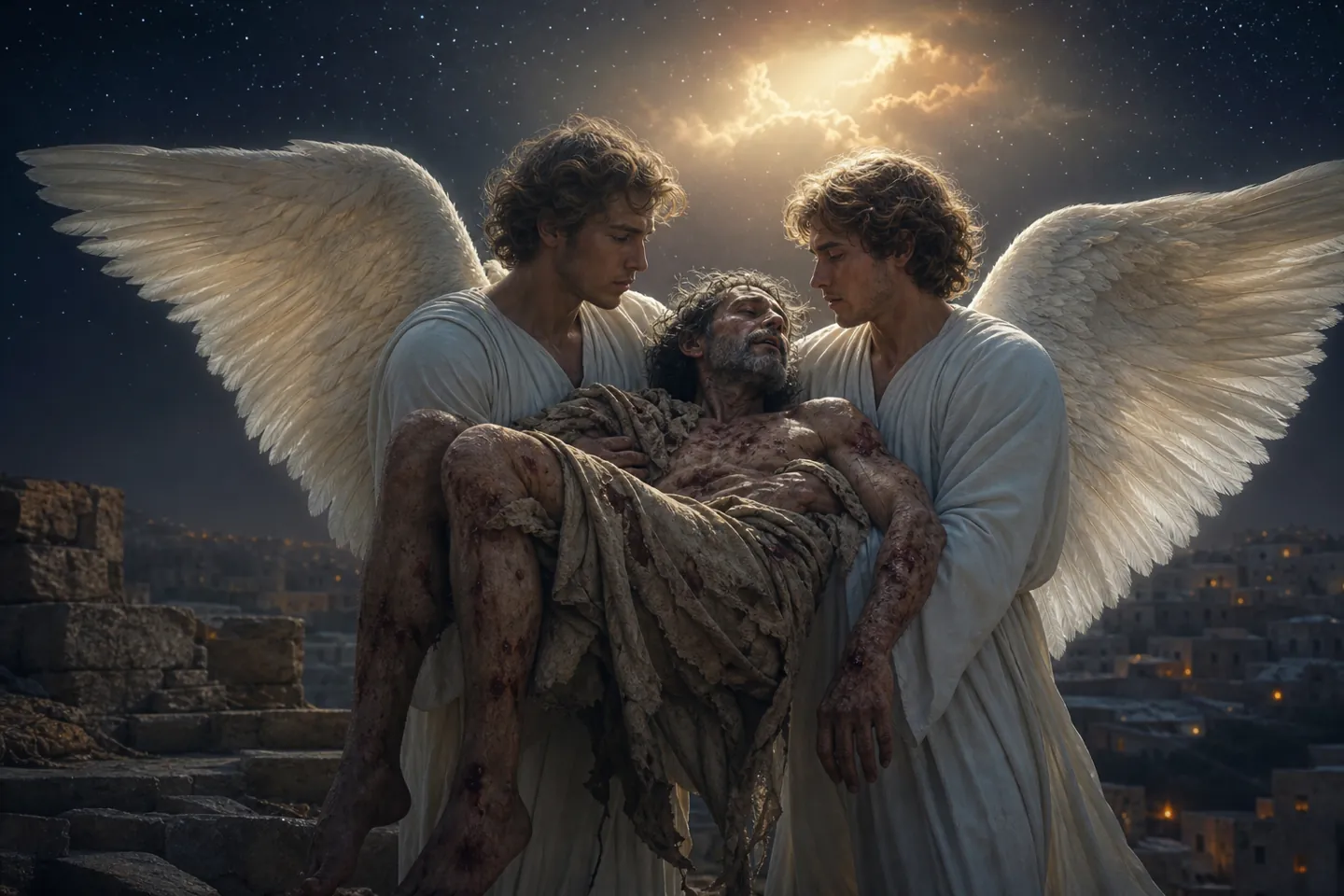
So it was that the beggar died, and was carried by the angels to Abraham’s bosom. The rich man also died and was buried. And being in torments in Hades, he lifted up his eyes and saw Abraham afar off, and Lazarus in his bosom.
Luke 16:22-23 (NKJV)
Jesus could have said the beggar was carried to heaven, or to paradise. He says Abraham’s bosom, and He chooses the phrase for His audience. The Pharisees never stop quoting: our father is Abraham. So Jesus hands them a picture they cannot mistake: angels come for the beggar, and now Lazarus reclines against Abraham the way John reclined against Jesus at the Last Supper, Abraham’s arm around him, his head on Abraham’s chest. Their heads would have blown up, because their theology ran the other way: the rich man was rich because God loved how he lived, and a beggar who ended that miserably must have been punished for something. Jesus reverses the whole chart in one sentence.
And notice the rich man’s obituary: the rich man also died and was buried. That is it. The sentence is clipped on purpose. Make a big deal of all this stuff if you like; you cannot take any of it with you. Jesus built an entire parable on that point, and we studied it in the Parable of the Rich Fool.
The Man Who Learned Nothing
Then he cried and said, “Father Abraham, have mercy on me, and send Lazarus that he may dip the tip of his finger in water and cool my tongue; for I am tormented in this flame.”
Luke 16:24 (NKJV)
This man is learning nothing. He is calling across eternity: send that fellow who was beneath me, he should still be my servant, have him bring me some cold water. Even in torment he wants Lazarus ordered around for his comfort.
But Abraham said, “Son, remember that in your lifetime you received your good things, and likewise Lazarus evil things; but now he is comforted and you are tormented. And besides all this, between us and you there is a great gulf fixed, so that those who want to pass from here to you cannot, nor can those from there pass to us.”
Luke 16:25-26 (NKJV)
Notice that Abraham answers him as son. The rich man keeps saying Father Abraham, and Abraham acknowledges the lineage. Being a son of Abraham did not save him.
Christians have run wild with this sentence for thousands of years: the wealthy are guilty and go to hell, and the poor, by nature of being poor, go to heaven. Both statements are 100 percent wrong. The rich man is not here because he is wealthy. He is here because he does not care. He thinks the wealth is his, to hang on to and keep in the family. If he had understood Scripture, he would have known that wealth, resources, and opportunity come from God, and that he was only managing those assets for God, the very stewardship lesson Jesus taught earlier in this same chapter in the Parable of the Unjust Steward. When God lays a dying man at your gate and you have all these means, God expects you to use them. What would it have taken? Tell the servants: bring that man in, bathe him, make him some soup, give him a place to lie down, and let us see if his strength comes back. He would not have had to lift a finger. He could not have cared less.
The Truth About Life After Death
Two paragraphs into this story, Jesus has taught us more about the afterlife than most Christians have ever been told. The rich man died and was immediately in torment. He has no body; he is a spirit. Yet he feels the torment, he sees, he recognizes Abraham and he recognizes Lazarus, which tells us he knew Lazarus in this life. Full consciousness. Full memory. Immediately. And between the two places stands a great gulf fixed by God, so that nobody passes in either direction, ever. There is no fixing it once you die.
I know there is all kinds of teaching out there, people extracting one verse and saying, see, here it says this. Listen: all we need to do is put ourselves on that hill at Golgotha. Jesus is dying between two thieves. One trash-talks Him from his cross. The other defends Him, and then asks:
Then he said to Jesus, “Lord, remember me when You come into Your kingdom.” And Jesus said to him, “Assuredly, I say to you, today you will be with Me in Paradise.”
Luke 23:42-43 (NKJV)
Today. That is the dichotomy. The way you live and your relationship to God are establishing a vector right now, like a plane 300 miles out being handed its radar vector for the runway, locked in, knowing exactly where it will touch down. The second you stop living, you take off on whichever vector you have created, and that is where you arrive. There is no bargaining. It is bang, and you are there for eternity, one place or the other. That, to me, is startlingly final.
And we do not stay spirits. At Jesus’ second coming the redeemed receive a heavenly body like the one Jesus had when He appeared to the apostles and the five hundred. It does not matter if your body was blown up, incinerated, drowned, or torn apart by sharks: you get a body that looks exactly like you at your best. There will be a body for those in torment too. Then comes the great white throne judgment, then a new heaven and a new earth. Paul was given a glimpse of paradise and said no human words can describe it. Why would anyone gamble with that?

Moses and the Prophets Are Enough
Then he said, “I beg you therefore, father, that you would send him to my father’s house, for I have five brothers, that he may testify to them, lest they also come to this place of torment.” Abraham said to him, “They have Moses and the prophets; let them hear them.”
Luke 16:27-29 (NKJV)
Here we find out this man is probably an attorney; most of the Pharisees were lawyers, not so different from our own Congress, and lawyers bend everything. He is lodging an appeal: we did not get proper warning. And to Pharisee ears, six brothers sounds like a blessed family. No. Jesus is saying they are all just like him. Notice what he still does not say. If his heart had changed at all, it would have been: at least let me apologize for all the rotten things I did when I had so much. None of that. First cold water for his tongue, now a warning for his own brothers, and no thought for anyone else.
Abraham’s answer is a dose of their own medicine. They have Moses and the prophets, the very superstars the Pharisees quote constantly. If they understood Isaiah alone, they would have known the Messiah would be born in Bethlehem, poor, mistreated, no military conqueror, and killed by the Jewish leadership. Here He stands in their midst, and they dog Him every day, working out how to arrest and murder Him, just as their fathers killed most of the prophets.
And he said, “No, father Abraham; but if one goes to them from the dead, they will repent.” But he said to him, “If they do not hear Moses and the prophets, neither will they be persuaded though one rise from the dead.”
Luke 16:30-31 (NKJV)
Three days later, Jesus stood before a tomb in Bethany, in front of hundreds of people, many of them the Pharisees’ own spies, and cried, Lazarus, come forth. The witnesses had seen Lazarus dead, seen him prepared, seen him laid in the tomb, and now they watched him shuffle out in his grave clothes. Did the leaders repent? They said: this has gone too far, the whole world is running after this man; we need to kill Jesus, and kill Lazarus too, because as long as he lives everyone will point to him. They did not repent; they set out to murder the proof. The parable’s last line was fulfilled within the week, by the very men it was aimed at. Rotten to the core.
Playing with Fire: First Things First
So here is where I press, because this is hard teaching and it is meant to be. In terms of your own risk management, if you are not clear about your salvation, settle it right now. We already know from the parable of the four soils that 75 percent of hearers are not making the cut, and I believe it is closer to 80, because people do exactly what the Pharisees did: change the teaching about the kingdom of heaven to suit their purposes. I took over a church that believed all roads lead to heaven, that whatever you worship, God is such a good God He will eventually say: I was just kidding, you were good, come in. I asked them to point that out to me in the Bible. It does not say that anywhere. What it says is no: the minute you die, you are in one place or the other, forever. The remedy could not be simpler:
…that if you confess with your mouth the Lord Jesus and believe in your heart that God has raised Him from the dead, you will be saved.
Romans 10:9 (NKJV)
That is priority one. God created us for relationship with Him, and our time here is short compared to the rest of our existence. There is nothing wrong with your plans, your work, your assets, your relationships; they are wonderful blessings from God, as long as they stay second things. But when a second things first lifestyle eclipses first things first, and that is human nature, you are playing with fire. People are dying every week in each of our networks, for reasons nobody properly explains, and every one of them went immediately to one of two places. That is not something to fool around with.
And if you care about people, you cannot be casual with them either. I had a building business with a fantastic guy; he would do anything for me and I for him, but on this topic he shut it down cold: you need that teddy bear to cope with life, I don’t. I could never get past that point, so all I could do was pray for him, never with him. It is the four soils again: some hearts are packed down so hard nothing gets in. I do not know the answer. I just know this is serious, and it deserves better than our shyness.
Because look at the heart of Jesus in this chapter. He knows these men are going to murder Him, and He is still trying to crack through, still working to keep even one of them from spending eternity in hell. That is a big heart, when the man you are working on will be your murderer. You do not want to stare across that void and see somebody you loved in torment. It all comes down to that hill called Golgotha and its three crosses: which thief do you want to be, the repentant one, or the one still insisting he knows best? From here Jesus keeps walking toward Jerusalem, where ten desperate men are about to meet Him on the border road; we continue in The Ten Lepers.

A Prayer for Crossing the River
We close with a prayer attributed to Benjamin Franklin, a founder who prayed about the very crossing this parable takes so seriously:
Dear God, let us live then under the continual impression that men ought always to pray and not to faint… Come then in childlike confidence to our blessed and glorious Father, not as a formality, nor merely as a duty, but because you need His almighty arm to protect and sustain you, to guard and shield you in the midst of the evils of the world, and finally, to save you… He is our everlasting trust, our stronghold, the rock of our defense… who will be with us in every trial, in all our sufferings, and in crossing the cold river where He will receive us to Himself, to be with Him forever and ever. Amen and amen.
Evening prayer attributed to Benjamin Franklin
Crossing the cold river: that is the crossing the rich man and Lazarus sets before us, and Franklin prayed it to the only One who can set the vector right. First things first. Settle it tonight, say it out loud, and everything else God gives you becomes what it was always meant to be: a blessing on the right side of the river.
Further Reading
For deeper verse by verse study of Luke 16, David Guzik's commentary at Enduring Word is an excellent companion, and GotQuestions surveys the main interpretive questions around the rich man and Lazarus.
Chuck's own study over the years has leaned most on six teachers. If you want to keep going after this parable, their work is where he would send you:
- John MacArthur at Grace to You
- James Burton Coffman, whose Coffman Commentaries are free at StudyLight
- Charles Stanley at In Touch Ministries
- Robert Deffinbaugh at Bible.org
- Chuck Swindoll at Insight for Living
- David Guzik at Enduring Word
How this study was written: it comes from Chuck Frank’s own teaching on this passage. It was put into writing with the help of AI editing tools, then reviewed by Chuck for faithfulness to his message and to Scripture.