
February 21, 2026
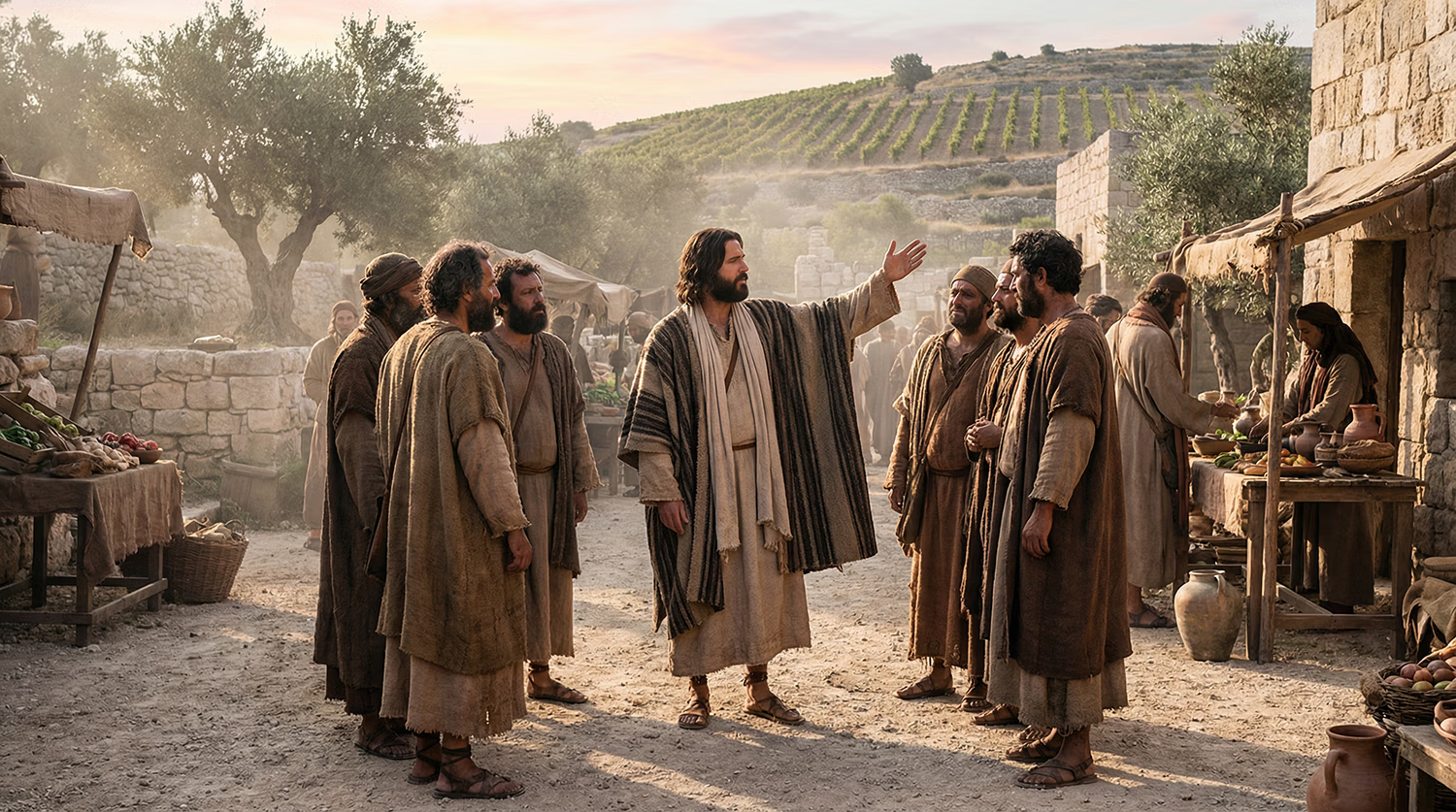
The laborers in the vineyard parable in Matthew 20 is one of Jesus’ most piercing teachings on God’s grace and human envy. In this parable, a vineyard owner hires workers at different hours of the day and pays them all the same wage, provoking outrage from those who worked the longest. Jesus uses this story to confront comparison, pride, and a misunderstanding of how God’s kingdom actually operates.
Table of Contents
What Is the Parable of the Laborers in the Vineyard?
The laborers in the vineyard parable, found in Matthew 20:1-16, is Jesus’ direct response to a moment of spiritual pride among His closest followers. Understanding it fully requires a step back into Matthew 19, where the story truly begins. When Jesus told the Apostles that a wealthy young ruler would find it nearly impossible to enter heaven, they were staggered. Their culture taught that wealth was a sign of God’s favor. If the richest, most accomplished man in the room couldn’t make it, who could?
Peter, never one to hold back, voiced what they were all thinking: “Look, we have given up everything and followed You. What then will there be for us?” (Matthew 19:27). That question, loaded with comparison and an expectation of reward, is the exact heart condition that Jesus sets out to correct with the story of the laborers in the vineyard.
Every parable Jesus taught grew from a real moment, a real question, or a real heart that needed addressing. As Chuck Frank often reminds us, Jesus didn’t carry parables around like weapons on a gun belt, ready to fire off at random. Each one was born from the situation at hand. The laborers in the vineyard is no different.
The Vineyard Owner Goes Out Five Times: God’s Relentless Invitation
For the kingdom of heaven is like the owner of an estate who went out in the morning at dawn to hire workmen for his vineyard. (Matthew 20:1)
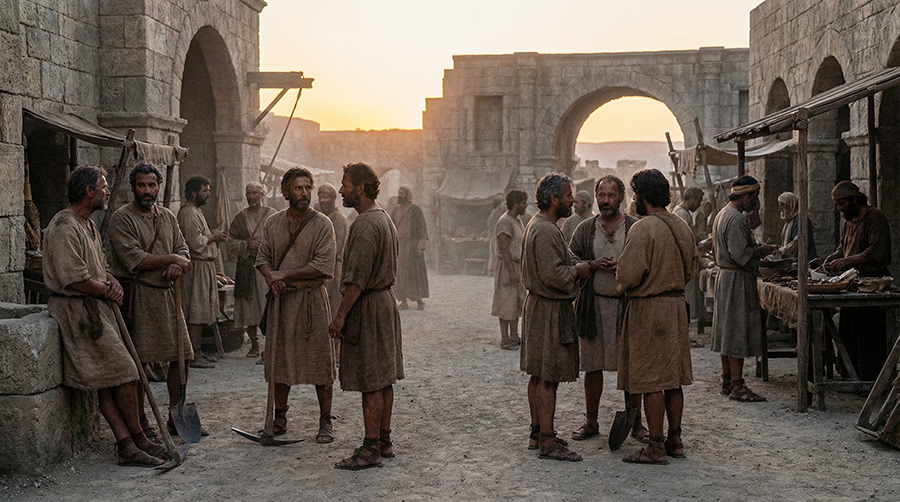
The laborers in the vineyard parable opens simply: a landowner goes to the marketplace at dawn, negotiates with workers for a denarius, a full day’s wage, and sends them into his vineyard. He goes back at 9:00 a.m., at noon, at 3:00 p.m., and finally at 5:00 p.m., just one hour before the workday ends. Each time, he finds men still standing in the marketplace. Each time, he invites them to work.
Five trips. Five invitations. One relentless landowner.
The landowner in this parable is God. The marketplace is the world. The workers are every human being who has ever had the chance to respond to the gospel. And those five trips? They represent something deeply personal to anyone who has spent years ignoring God’s call.
How many times did someone invite you to church before you finally went? How many times did a friend mention a Bible study, or a card show up in your mailbox, or a message on the radio catch your ear at just the right moment? Chuck Frank has spoken openly about rejecting God’s invitation for nearly forty years. Most of us, if we’re honest, can say the same. The laborers in the vineyard parable is not just a story about fairness in wages. It is a portrait of a God who keeps coming back to the marketplace, no matter how many times we walk away.
You can explore this theme of God’s persistent invitation throughout Chuck Frank’s broader Bible Messages series, which unpacks Scripture verse by verse across multiple books of the Bible.
Idleness and Kingdom Work: What God Actually Values
When the landowner finds workers still standing idle at 5:00 p.m. and asks why they have been standing there all day, they answer, “Because no one hired us.” Jesus describes their condition with one sharp word: idle.
That word deserves close attention. Jesus is not describing people who were genuinely at rest. He is describing people who were avoiding the one thing that mattered most. They may have been gambling in the shade, having warm drinks, making excuses, calculating whether the heat was worth it. And Jesus, speaking about the kingdom of heaven, translates that picture directly into spiritual terms: all of our secular striving, the career-building, the achievement-chasing, the provision-hustling, is what God sees as idleness when it crowds out kingdom work.
“If you’re not working in my vineyard, I’m not valuing the work you’re doing. Your secular work is absolutely idleness as far as I’m concerned.”
That is a difficult truth. Most Christians are not sitting in the shade gambling. They are working hard, providing for families, managing responsibilities. But Jesus is not condemning honest labor. He is calling attention to the spiritual work that we sideline when life gets full. Kingdom work means using the spiritual gifts God has placed in you, serving alongside your pastor, coming alongside other believers, and putting real effort into the vineyard, not just showing up for an hour on Sunday and going back to business as usual.
The Five Smooth Stones series on this site is a powerful starting point for anyone who wants to identify and apply those gifts in practical, meaningful ways.
The Denarius: What the Wage Really Represents
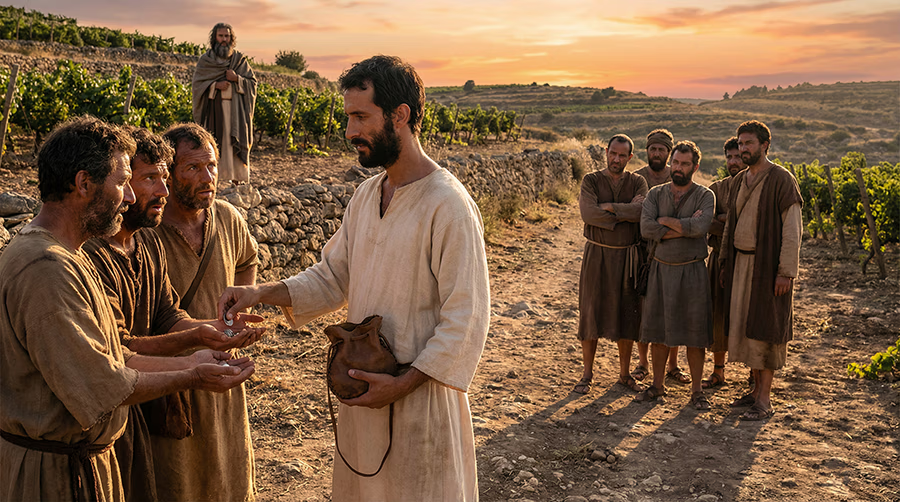
When evening comes at the end of that twelve-hour workday, the landowner instructs his manager to call all the workers in and pay them their wages, beginning with the last hired and ending with the first. Every worker receives a denarius.
The twelve-hour workday, from 6:00 a.m. to 6:00 p.m., is a symbol of a human lifespan. Evening represents the end of life. The manager who calls everyone in for their reward? That is Jesus Christ. And the denarius? It does not represent money. It represents salvation itself.
“Call the workers and pay them their wages, beginning with the last to be hired and ending with the first.” (Matthew 20:8)
Deuteronomy was unmistakably clear that workers must be paid their wages at the end of the day. The laborer’s hope through all the toil of that twelve-hour shift is the payment waiting at the end. In the same way, the Christian’s hope through all the difficulty of a faithful life, and the convert’s hope even in the final hour, is the same eternal reward.
This is why the laborers in the vineyard parable is so intimately connected to the penitent thief on the cross. That thief, crucified beside Jesus with perhaps minutes to live, said simply: “Remember me when You come into Your kingdom.” And Jesus responded: “Today you will be with Me in Paradise.” (Luke 23:42-43). He is the 4:55 p.m. worker, arriving with one hour left, receiving the full denarius. No prior service. No years of faithfulness recorded. Just trust with no contract.
The temptation, of course, is to think: Well then, I’ll just live however I want and convert at the last minute. But as Chuck Frank points out with blunt clarity, no one knows the hour. You cannot time the salvation market any more than a financial advisor can time the stock market. People who try that plan may find the workday ends before they ever make it to the vineyard.
The Grumbling: Envy Disguised as Justice
When the early workers see the late workers receive a full day’s wage, something ugly surfaces. They grumble. They accuse the landowner of unfairness. “These men who came last worked only one hour, and yet you have made them equal in wages to us who have borne the burden and the scorching heat of the day.” (Matthew 20:12)
The landowner’s reply is measured and firm:
“Friend, I am doing you no injustice. Did you not agree with me for a denarius? Take what belongs to you and go. I choose to give to this last man the same as I give to you. Am I not lawfully permitted to do what I choose with what is mine? Or is your eye envious because I am generous?” (Matthew 20:13-15)
Note the word friend here. In the original Greek, it is the same word Jesus uses when He addresses Judas Iscariot in the garden. It is not warm friendship. It is the address of a superior to someone who has just accused Him unjustly. And note what the landowner says next: “Take what belongs to you and go.” Many translations suggest the workers threw the coins into the dirt in protest. God sees that act of contempt every time He offers grace and someone dismisses it.
The laborers in the vineyard parable targets the Apostles directly here. They were full of competitive comparisons, constantly maneuvering for position, debating who was greatest. This same spirit would surface at the Last Supper, and even through the mother of James and John, who came asking that her sons be seated at Jesus’ right and left hand in the coming kingdom. Jesus told her plainly: “You do not know what you are asking.” (Matthew 20:22)
This pattern of pride and ranking surfaces throughout the Scriptures, and Chuck Frank addresses it head-on in his teaching on The Parables of the Wedding Feast and the Wicked Husbandmen, where God’s patient invitation is repeatedly rejected by those who think they deserve more.
There Is No Seniority in the Kingdom of God
One of the most direct and challenging conclusions of the laborers in the vineyard parable is this: there is no seniority system in God’s kingdom. None. Not for years of service, not for difficulty of mission, not for personal sacrifice, not for effective results.
This is deeply countercultural, and it cuts right through the structure of almost every human institution, including the Church. I’ve been here for thirty-five years. My family built this ministry. I give more than anyone else. Why does my opinion not carry more weight? These are the 6:00 a.m. workers grumbling at the payment table, and according to Jesus, that very attitude makes them last.
The Apostle Paul understood this dynamic with unusual clarity, and only because he had been knocked off it forcefully. He once considered himself a “super Jew,” trained at the feet of Gamaliel, a Hebrew of Hebrews, holding every advantage of birth, education, and religious connection. He was 100% wrong and required a literal encounter with the risen Christ on the road to Damascus, blinded at midday, to begin the correction. After that, Paul consistently called himself the least of the apostles. He had blood on his hands. He had persecuted the very Church he now served.
That humility shaped everything he wrote. And it was not performance. It was the result of understanding, deeply and personally, what grace actually costs. If you want to explore the radical nature of that grace, the Parable of the Pearl of Great Price and Dragnet captures how Jesus described the surpassing value of salvation in a way that leaves no room for comparison or boasting.
“So those who are last in this world shall be first in the world to come, and those who are first shall be last.” (Matthew 20:16)

The First Made Last: A Danger for Long-Time Believers
Jesus delivers the final verdict of the laborers in the vineyard parable with the line that opened and closes this entire section of Matthew: “The first will be last, and the last will be first.” This is not an arbitrary reversal. It is a precise diagnosis.
The 6:00 a.m. workers made themselves last through self-importance. They arrived first. They worked hardest. They carried the burden of the scorching heat. And then they let it become a wall between themselves and God’s generosity. Their sacrifice, which should have deepened gratitude, curdled into entitlement. The last-hired workers, by contrast, entered the vineyard on faith alone. No negotiated contract. No leverage. Just “go into the vineyard and I will pay you what is right,” and they went. That is trust. That is the posture God honors.
This same principle runs through the Parable of the Talents and the Seed Growing Secretly, where faithful stewardship and quiet, obedient kingdom work are what God rewards, not volume or visibility.
Chuck Frank draws a striking contemporary parallel to this dynamic in his series on Today’s Concerns, where he examines how the same human tendency toward self-promotion and status-seeking that Jesus addressed in first-century Galilee is just as visible, and just as destructive, in modern culture and politics. He notes that this inflated self-evaluation tears apart churches, families, and governments with equal force. It is not unique to any one era. It is a feature of fallen humanity.
Practical Application: Working Without Comparison
So what do the laborers in the vineyard teach the modern believer about how to actually live? Jesus gives several clear correctives through this parable.
Work faithfully, not comparatively. The moment you begin measuring your contribution against someone else’s, you have stepped off the path. God does not grade on a curve. He is not keeping a comparative ledger. The only question at the end of the day is whether you used the gifts He gave you and served the vineyard He placed you in.
Respond to the invitation, whenever it comes. Whether you heard the gospel at five years old or will hear it at ninety-five, the wage is the same. Do not calculate. Do not delay. No one knows the hour of evening. The resources available on this site are designed for exactly this kind of ongoing response, tools to keep you in the vineyard and growing.
Let generosity toward others delight you, not disturb you. When God pours out grace on someone who has served far less time than you, the right response is joy, not protest. Every new worker in the vineyard is a gift to the mission, not a threat to your standing.
Check your motivation. If you are serving so that you can point to your record, you are serving yourself. The 4-3 Formula that Chuck Frank has developed is a simple framework for staying purpose-driven and obedient rather than achievement-driven, a useful reset for anyone who feels the pull toward comparison.
For those who want to go deeper into the life of faithful kingdom service and how to practically engage with the broader community of believers, the Community section of this site is a place to connect, share, and grow alongside other believers doing the same work.
John Quincy Adams and the Light That Never Fails
The laborers in the vineyard parable closes not with comfort but with challenge. And fittingly, Chuck Frank ends his teaching on this passage with a glimpse into a man who understood exactly what it meant to keep working in the vineyard when everything looked dark.
John Quincy Adams, the sixth President of the United States and a man whose faith has been deliberately obscured by secular rewriters of history, began the year 1829 in grief. His wife was desperately ill. His oil lamp went out as he sat down to write. And in his journal, by lamplight he had just refilled, he wrote words that deserve to be read slowly:
“The year begins in gloom. My wife had a sleepless and painful night. The dawn was overcast, and as I began to write, my shaded lamp went out, self-extinguished. It was only for lack of oil… But in good or in evil fortune, it is not in man that walketh to direct his steps. Let him look to the fountain of all good. Let him consult the oracles of God. I began the year with prayer and then turning to my Bible read the first psalm… May the light of this lamp never forsake me.”
He was not talking about oil. He was talking about Christ. That is the testimony of a man who worked faithfully in the vineyard regardless of the hour, regardless of the darkness, regardless of what the culture around him said about God or faith or Scripture. He kept reading his Bible. He kept praying. He kept trusting.
The Parables of the Wheat and the Tares and the Hidden Treasure speak to the same quiet, enduring faithfulness that God prizes above all, the kind that looks like nothing from the outside but is deeply rooted and fully known by the Landowner.

Conclusion: The Vineyard Is Still Open
The laborers in the vineyard parable does not describe a closed system. The landowner keeps going back to the marketplace. The invitation stays open until evening falls. And the wage, the full, undeserved, unearnable denarius of salvation, is available to everyone who enters.
If you came to faith early, resist the temptation to keep score. If you came late, resist the lie that you have nothing to offer. If you have not yet come at all, understand that the landowner has been to that marketplace every hour of your life, looking for you, ready to offer you work and the wage that no amount of human effort could ever purchase.
The laborers in the vineyard teach us that God’s generosity is not limited by our calendars, our contributions, or our comparisons. It is limited only by our willingness to enter the vineyard when He calls.
The light, as John Quincy Adams knew, is not the oil. The light is Christ. And it never goes out.
Frequently Asked Questions (FAQs)
What is the main lesson of the Laborers in the Vineyard parable?
The main lesson of the laborers in the vineyard parable is that God’s grace is not earned by length of service or personal sacrifice. Salvation, represented by the denarius wage, is a gift available to all who respond to God’s invitation, whether early or at the last hour, and comparing our service to others’ destroys the spirit of the kingdom.
Why did Jesus tell this parable to the Apostles specifically?
Jesus told the laborers in the vineyard parable in direct response to Peter’s question in Matthew 19:27, where the Apostles were comparing their sacrifices and expecting special reward above other believers. Jesus used the parable to confront competitive thinking that would later threaten to divide the early Church, as seen at the Last Supper and in the request by the mother of James and John.
What does the denarius represent in this parable?
The denarius represents salvation itself, the eternal reward that God promises every believer. It does not represent a proportional wage based on effort. Every worker, from the 6:00 a.m. laborer to the 5:00 p.m. arrival, receives the same denarius, illustrating that salvation is not graduated by merit but given equally by grace through faith.
Is it too late to come to faith if you have lived a sinful life?
The laborers in the vineyard parable directly addresses this. The 5:00 p.m. workers, and the penitent thief on the cross, demonstrate that no one is too late as long as they respond before the day ends. However, Jesus is equally clear that no one knows when that day ends. Waiting deliberately is a dangerous gamble, because the hour of the evening is unknown to all.
Further Reading
- Matthew 20:1-16 (AMP) on Bible Gateway — Read the full text of the laborers in the vineyard parable in the Amplified Bible for enhanced clarity on each verse.
- Enduring Word Commentary on Matthew 20 — David Guzik’s thorough verse-by-verse commentary on Matthew 20, covering the historical context of the denarius and the significance of the grumbling workers.
- What Is the Meaning of the Parable of the Laborers in the Vineyard? — GotQuestions.org provides a clear theological explanation of the parable and its connection to salvation by grace alone, not merit.
- The Parable of the Laborers in the Vineyard — Ligonier Ministries offers a Reformed perspective on what the parable reveals about God’s sovereign right to dispense grace as He chooses.
- Bible Gateway: Matthew 19:23-30 (AMP) — The critical context from Matthew 19, including the rich young ruler and Peter’s question that prompted the laborers in the vineyard parable.
