
At the Last Supper, Jesus knelt to wash his disciples’ feet, offered a final act of grace to the man who would betray him, and promised a Helper who would change everything. The betrayal of Jesus did not begin in a garden; it began at a dinner table, in the heart of a man who had been drifting away from the truth for months, and in a religious establishment so determined to protect its power that it would send two hundred soldiers to arrest one unarmed teacher. Part 2 of our Easter series picks up in Bethany and follows the road all the way to Gethsemane.

Table of Contents
The Anointing at Bethany: What Mary Understood That the Disciples Missed
Six days before the Passover, Mary of Bethany poured an entire pound of pure spikenard on the feet of Jesus and wiped them with her hair. The disciples were baffled. Judas was furious. But Mary understood something that none of the twelve had grasped: Jesus was going to his death, and this was her moment to honor him before it was too late.
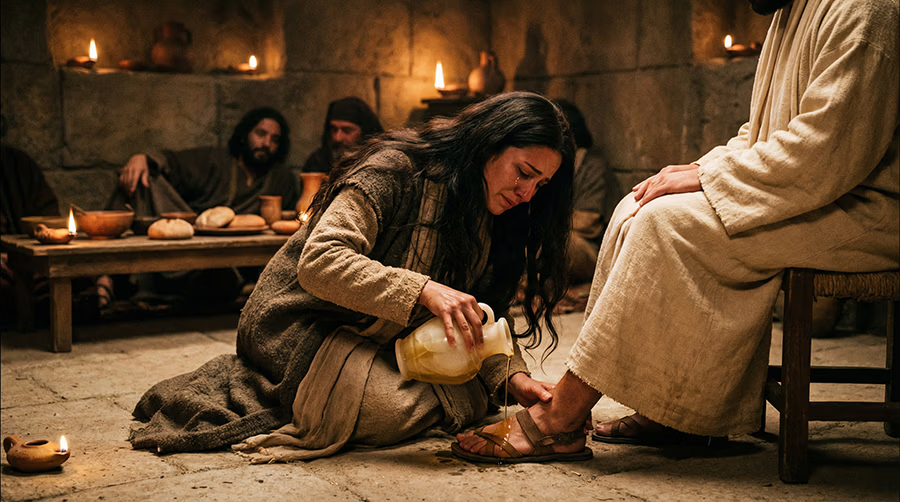
In Part 1 of this Easter series, we watched the raising of Lazarus set the entire Passion in motion. Now the same household sits down to a meal with the man who had been dead four days and is now sharing bread with the Son of God. Lazarus was at the table. Martha served. And Mary brought out a treasure.
Spikenard is a tiny flower that grows high in the Himalayan mountains. Pure spikenard was so potent that most people cut it with other fragrances before use. Mary used it undiluted. The fragrance filled the entire house. The cost was three hundred denarii, roughly three hundred full days of wages. This was not an impulsive gesture; it was a deliberate, costly act of worship from someone who had been listening far more carefully than anyone around her.
“But one of His disciples, Judas Iscariot, Simon’s son, who would betray Him, said, ‘Why was this fragrant oil not sold for three hundred denarii and given to the poor?’ This he said, not that he cared for the poor, but because he was a thief, and had the money box; and he used to take what was put in it.” John 12:4–6 (NKJV)
The Gospel does not mince words about Judas. He was not a concerned treasurer. He was a thief who had been skimming the ministry’s funds. His objection to the anointing was about money, not the poor. Jesus shuts the conversation down directly:
“Let her alone; she has kept this for the day of My burial. For the poor you have with you always, but Me you do not always have.” John 12:7–8 (NKJV)
I believe Mary understood, through her closeness with Jesus, exactly what was coming. Jesus had told this household that his purpose in raising Lazarus was for the glory of God and that danger would follow. Mary heard it. She responded with everything she had. The disciples, including Judas, were still waiting for a crown. Mary was preparing a burial.
Palm Sunday and the Ancient Prophecy
The next day, crowds flooded the road from Jerusalem out to meet Jesus as he came from Bethany. They cut palm branches and cried out a Hebrew phrase that most churchgoers have heard but few have unpacked: Hosanna. It means “Oh Jehovah, save now.” They were not singing a worship chorus. They were crying out for a deliverer. And they were right about who he was, even if they were wrong about what deliverance would look like.
“Fear not, daughter of Zion; behold, your King is coming, sitting on a donkey’s colt.” John 12:15 (NKJV)
John tells us this was a fulfillment of Zechariah 9:9, written five hundred years before Jesus rode that colt through the city gate. The Pharisees and the Sanhedrin had read Zechariah their entire lives. They knew the passage. They were watching it happen in front of them, and their response was to plan a murder.
“The Pharisees therefore said among themselves, ‘You see that you are accomplishing nothing. Look, the world has gone after Him!'” John 12:19 (NKJV)
The Crowds That Believed in Celebrity, Not in Christ
The tragic irony of Palm Sunday is what comes in the verses immediately following. John tells us that despite all the signs and all the shouting, the crowds did not truly believe in Jesus. They believed in his miracles and his celebrity. It was shallow enthusiasm, not saving faith. John reaches back to Isaiah 53 to explain it:
“Lord, who has believed our report? And to whom has the arm of the Lord been revealed?” John 12:38 (NKJV)
Isaiah wrote those words seven hundred and forty years before Jesus entered Jerusalem. God had already revealed, through his prophet, that the Messiah would be rejected by his own people. John adds a harder truth: some people cannot believe because God has blinded their eyes and hardened their hearts. That is not a comfortable doctrine. It is, however, an honest one. If you are reading this and something in you is being drawn toward faith, that drawing is not coming from you.

“Now My Soul Is Troubled”: Jesus Predicts the Cross
When Jesus said “Now My soul is troubled,” the natural reading is that he was dreading the physical agony of crucifixion. But I do not think that is what was grieving him. What he was seeing in those crowds was that his ministry would not benefit his own people. The Jews were rejecting him. The fruit of his sacrifice would go largely to the Gentiles. That is the weight he was carrying.
And yet, in that grief, he does not pray for himself. He prays for the Father’s glory.
“Father, glorify Your name. Then a voice came from heaven, saying, ‘I have both glorified it and will glorify it again.'” John 12:28 (NKJV)
Some in the crowd said it had thundered. Others said an angel had spoken. Jesus told them the voice was not for his sake but for theirs. Then he says something that reframes the entire cross:
“Now is the judgment of this world; now the ruler of this world will be cast out. And I, if I am lifted up from the earth, will draw all people to Myself.” John 12:31–32 (NKJV)
Lifted up means crucifixion. And in that same lifting, Satan is cast out permanently. He can still make trouble in this world; he does it every day. But the moment Jesus dies on that cross, Satan loses. The free gift of salvation becomes available to anyone willing to receive it. His only remaining power is deception, and the moment a person comes to a saving knowledge of Jesus Christ, that deception has no ultimate hold. This theme of spiritual warfare behind institutional evil runs through everything we study in our Today’s Concerns series, from the Sanhedrin to modern political corruption.
The Last Supper: The Servant Who Washes Feet
To understand why Jesus washed his disciples’ feet at the Last Supper, you have to understand what the disciples were arguing about in the days leading up to it. The mother of James and John had brought her sons to Jesus and asked him point-blank to promise them the two seats of honor at his right and left when he became king. The other ten disciples found out and were furious, not because the request was wrong, but because they had not thought to ask first.
This is the same jockeying for position we see analyzed in our study of the Parable of the Wicked Husbandmen: the human appetite for status and power that corrupts even those closest to the most important moment in history. Jesus was hours away from his arrest, and his inner circle was fighting over seating assignments.
His response was to get up from the table, lay aside his garments, wrap a towel around his waist, and wash their feet. This was a slave’s task. No self-respecting disciple would have done it. No rabbi would have done it. Jesus did it without explanation, starting with Simon Peter, who immediately objected.
“Lord, are You washing my feet?” Jesus answered and said to him, “What I am doing you do not understand now, but you will know after this.” John 13:6–7 (NKJV)
Peter refuses. Jesus answers with one of the most clarifying statements in the Gospel:
“If I do not wash you, you have no part with Me.” John 13:8 (NKJV)
Peter overcorrects immediately: wash my hands and head too. Jesus tells him a person who has already bathed only needs his feet washed, and you are clean. Then he adds: “but not all of you.” He knew who would betray him.
The Lesson That Cuts Against Every Human Instinct
After drying his hands, Jesus puts his point plainly. You call me Lord and Teacher, and you are right. If I, your Lord, wash your feet, then you have to do the same for each other. Stop fighting about who gets the chief seat. The entire kingdom operates on servant leadership, not power. This principle, grounded in Scripture, is exactly what our Five Smooth Stones toolkit is designed to help believers internalize and apply.
“For I have given you an example, that you should do as I have done to you. Most assuredly, I say to you, a servant is not greater than his master; nor is he who is sent greater than he who sent him.” John 13:15–16 (NKJV)
And then the line that is easy to glide past: “If you know these things, blessed are you if you do them.” Knowing something and doing it are two entirely different things. Knowing is where most people stop. Doing is where the blessing lives.
The Betrayal of Jesus: How Judas Made His Choice
The betrayal of Jesus was not a sudden act of evil by a man who was always wicked. Judas started as a genuine disciple. But at some point, he began to nurse a private discontent, and instead of bringing it to God or to Jesus, he kept it to himself. That silence gave Satan a foothold.
Judas had expected that following Jesus would eventually lead to power, position, and probably money. The longer he followed, the more obvious it became that none of those things were coming. Jesus showed no interest in being declared king in the political sense. The money box was not growing. Judas kept his frustration private, and Satan watched it fester.
This pattern of gradual moral drift followed by a decisive choice is exactly what we examine in our verse-by-verse study of Book of Jonah 3: the difference between the person who turns back and the person who does not. Nineveh turned back. Judas did not. The consequences are eternal in both directions.
“When Jesus had said these things, He was troubled in spirit, and testified and said, ‘Most assuredly, I say to you, one of you will betray Me.'” John 13:21 (NKJV)
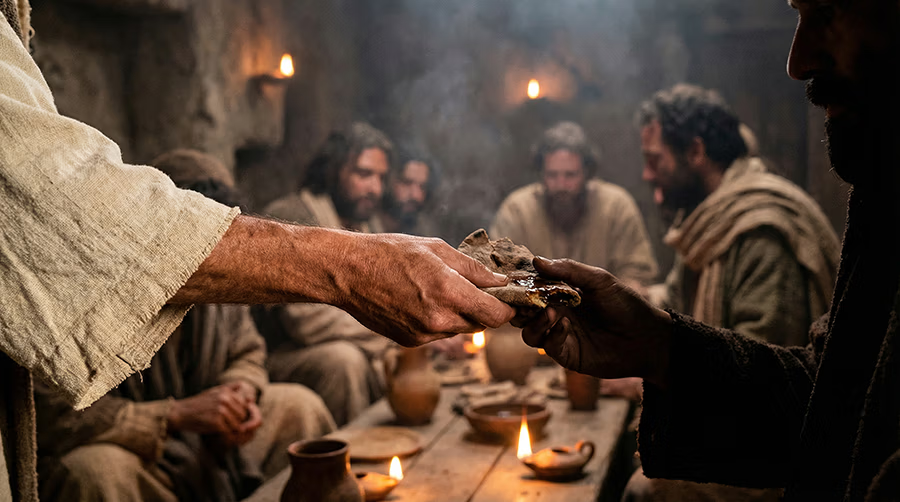
The disciples look at one another, bewildered. John, leaning against Jesus, asks who it is. Jesus answers with a gesture drawn from their own dinner customs: at the end of a meal, the host would dip a final piece of bread into the remaining juices and hand it to the guest of honor. Jesus hands it to Judas. It was not an accusation. It was an offer. A final moment of grace, an invitation to choose differently. Judas ate the bread, and Satan entered him.
“Then Jesus said to him, ‘What you do, do quickly.'” John 13:27 (NKJV)
The disciples thought Jesus was sending Judas on an errand. They did not understand what was happening. Judas walked out into the night, and Jesus was alone with the eleven who would scatter before morning.
The Promise of the Holy Spirit: Why the Disciples Needed to Lose Jesus
Jesus told his disciples that it was to their advantage that he go away. They had no framework for that sentence. Everything they had built their hopes on was about to be arrested, tried, and executed. How could his absence possibly be better?
“Nevertheless I tell you the truth. It is to your advantage that I go away; for if I do not go away, the Helper will not come to you; but if I depart, I will send Him to you.” John 16:7 (NKJV)
The Holy Spirit’s primary mission for these disciples was not to add new revelation. It was to take everything Jesus had already taught them and make it finally make sense. They had been with him for three years. They had heard every parable, every sermon, every private explanation. But they were overwhelmed, frightened, and spiritually immature. None of it had settled. The Holy Spirit would change that.
“When He, the Spirit of truth, has come, He will guide you into all truth; for He will not speak on His own authority, but whatever He hears He will speak; and He will tell you things to come.” John 16:13 (NKJV)
These frightened, arguing, confused men would become the emissaries who carried the faith of Jesus Christ across the known world. That transformation was entirely the work of the Holy Spirit. It is also the reason the 4-3 Formula at the heart of this ministry emphasizes Spirit-grounded obedience rather than willpower and good intentions alone. You cannot sustain what these disciples were called to sustain on human courage. They needed something beyond themselves, and Jesus was telling them it was coming.
Jesus closes this section of his teaching with a statement that is both a warning and a promise:
“In the world you will have tribulation; but be of good cheer, I have overcome the world.” John 16:33 (NKJV)
The Arrest in Gethsemane: “I Am”
After crossing the Brook Kidron, Jesus entered a garden he had visited many times with his disciples. It was his place of prayer, his retreat from the crowds. And Judas knew exactly where it was.
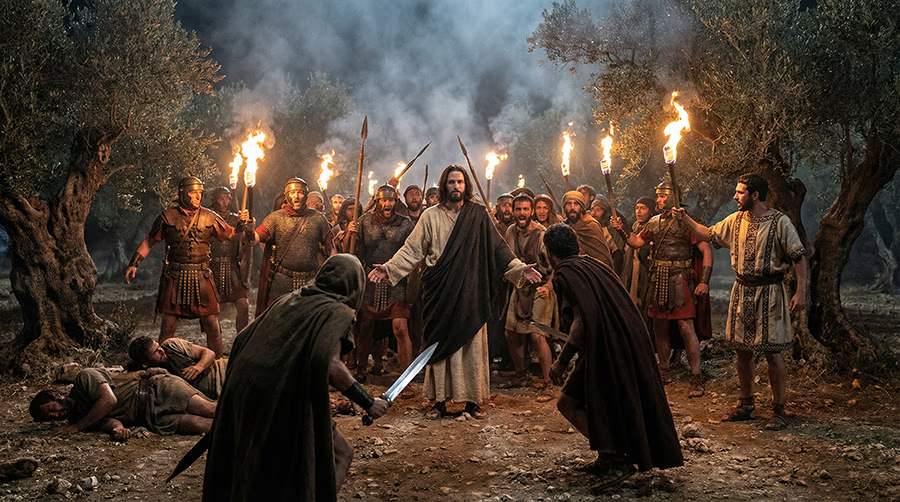
Two hundred temple soldiers, armed with torches, lanterns, and weapons, came to arrest one man. The sheer size of the detachment tells you everything about how frightened the Sanhedrin was of Jesus. As we examined in Book of Esther 3, when conspiracies rise against the righteous, the powerful always overreact when they feel their grip slipping. Two hundred soldiers for a carpenter from Nazareth was not a security operation. It was a statement of institutional terror.
Jesus walked toward them and asked: “Whom are you seeking?”
They answered with an insult: “Jesus of Nazareth.” The phrase wa a regional slur; the saying of the day was, “Can anything good come out of Nazareth?”, because it was a Roman garrison town. This is why the Chief Priests of the Temple said that no prophet could come from Nazareth. Jesus answered with a title, not a name:
“Jesus said to them, ‘I am.’ And Judas, who betrayed Him, also stood with them. Now when He said to them, ‘I am,’ they drew back and fell to the ground.” John 18:5–6 (NKJV)
Two hundred armed soldiers, knocked to the ground by two words. I AM is the divine name spoken to Moses at the burning bush. Jesus was not identifying himself to an arrest party. He was declaring his identity as God to a group of men who were about to bind him and drag him to a kangaroo court. He let them get back up. He asked them again who they were seeking. He negotiated the release of his disciples. And then he allowed them to bind him, not because they had any power over him, but because his hour had come.
Peter’s Sword and the Cup the Father Gave
Peter, characteristically, drew a sword and cut off the ear of a servant named Malchus. Jesus stopped him immediately:
“Put your sword into the sheath. Shall I not drink the cup which My Father has given Me?” John 18:11 (NKJV)
That is the entire Easter story in one sentence. This was not a rescue mission Peter could complete with a sword. The cup was not something Jesus was trying to avoid. It was the reason he had come. The binding, the humiliation, the trial, the cross, all of it was the cup the Father had given him, and he would drink it to the last drop.
They led him first to Annas, the former high priest and political patriarch whose son-in-law Caiaphas held the office that year. Annas had no legal authority, but he had all the real power. He had spent years appointing compliant family members to a position the law required to rotate annually. He was not going to step aside just because the law said he should. The same spirit of institutional corruption that our G-Drop series documents in today’s political landscape was alive and operating in the temple’s power structure two thousand years ago. The names change. The mechanics do not.
King David, centuries earlier, prayed for protection against exactly this kind of coordinated evil. Chuck read Psalm 140 to close this teaching, and it is worth sitting with:
“Deliver me, O Lord, from evil men; preserve me from violent men, who plan evil things in their hearts and continually gather together for war.” Psalm 140:1–2 (NKJV)
David wrote those words for his own circumstances. God preserved them for ours. The prayer of a man surrounded by violent enemies who conspired against him points directly to the Messiah, surrounded by the same forces for the same reason. And the mission that drives this ministry is grounded in that same conviction: that people of faith must be willing to name the evil they see, pray against it, and trust God with the outcome.
Practical Application
The arc from the anointing at Bethany to the arrest in Gethsemane is not just ancient history. It speaks directly to how we live today.
- Pay attention to your private discontents. Judas did not go from faithful disciple to betrayer overnight. He nursed a private grievance and kept it from God. That silence is where the drift begins. Bring your honest frustrations to the Lord before they become something you cannot walk back from.
- Learn Mary’s kind of listening. The disciples were distracted by expectations. Mary was paying attention to what Jesus was actually saying. That kind of attentive faith produces the kind of costly worship that Jesus himself defends.
- Examine what servant leadership actually costs you. Jesus did not teach footwashing as a metaphor. He knelt on the floor and washed twelve pairs of dirty feet. Ask where in your life the Lord is asking you to take the towel.
- Trust the Holy Spirit with what you cannot yet understand. The disciples could not bear everything Jesus had to tell them. Neither can we always. The Spirit illuminates in time. Walk in what you know today, and trust him with what you do not.
Conclusion
From a fragrant anointing to a torchlit garden, Part 2 of our Easter series traces the betrayal of Jesus through every stage: the heart that hardened slowly, the institution that sent soldiers to silence a miracle worker, the disciples who did not yet understand what they were living through, and the Lord who walked into all of it voluntarily, with full knowledge of every step.
He told the soldiers who he was. He told Peter to put away the sword. He asked only that his disciples be allowed to go free. Then he let them bind his hands, because the cup the Father had given him was what everything had been building toward since the garden of Eden.
Part 3 of this series will take us into the trials and toward the cross. These are not easy passages. But the weight of them is the weight of real love, and we need to carry it all the way to the empty tomb.
For additional verse-by-verse study resources on the Gospel of John and other scriptural series, explore our full Bible Messages library.
Frequently Asked Questions (FAQs)
Was Judas predestined to betray Jesus, or did he have a choice?
Both are true at the same time, and the tension is intentional. Scripture is clear that Judas’s betrayal fulfilled prophecy, including Psalm 41:9. It is equally clear that Judas made a deliberate series of choices: to nurse his discontent privately, to make the deal with the chief priests, and to eat the bread Jesus offered him at the Last Supper. God’s sovereign plan and human free will are not mutually exclusive in Scripture. Judas was not a puppet. He made his choices. God worked through them.
Why did Jesus wash the disciples’ feet at the Last Supper?
The immediate context is a dispute among the disciples about rank and position, sparked by Salome’s request that her sons James and John receive the chief seats in Jesus’ kingdom. Jesus responded not with a lecture but with a demonstration: kneeling to wash their feet, a task reserved for the lowest servant. The lesson was direct: greatness in the kingdom of God is measured by service, not by position. For further reflection on applying this to daily life, explore our resources for Christian growth and Scripture study.
What does it mean that the soldiers fell to the ground when Jesus said “I Am”?
“I Am” is the divine name God revealed to Moses at the burning bush in Exodus 3:14. When Jesus speaks it in Gethsemane, he is not merely identifying himself to an arrest party. He is declaring his identity as the eternal God. The soldiers’ reaction, two hundred armed men dropping to the ground, was an involuntary response to the presence of divine authority. Jesus allowed them to recover and proceed with the arrest, which underscores that what followed was entirely voluntary on his part.
What was the role of Annas in the arrest of Jesus?
Annas had served as high priest years earlier and remained the dominant political power in the Jerusalem temple, installing a series of family members including his son-in-law Caiaphas in the high priest position. The law required that the office rotate annually, but Annas controlled who held it. Jesus was brought to Annas first, not because of any official authority, but because Annas was the real power behind the institution. It was a political visit before the legal proceedings began.
Further Reading
- John 13 Verse-by-Verse Commentary at Blue Letter Bible
- John 18 Verse-by-Verse Commentary at Enduring Word
- Who Was Judas Iscariot and Why Did He Betray Jesus at GotQuestions.org
- Psalm 140 Commentary and Context at Bible Hub


