
The crucifixion of Jesus is the hinge point of all of human history. Everything in Part 1 of this Easter series and Part 2 has been building toward this: the trials before Annas and Pilate, the scourging, the crown of thorns, the walk to Golgotha, and three words spoken from the cross that changed everything forever. It is finished. Not a cry of defeat. A declaration of completion.
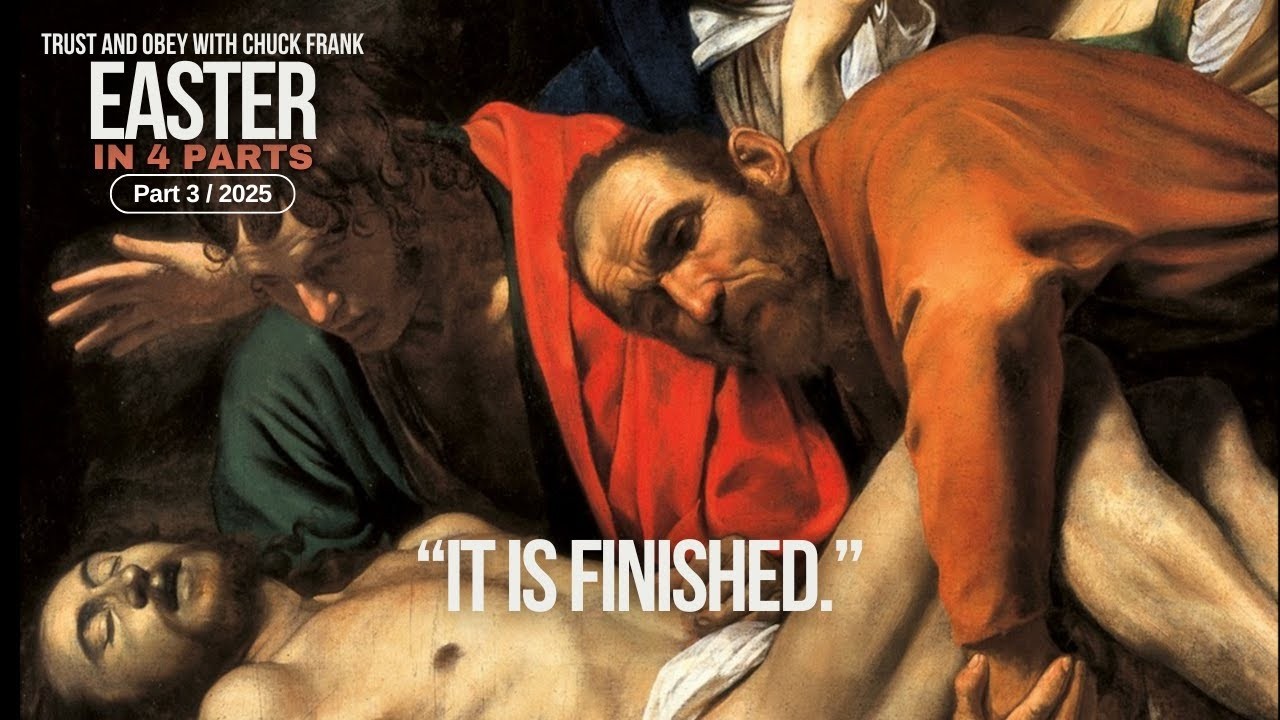
Table of Contents
The Trial Before Annas: Lawfare Against the Son of God
The trial of Jesus before Annas was not a legal proceeding. It was a fishing expedition by a man who had already decided the verdict. Annas had no current legal authority; he was the former high priest and the political patriarch who controlled the office through a chain of compliant son-in-laws. Jesus was brought to him first because Annas was the real power behind the institution. The law meant nothing to him when his position was at stake.
Annas interrogated Jesus about his disciples and his doctrine, hoping to extract something that could be used in the proceedings ahead. Jesus answered with surgical clarity: he had taught openly in synagogues and in the temple, in full public view, with nothing hidden. If Annas wanted to know what he had said, he could ask the spies he had been sending for months.
“I spoke openly to the world. I always taught in synagogues and in the temple, where the Jews always meet, and in secret I have said nothing. Why do you ask Me? Ask those who have heard Me what I said to them. Indeed they know what I said.” John 18:20–21 (NKJV)
That was too much truth for the room. An officer standing nearby slapped Jesus across the face. Jesus responded not with anger but with the same calm authority he had shown throughout: “If I have spoken evil, bear witness of the evil; but if well, why do you strike Me?” Annas, unable to extract anything useful, sent him bound to Caiaphas. This pattern, the abuse of institutional power to manufacture charges against an innocent man, is examined throughout our Today’s Concerns series which applies this same biblical framework to the political and legal realities of our own time.
The Hypocrisy of the Temple Deep State
After Caiaphas also failed to produce usable charges, they led Jesus to the Praetorium, Pilate’s headquarters, at six in the morning. But they would not go inside. Setting foot in a Gentile building on Passover preparation day would defile them, and they could not participate in the feast.
Let that sink in. The men orchestrating the murder of the Son of God, the Messiah referenced on every page of their own Scriptures, would not walk through a doorway because they might become ceremonially unclean before the Passover. The religious scrupulosity and the moral corruption existing side by side, without a flicker of self-awareness, is among the most chilling details in the entire Passion narrative. As we traced in our study of Book of Esther 3, Haman operated the same way: meticulous about appearances and utterly ruthless in private.
Pilate was forced to go out to them. He asked what accusation they were bringing. Their answer was breathtaking in its circular logic: if he were not an evildoer, we would not have delivered him to you. No charge. No evidence. Just the claim that their bringing him was itself sufficient proof of guilt. Pilate told them to judge Jesus by their own law. They replied that they were not permitted to execute anyone. What they meant was that they were afraid to execute someone this popular in front of this many Passover pilgrims. They needed Rome to do it, and they needed Rome to own it.
“What Is Truth?”: Pilate Faces the King He Cannot Handle
Pontius Pilate tried seven times to release Jesus. Not out of compassion or righteousness, but out of risk management. He was a politically calculating man who recognized that something about this prisoner was unlike anything he had encountered before, and he wanted no part of the consequences. His famous question, “What is truth?”, was not philosophical inquiry. It was the exasperated deflection of a man who had just been confronted with Truth himself and could not find a way around it.
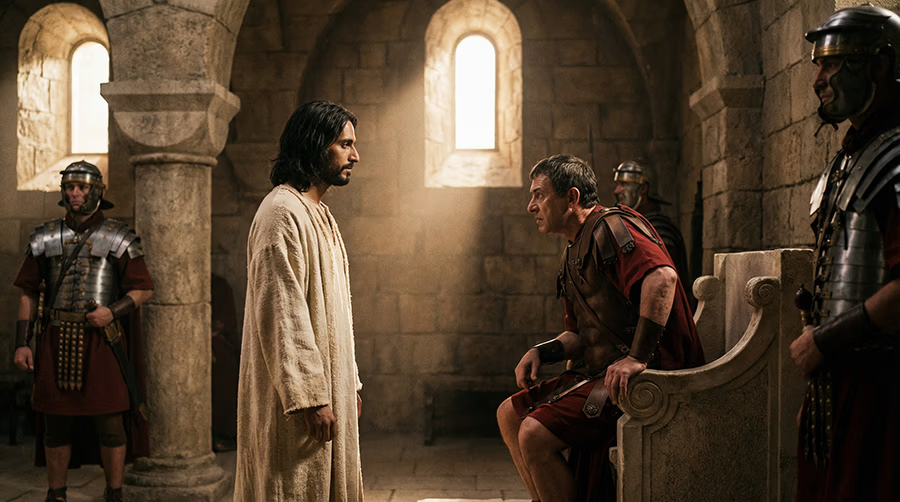
Inside the Praetorium, Pilate asked Jesus directly whether he was the king of the Jews. Jesus turned the question back on him: are you asking this yourself, or are others telling you this? Pilate bristled. He was not a Jew. He had no personal investment in Jewish messianic claims. He was trying to understand what he was dealing with. Jesus answered:
“My kingdom is not of this world. If My kingdom were of this world, My servants would fight, so that I should not be delivered to the Jews; but now My kingdom is not from here.” John 18:36 (NKJV)
Pilate pressed: so you are a king? Jesus confirmed it, and explained what kind:
“You say rightly that I am a king. For this cause I was born, and for this cause I have come into the world, that I should bear witness to the truth. Everyone who is of the truth hears My voice.” John 18:37 (NKJV)
Pilate walked back out and told the crowds he found no fault in the man. He then attempted a political escape through the Passover custom of releasing one prisoner. He offered them Jesus, calling him the king of the Jews. The crowd, manipulated and inflamed by the chief priests, demanded Barabbas instead, a known revolutionary and robber. This is worth pausing on: the temple authorities, who had positioned their opposition to Jesus as a matter of protecting Rome’s interests, were now loudly demanding the release of an actual insurrectionist. The same spirit of corrupt institutional power documented in our G-Drop commentary series operates identically across every generation: the stated reason is always justice, and the actual reason is always self-preservation.
The Scourging and the Crown of Thorns
Pilate ordered Jesus scourged, hoping the brutality of the punishment would satisfy the crowd without requiring an execution. The scourging was not mercy. It was a calculated gamble using a man’s suffering as a bargaining chip.
Roman scourging meant being stripped, bound to a pillar, and flogged with a flagrum, a whip fitted with pieces of bone and metal at the ends. It shredded skin and muscle. Many men did not survive it. After the scourging, the soldiers twisted a crown of thorns and pressed it into his skull, draped a purple robe over his ruined body, and mocked him: “Hail, King of the Jews!” They struck him repeatedly.
The purple robe was reserved for high priests. The mockery was layered: they were dressing him in the garments of the very office whose occupants had just handed him over for death. They had no idea how precisely accurate the costume was.
Pilate brought Jesus back out before the crowd, bloodied and barely standing, and said: “Behold the man.” When the chief priests and officers saw him, they did not flinch. They cried louder: “Crucify Him! Crucify Him!” Pilate pushed back again. He could find no fault. The temple leaders finally dropped the lawfare framing and stated the actual charge:
“We have a law, and according to our law He ought to die, because He made Himself the Son of God.” John 19:7 (NKJV)
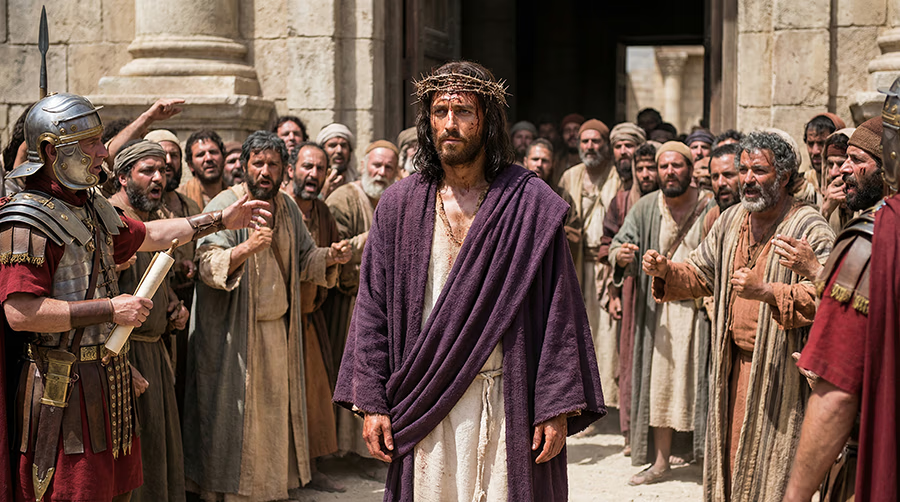
That answer frightened Pilate more than anything that had come before it. He went back inside and asked Jesus directly: where are you from? Jesus gave him no answer. Pilate, exasperated, reminded him that he had the power to crucify or release him. Jesus replied with a statement that cut through all of Pilate’s political calculations:
“You could have no power at all against Me unless it had been given you from above. Therefore the one who delivered Me to you has the greater sin.” John 19:11 (NKJV)
The Final Threat That Broke Pilate
From that point Pilate was actively trying to release Jesus. He had already declared him innocent multiple times, survived the crowd’s anger, and absorbed the accusation that he was betraying Caesar. Then the temple leadership delivered the threat that ended his resistance: “If you let this Man go, you are not Caesar’s friend. Whoever makes himself a king speaks against Caesar.”
That was the political trap Pilate could not escape. He had more fear of a delegation going to Caesar to report that he had released a self-proclaimed king than he had reverence for the truth standing in front of him. He sat down on the judgment seat at a place called the Pavement, and he handed Jesus over. The chief priest sealed their own doom with the words they chose in that moment:
“We have no king but Caesar!” John 19:15 (NKJV)
The full rejection of God. The chief priests of the temple, keepers of the covenant, descendants of Abraham, stewards of every messianic prophecy, stood in front of the Messiah and declared Caesar their king. In 70 AD, Caesar’s armies surrounded Jerusalem and destroyed it completely. The historian Josephus records that the Romans crucified thirty thousand Jewish men on the ruined walls of the city. The temple deep state chose Caesar. Caesar delivered exactly what he always delivered.
Golgotha: The Place of the Skull
Jesus was led out bearing his own cross to a hill outside the city walls called Golgotha, meaning the place of the skull. The hill was visible from a major road into Jerusalem, and at Passover that road was flooded with pilgrims from across the ancient world. Millions of people would pass by within sight of this crucifixion. The same crowds that had cried Hosanna four days earlier would now see the sign above his head.
Pilate had written the inscription himself and posted it in three languages: Hebrew, Greek, and Latin. Jesus of Nazareth, the King of the Jews. The chief priests demanded he change it to read that Jesus had merely claimed to be king. Pilate refused with four words that echo across centuries:
“What I have written, I have written.” John 19:22 (NKJV)
He could not save Jesus. But he could make sure every literate person on that road knew exactly who Rome had crucified and under what title. Whether he knew the significance of what he was doing is irrelevant. God was using his pettiness and his anger at the temple leadership to ensure that the declaration was posted in every major language of the ancient world.
Two others were crucified alongside Jesus, one on either side, with Jesus in the center. This fulfilled the Isaiah 53 prophecy that the Servant of the Lord would be numbered among transgressors. Every detail of the crucifixion of Jesus had been written centuries before it happened, from the casting of lots for his garments described in Psalm 22 to the specific manner of his death.
The Women and the Disciple He Loved
Four people stayed close to the cross: Mary, the mother of Jesus; her sister Salome, who was also the mother of James and John; Mary the wife of Clopas; and Mary Magdalene. And John, the author of this Gospel, who refers to himself as the disciple Jesus loved.
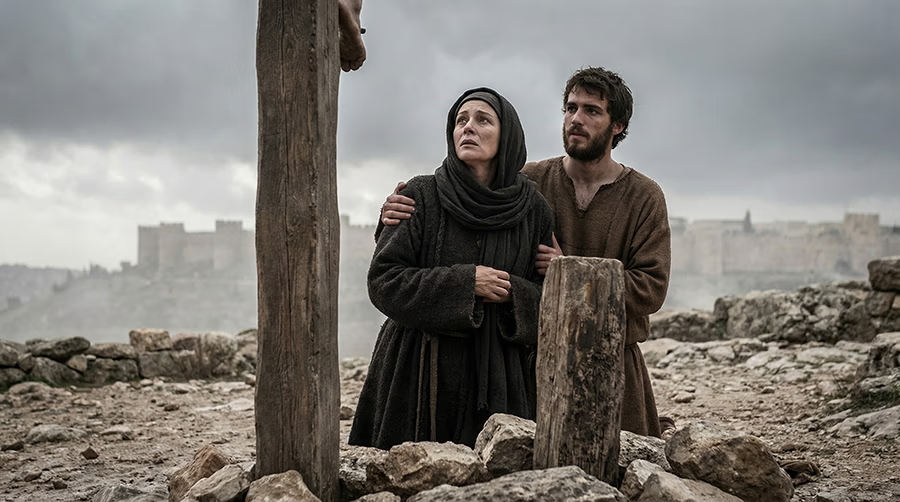
When Jesus looked down and saw his mother standing with John, he entrusted her to the disciple’s care:
“Woman, behold your son.” Then He said to the disciple, “Behold your mother.” And from that hour that disciple took her to his own home. John 19:26–27 (NKJV)
There is pastoral tenderness here in the middle of unimaginable agony. Jesus made arrangements for his mother before he died. He knew what was coming for everyone close to him after the resurrection. Lazarus had a death sentence over him. The apostles would be hunted. His mother would not be safe in Jerusalem. John would eventually take Mary out of the city entirely. Even at Golgotha, Jesus was thinking about the people he loved.
“It Is Finished”: The Words That Changed Everything
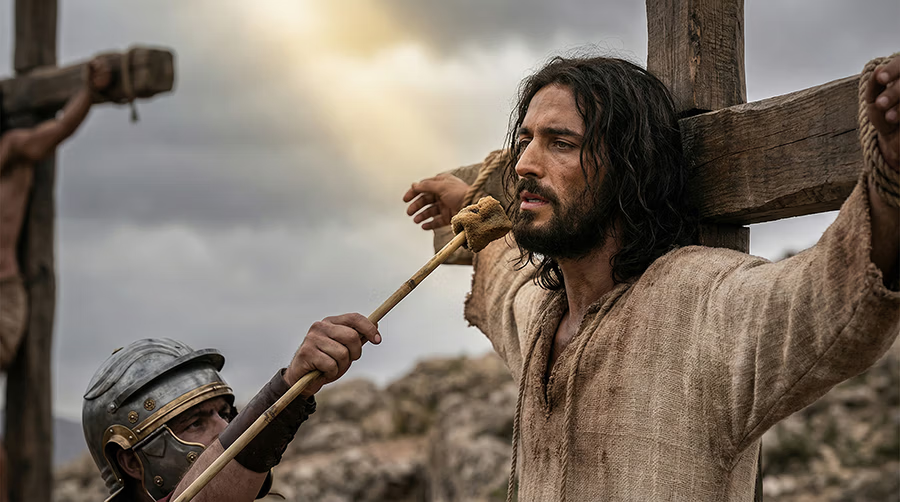
“It is finished” is the climax of the crucifixion of Jesus and the answer to every question the Passion raises. After Jesus declared “I thirst” and received sour wine on a sponge lifted on a hyssop branch, he spoke three words in Greek: Tetelestai. It is finished. It is completed. It is accomplished.
“So when Jesus had received the sour wine, He said, ‘It is finished!’ And bowing His head, He gave up His spirit.” John 19:30 (NKJV)
This was not a cry of defeat. Tetelestai was a term used in the ancient world to stamp a paid debt, to mark an account as settled in full. What was finished? The full payment of the sin debt of every human being who would ever receive the free gift of salvation. The moment Jesus spoke those words, Satan lost. Not lost ground. Lost. The ruler of this world was cast out, just as Jesus had predicted in John 12. Death had been defeated in principle, and the resurrection three days later would make it visible to human eyes.
The mission that drives this ministry is grounded in the conviction that a Constitutional Republic requires a believing populace. That belief is only possible when people understand what was accomplished at Golgotha. Freedom, properly understood, is not a political achievement. It flows from the finished work of Jesus Christ on that cross. Every political and cultural battle we engage in through our Bible Messages series is downstream of that truth.
Psalm 22: Written a Thousand Years Before Golgotha
David wrote Psalm 22 approximately a thousand years before the crucifixion of Jesus. He had never seen a Roman crucifixion. The practice did not exist in his time. And yet:
“They pierced My hands and My feet; I can count all My bones. They look and stare at Me. They divide My garments among them, and for My clothing they cast lots.” Psalm 22:16–18 (NKJV)
Every detail was there. The physical description of crucifixion. The soldiers dividing garments. The crowd staring and mocking. The opening line of the psalm, “My God, My God, why have You forsaken Me?”, was the cry Jesus spoke from the cross in Matthew 27, quoting his ancestor David’s prophecy about himself.
Psalm 22 does not end in despair. It ends in triumph:
“All the ends of the world shall remember and turn to the Lord, and all the families of the nations shall worship before You. For the kingdom is the Lord’s, and He rules over the nations.” Psalm 22:27–28 (NKJV)
A thousand years before the cross, God told David the end of the story. The kingdom belongs to the Lord. The nations will worship. What looked like the worst defeat in history was always the greatest victory. The same God who inspired Psalm 22 is the same God who spoke through Zechariah about the donkey, through Isaiah about the suffering servant, and through every prophet who pointed toward the Messiah. They all converged at Golgotha on a Friday afternoon. The Five Smooth Stones framework we use in discipleship is anchored in this kind of prophetic coherence: Scripture interprets Scripture, and all of it points to Christ.
Practical Application
The crucifixion of Jesus is not a past event to be observed at a distance. It is a present reality that calls for a response.
- Sit with “It is finished.” Not as a fact to be acknowledged and moved past, but as a statement about your own account before God. The debt is paid. What are you still trying to add to it?
- Notice the cost of silence. Pilate knew the truth and chose political safety over it seven times. The 4-3 Formula at the heart of this ministry is built on the opposite conviction: that obedience to truth, at personal cost, is exactly what God calls his people to. Ask yourself where in your life you are making the same trade Pilate made.
- Read Psalm 22 this week in full. Read it knowing David wrote it a thousand years before the events it describes. Then consider what it means that the same God who orchestrated all of that is the God who knows your name.
- Let the women at the cross challenge you. They stayed. The disciples scattered. Faithfulness in the darkest moments looks like showing up, staying close, and not running.
Conclusion
From the Praetorium to Golgotha, Part 3 of our Easter series has traced the full arc of the crucifixion of Jesus: the lawfare of the temple deep state, the political cowardice of Pilate, the mocking of soldiers who did not know they were crowning the King of the universe, and the moment when the debt of every human sin was stamped paid in full with three words spoken from a Roman cross.
It is finished. The cross was not an accident. It was not a tragedy that God had to recover from. It was the plan, written into the prophets a thousand years before it happened, executed on the exact timetable God had set, for the exact purpose God had declared: to draw all people to himself through the lifted-up Son of Man.
Part 4 will bring us to the empty tomb. Everything that has been building since Part 1, since Lazarus came out of his cave, since Mary poured spikenard on the feet of a man she knew was going to die, since the soldiers fell in Gethsemane at two words, all of it points to what happens on Sunday morning. Do not miss it.
For additional study on the Gospel of John and the full biblical story of redemption, explore our full Bible Messages library and our resources for Christian growth and Scripture study.
Frequently Asked Questions (FAQs)
Why did Pilate try seven times to release Jesus if he ultimately condemned him?
Pilate was engaged in pure political risk management, not moral discernment. He recognized that Jesus was innocent and that executing him carried real danger. But when the temple leadership threatened to report him to Caesar as an enabler of a would-be king, the political cost outweighed everything else. His repeated attempts to release Jesus were not acts of conscience. They were attempts to avoid personal accountability for a decision he ultimately made anyway.
What does “It is finished” actually mean?
The Greek word tetelestai was used in the ancient world to mark a debt as paid in full. When Jesus said “It is finished,” he was declaring that the full payment for human sin had been completed. Nothing needed to be added, repeated, or supplemented. The account was settled. This is the theological foundation of salvation by grace through faith, explored further in our resources for Christian growth.
Why did the chief priests say “We have no king but Caesar”?
It was the ultimate act of institutional self-preservation. To secure the death of Jesus, the chief priests needed to frame him as a threat to Roman authority. Declaring Caesar their king was the price they paid to get Pilate to act. It was also, whether they understood it or not, a formal renunciation of God’s covenant kingship over Israel, a statement with catastrophic consequences that were fulfilled in 70 AD.
How does Psalm 22 connect to the crucifixion of Jesus?
David wrote Psalm 22 approximately one thousand years before the crucifixion, describing in precise detail physical experiences that match crucifixion: pierced hands and feet, bones out of joint, extreme thirst, onlookers dividing garments by lot. The Psalm opens with the exact words Jesus cried from the cross in Matthew 27:46. It is one of the clearest prophetic previews of the Passion in all of Scripture and one of the most powerful arguments for the divine authorship of the Bible.
Further Reading
- John 19 Verse-by-Verse Commentary at Blue Letter Bible
- John 18-19 Commentary at Enduring Word
- The Meaning of It Is Finished at Desiring God
- Psalm 22 and the Passion of Christ at Bible Hub


