
February 28, 2026
The parable of the Good Samaritan in Luke 10 is one of the most recognized stories in all of Scripture — but most people only know the surface lesson. Jesus did not simply tell a story about being kind to strangers. He told a story about the fall of man, the failure of the law, the identity of a Savior, and the only path to salvation. This article unpacks every layer.
Table of Contents
The Scene Before the Parable: Seventy Disciples and a Falling Satan
Before telling the parable of the Good Samaritan, Jesus sent out seventy disciples empowered by the Holy Spirit to heal, cast out demons, and preach. When they returned rejoicing, He warned them not to let their spiritual power become a source of pride — pointing to Satan’s own fall as a cautionary example.
Most Bible readers jump straight to the story of the traveler on the Jericho road. But Jesus told this parable within a very specific context, and that context changes everything. In Luke 10, Jesus had just sent out seventy disciples — not the original twelve, but a larger second wave of workers. He gave them the same spiritual authority He carried: the power to heal the sick, raise the dead, read hearts, and cast out demons. He sent them out two by two into every town He was about to visit.
When those seventy returned, they were overjoyed. “Lord, even the demons are subject to us in Your name!” they reported. It was an electrifying moment. These were ordinary men and women who had gone out not entirely sure anything would happen — and everything happened. Who would not be ecstatic?
Jesus’ response, though, was immediate and sobering:
“I was watching Satan fall from heaven like a flash of lightning.” — Luke 10:18 (AMP)
He was saying two things at once. First, He was affirming His own divine identity: only the Son of God could have witnessed Lucifer’s original expulsion from heaven. Second, He was issuing a sharp warning to His disciples. Satan had been the most glorious of all angels. His gifts went to his head. His ego displaced his worship. That pride cost him everything — and Jesus did not want to see the same thing happen to His seventy.
He continued:
“Nevertheless, do not rejoice at this, that the spirits are subject to you, but rejoice that your names are recorded in heaven.” — Luke 10:20 (AMP)
This is the kind of corrective wisdom you will find woven throughout the Five Smooth Stones teaching series — the call to keep spiritual perspective firmly rooted in eternal realities rather than temporary victories. The disciples had been given extraordinary power, but their true treasure was not the power. It was the promise. Their names were written in the Book of Life, and that was what mattered most.
Jesus’ Happiest Moment in His Earthly Ministry
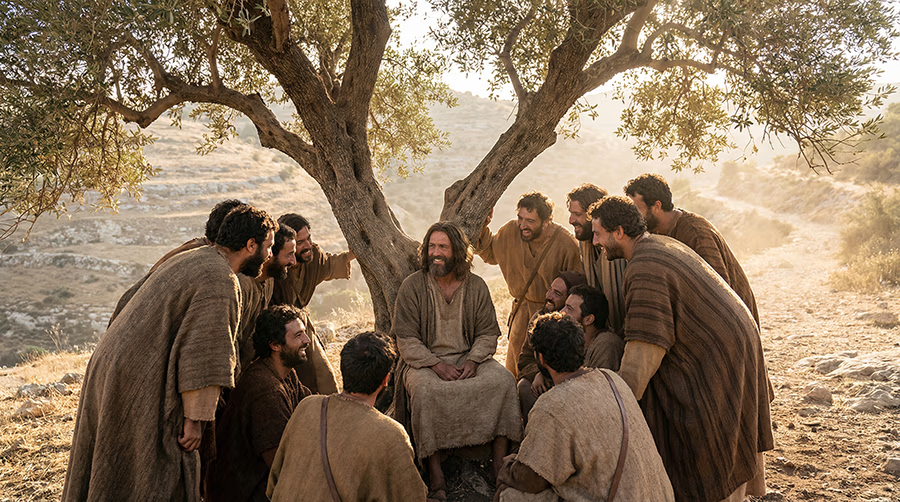
Luke 10:21 records the only moment in the Gospels where Jesus is described as “overjoyed” and rejoicing through the Holy Spirit. He praised the Father for revealing salvation not to the intellectual elite, but to the humble and childlike — a confirmation that the Gospel would spread.
What happens next is one of the most remarkable verses in the entire New Testament:
“In that very hour He was overjoyed and rejoiced greatly through the Holy Spirit, and He said, ‘I praise You, O Father, Lord of heaven and earth, that You have hidden these things relating to salvation from the wise and intelligent, and have revealed them to infants, the childlike and untaught.'” — Luke 10:21 (AMP)
This is the only place in Scripture where Jesus is described as being overjoyed and rejoicing greatly through the Holy Spirit. Think about what that means. Jesus — who knew the cross was coming, who knew Judas would betray Him, who carried the weight of every sin that had ever been committed — stopped in that moment and praised the Father with unmistakable joy.
Why? Because the seventy who came back dancing had not been trained theologians or Sanhedrin scholars. They were ordinary people. And yet the Gospel worked through them. The good news was going to spread. Satan’s defeat was now visible in real time, and the intimacy between Father and Son remained unbroken:
“No one knows who the Son is except the Father, or who the Father is except the Son and anyone to whom the Son wishes to reveal Him.” — Luke 10:22 (AMP)
He then turned privately to His disciples and said, “Blessed are the eyes which see what you see. For I say to you, many prophets and kings desired to see what you see and did not see it.” Generations of faithful men and women had longed for this day — the day Emmanuel walked among His people. The disciples had been born for such a time as this.
And so, Chuck Frank reminds us, have we. We may be living through days that feel difficult and disorienting. But we are watching biblical prophecy unfold in real time. This is not the worst of times dressed up as the best. It is, in fact, the best dressed up as the worst. The Today’s Concerns commentaries on this site exist precisely to help believers hold that perspective when the news cycle makes it nearly impossible.
The Lawyer Who Accidentally Gave Us One of History’s Greatest Parables
A Jewish legal expert tried to trap Jesus with a theological question about eternal life. Jesus answered his question with a question, exposed his hidden motive — racial bias against Samaritans and Gentiles — and responded with a parable that would redefine neighbor, law, grace, and salvation.
Every parable has a trigger. The parable of the Good Samaritan exists because a particular man decided to pick a public fight.
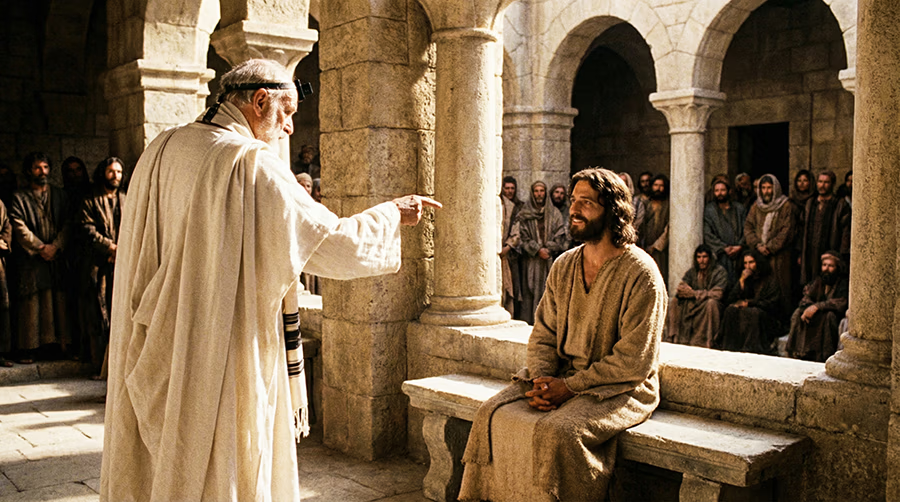
“And a certain lawyer stood up to test Jesus, saying, ‘Teacher, what must I do to inherit eternal life?'” — Luke 10:25 (AMP)
Notice the opening insult. This man was an expert in Mosaic law, a member of the Sanhedrin. He called Jesus “Teacher” — not Messiah, not Lord, not Rabbi in any reverential sense. He refused to acknowledge the claim Jesus had been making publicly about His divine identity. And his question was not sincere curiosity. It was a trap, the kind of gotcha question our modern media uses to destabilize anyone they view as a political or cultural threat.
But Jesus could see his heart. He answered a question with a question: “What is written in the law? How do you read it?” The lawyer answered perfectly:
“You shall love the Lord your God with all your heart and with all your soul and with all your strength and with all your mind, and your neighbor as yourself.” — Luke 10:27 (AMP)
Jesus affirmed him: “You have answered correctly. Do this habitually, constantly, and you will live.” But here was the lawyer’s real problem. The first part — loving God with his whole heart, soul, strength, and mind — he believed he had covered. The second part — loving his neighbor as himself — was where his theology got complicated.
The Sanhedrin did not consider Gentiles to be neighbors. And Samaritans — Jews who had intermarried with Gentiles during the Assyrian captivity — were considered worse than Gentiles. They were despised, considered racially and spiritually defiled. So when the lawyer asked, “And who is my neighbor?” he was essentially asking: “Can I hold all my existing prejudices and still get into heaven?” He was not looking for truth. He was looking for a loophole.
Jesus did not give him one. Instead, He told a parable.
You can explore how this same tension between the letter of the law and the spirit of God’s grace plays out in The Parables of the Wedding Feast and the Wicked Husbandmen, where religious insiders again find themselves on the wrong side of God’s invitation.
A Man Going Down from Jerusalem to Jericho: The Fall of Man Encoded in Geography
In the parable of the Good Samaritan, the journey “down from Jerusalem to Jericho” is not casual geography. It is a symbolic picture of the fall of man — a literal 17-mile descent from the holy city into the world below, representing Adam’s fall and humanity’s broken spiritual condition.
“A man was going down from Jerusalem to Jericho, and he encountered robbers who stripped him of his clothing and belongings, beat him, and went their way leaving him half dead.” — Luke 10:30 (AMP)
When Jesus opened with “A man,” He was deliberately vague. No name. No race. No tribe. Just a man. That man is Adam. He is also every one of us. Adam bore responsibility for the original fall in the Garden of Eden, and every human being born since has entered life carrying the weight of that fall.
The geography is not accidental. Jerusalem sits approximately 2,500 feet above sea level. Jericho, located near the Jordan River valley, sits at roughly 850 feet below sea level. The road between them descends nearly 3,400 feet over about seventeen miles through rocky, arid, limestone wilderness. When Jesus said the man was going down from Jerusalem to Jericho, He was painting a picture that every Jewish listener in that crowd would have immediately felt: this is the descent of fallen humanity away from the holy city of God and into the broken world below.
The robbers who attacked him? They represent Satan and his demonic forces. They strip the man of what little good he had, beat him senseless, show not an ounce of compassion, and leave him half dead in the dirt. That phrase “half dead” is loaded with meaning. Jesus was saying: this is the condition of every human being walking this earth. Because of sin, we start the race already wounded. We are not people who could simply choose better and arrive at salvation on our own effort. We are half dead before we take our first steps.
For a deeper study of how Jesus uses narrative layers to communicate eternal truths about the Kingdom of God, the Parables of the Pearl of Great Price and Dragnet offer a powerful companion teaching on the surpassing value of salvation.

The Priest and the Levite: What Happens When Religion Cannot Save You
In the parable of the Good Samaritan, the priest represents the Mosaic Law and the Levite represents the Prophets — the two pillars of Jewish religious authority. Jesus deliberately has both men pass the wounded traveler by, showing that neither the law nor the prophets can provide salvation, compassion, or rescue to the fallen soul.
Here is where the parable shifts from heartbreaking to theologically explosive.
“Now by coincidence a priest was going down that road, and when he saw him, he passed by on the other side. Likewise a Levite also came to the place and saw him, and passed by on the other side of the road.” — Luke 10:31-32 (AMP)
Two religious leaders. Two men who devoted their entire lives to the service of God and the study of His Word. Both walked by. Both crossed to the other side of the road. Both left a dying man in the dirt without a second glance.
Why does Jesus choose a priest and a Levite specifically? This is not a random narrative choice. It is a precise theological statement.
- A priest was an expert in the Mosaic Law — the Torah, the commandments, the sacrificial system.
- A Levite was trained extensively in the writings of the Prophets — the second pillar of Jewish religious teaching.
Together, the priest and the Levite represented the entire religious system of Israel. Every member of the Sanhedrin believed that the path to heaven ran directly through the Law and the Prophets. Study them. Follow them. Observe their commands. That was the formula for salvation in the dominant Jewish religious thinking of the day.
Jesus was saying: Wrong. And here is your proof. When a man is dying in the road, the Law cannot save him. The Prophets cannot save him. Religion, by itself, has no compassion. It has no power to restore what sin has broken. It can only walk past, cross to the other side, and leave you exactly where you fell.
This is the same verdict Paul would later articulate in his letter to the Galatians: the law was a tutor to lead us to Christ, not a ladder to climb to heaven. The comprehensive Bible Messages series explores this exact tension between law and grace across multiple books of Scripture, and it is worth returning to as you study this parable in depth.
The Good Samaritan Is Jesus Christ
In the deeper meaning of the parable of the Good Samaritan, the Samaritan represents Jesus Christ Himself. He is the outsider, despised by the religious establishment, who comes to the wounded traveler with compassion, pays the full debt, and promises to return. Every detail of His care points to the work of redemption.
Now the parable reaches its heart:
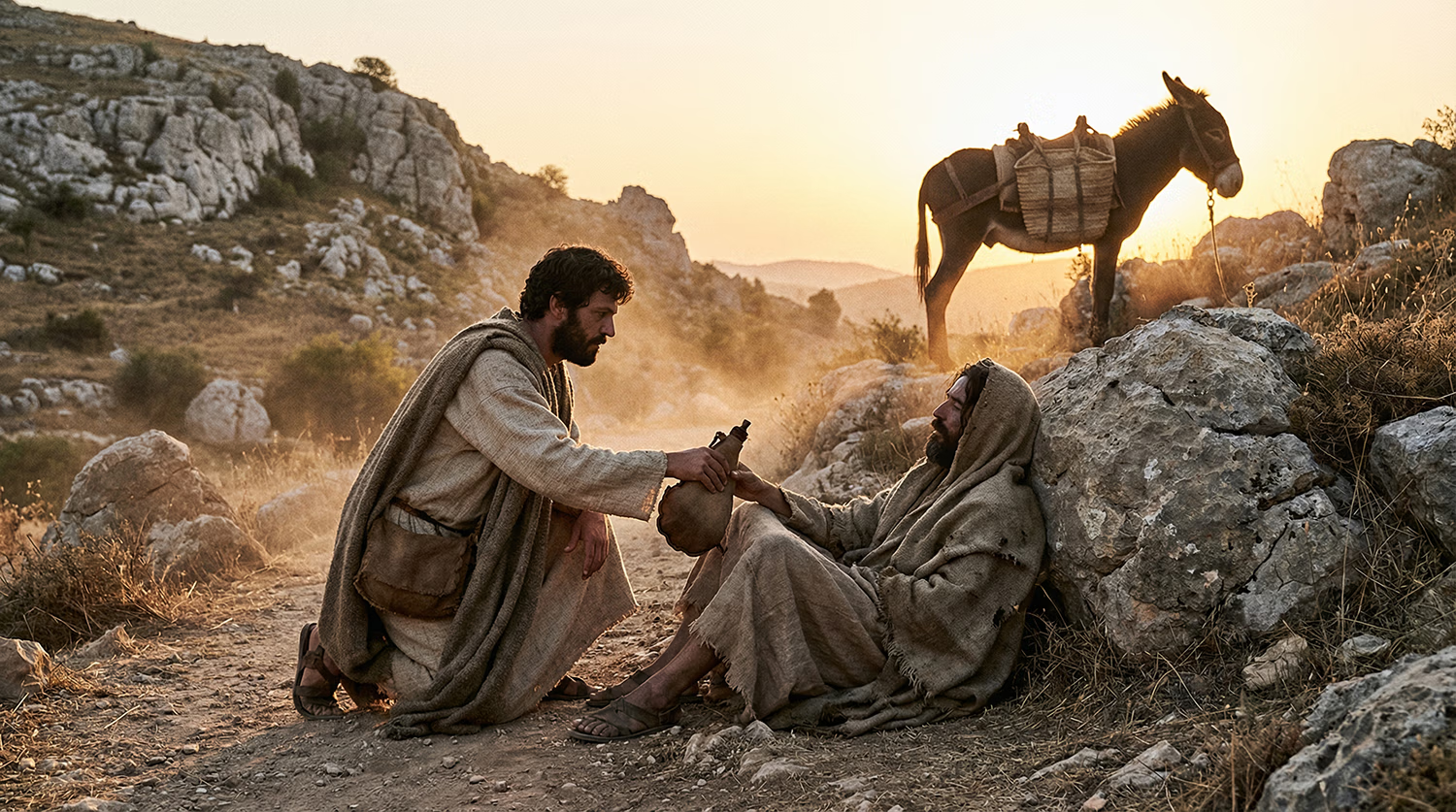
“But a Samaritan who was traveling came up to him, and when he saw him, he was deeply moved with compassion for him and went to him and bandaged up his wounds, pouring oil and wine on them to soothe and disinfect. And he put him on his own pack animal and brought him to an inn and took care of him.” — Luke 10:33-34 (AMP)
The Samaritan was on the lowest rung of the social ladder in first-century Judea. He was considered racially impure, spiritually unclean, and culturally beneath contempt by the religious establishment. In the eyes of the Sanhedrin, he had no business touching a Jewish man, let alone rescuing him.
And yet here is the Samaritan. Not the priest. Not the Levite. The one who was despised.
The Samaritan is Jesus Christ.
Think about it carefully. Jesus was rejected by the religious authorities of His day. The Pharisees and scribes considered Him a threat, a blasphemer, an outsider who disrupted their tidy religious order. Like the Samaritan, He came from outside the accepted religious establishment. And when He found us — beaten, stripped, half dead in our sins — He was deeply moved with compassion. Not obligation. Not duty. Compassion.
He bandaged our wounds. He poured oil and wine — symbols of the Holy Spirit and the cleansing power of His blood. He placed us on His own animal, bearing the cost Himself. And then:
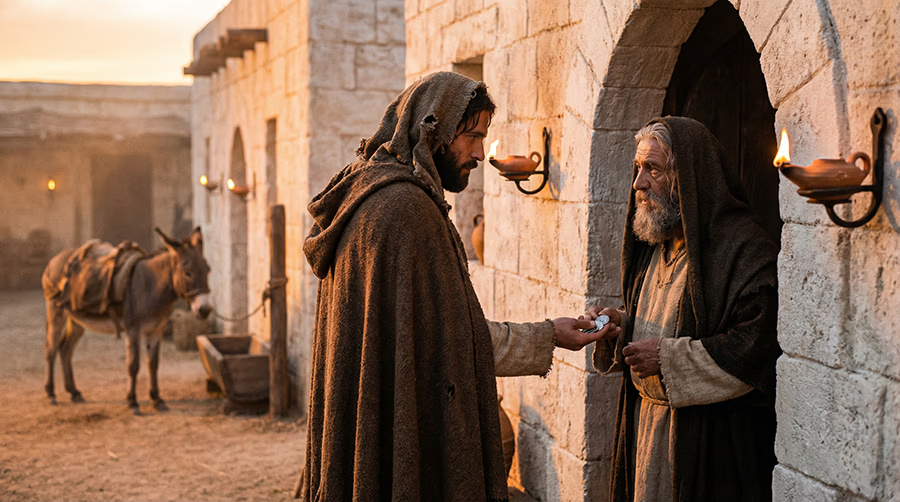
“On the next day he took out two denarii and gave them to the innkeeper and said, ‘Take care of him, and whatever more you spend, I will repay you when I return.'” — Luke 10:35 (AMP)
The debt is paid in full. The two denarii represent the full payment for our sin that Jesus made at the cross. He did not negotiate. He did not set conditions. He said: whatever it costs, I will cover it. This is the Gospel in four sentences.
This is the teaching that makes the popular cultural reading of this parable so inadequate. To reduce the Good Samaritan to a lesson in civic kindness is to miss the entire point. It is like reading the Parable of the Talents and concluding it is simply a story about financial investment. Jesus was always doing something much deeper than the surface reading allows.

The Inn, the Innkeeper, and the Promise of His Return
In the parable of the Good Samaritan, the inn represents the Church and the innkeeper represents the pastor. Jesus paid the debt and entrusted the wounded man’s ongoing care to the innkeeper until He returned — a picture of Christ commissioning the Church to care for souls until His Second Coming.
The Samaritan did not simply pay and disappear. He entrusted the wounded man to the innkeeper and gave specific instructions: “Take care of him. Whatever more you spend, I will repay you when I return.”
Every word matters here.
- The inn represents the Church — the place of shelter, restoration, and ongoing care for the soul.
- The innkeeper represents the pastor — entrusted with the care of those who come broken through the doors.
- “I will repay you when I return” is a direct reference to the Second Coming of Christ.
There will be an accounting. The Samaritan is coming back. And when He does, He will settle every account. He will pay every debt that remains. He will also, Chuck Frank notes with pastoral seriousness, hold every innkeeper accountable for how they cared for those entrusted to them.
How many people walk into a church desperate for the kind of compassion the Good Samaritan showed, only to find a busy program schedule, an overwhelmed pastor, and no one who has time to stop? That is not going to be an acceptable answer at the final accounting. The Church has been given a sacred commission: tend to the wounded while the Samaritan is away.
If you are looking for that kind of genuine, faith-centered community, the Trust and Obey Community exists precisely for believers who want to grow together in obedience, share prayer requests, and encourage one another in the faith while we wait for His return.
What This Parable Demands of Us Today
The parable of the Good Samaritan calls believers to reject the false gospel of self-improvement and good deeds as a path to heaven, embrace Christ as the only true Savior, and reflect His compassion practically — caring for those in need while trusting only His grace for salvation.
At the end of the parable, Jesus closed the loop on the lawyer’s original question:
“Which of these three do you think proved himself a neighbor to the man who encountered the robbers? He answered, ‘The one who showed compassion and mercy to him.’ Then Jesus said to him, ‘Go and constantly do the same.'” — Luke 10:36-37 (AMP)
Notice what the lawyer could not bring himself to say. He would not say “the Samaritan.” Even at the end, the word stuck in his throat. He said only, “The one who showed compassion.” Old prejudices die hard, even in the presence of truth.
But Jesus gave him — and us — a clear command: “Go and constantly do the same.” This is not the command to earn salvation by being a good person. The entire parable has already demolished that idea. The priest and the Levite were “good people” by the standards of their society, and they passed the dying man by. Religion without the heart of Christ produces exactly that.
The command is something different. It is the call to let the compassion of the Samaritan flow through us because we have been rescued by Him. We love because He first loved us. We show mercy because we have received mercy. We care for the wounded because we know what it is to be left half dead in the road and found by Someone who paid our debt in full.
Chuck Frank closes this teaching with a prayer from Charles Carroll, the only Catholic signer of the Declaration of Independence and its last surviving signatory. On his deathbed at the age of 89, Carroll prayed:
“On the mercy of my Redeemer I rely for salvation, and on His merits, not the works I have done in obedience to His precepts.”
That is the verdict of a man who had spent fifty years reflecting on what it means to be rescued. Not works. Not law. Not good deeds. The merits of the Redeemer alone. The man beaten on the road to Jericho did not save himself. He was saved by the one who stopped.
The mission of Trust and Obey with Chuck Frank has always been grounded in this truth: that a Constitutional Republic can only survive and thrive with a believing populace, and a believing populace begins with men and women who have been genuinely rescued — not just religiously educated.

Conclusion: The Road to Jericho and the Road We Walk Today
We are all the man on the road. We entered this life already half dead, marked by the fall, stripped by the enemy of our sins, left in the dirt of our own inability. The law looked at us and kept walking. Religion crossed to the other side. And then the One nobody expected — the Samaritan, the outsider, the one the religious establishment had already written off — came and knelt in the dirt beside us.
He paid what we could not pay. He carried us when we could not walk. He entrusted us to a community of care until He returns to settle every account.
The parable of the Good Samaritan is not an inspiring story about civic kindness. It is the story of your rescue. It is the story of the Gospel. And the question Jesus leaves ringing in the air is not “Who is your neighbor?” but rather “Do you know who your Savior is?”
For additional study and daily wisdom resources, the Books of the Bible overview is a wonderful companion as you continue studying the teachings of Jesus, and the resources page offers practical tools to help you go deeper in your walk with Scripture every week.
Reflect on this: The Samaritan is coming back. Until then, you have been placed in an inn, cared for by those He has charged with the task. Live like someone who knows what that rescue cost. And go — constantly — and do likewise.
Frequently Asked Questions (FAQs)
What is the main point of the Parable of the Good Samaritan?
The main point of the parable of the Good Samaritan is not simply to encourage human kindness. At its deepest level, Jesus used this story to reveal that the Law and the Prophets cannot save a fallen humanity, and that He — represented by the despised Samaritan — is the only one who can pay the debt of sin and restore the broken soul.
Who does the Samaritan represent in the parable?
The Samaritan represents Jesus Christ. Like the Samaritan who was rejected and despised by the religious establishment yet showed compassionate, costly love to the wounded man, Jesus came to rescue a humanity left half dead by sin and paid the full price of our redemption at the cross.
Why did the priest and Levite pass by the wounded man?
In the deeper reading of the parable, the priest symbolizes the Mosaic Law and the Levite symbolizes the Prophets — the twin pillars of Jewish religious authority. Jesus deliberately has both men pass by to demonstrate that neither religious observance nor prophetic knowledge can rescue a fallen soul. Only Christ can do that, and that is the parable’s central claim.
What does the inn represent in the Parable of the Good Samaritan?
The inn represents the Church, and the innkeeper represents the pastor. Jesus — the Samaritan — entrusted the wounded man’s ongoing care to the innkeeper until He returns, a picture of Christ commissioning the Church to care for wounded souls until the Second Coming. The Samaritan’s promise, “I will repay you when I return,” points directly to the final accounting at the return of Christ. If you are looking for a community of believers committed to that kind of care, explore the Trust and Obey Community to connect with fellow believers walking this road together.
Further Reading
- Luke 10:25-37 — Bible Gateway (Amplified Bible) — Read the full passage in the Amplified Bible, the translation used throughout this teaching, with expanded word meanings that illuminate the depth of Jesus’ language.
- Luke 10 Commentary — Enduring Word by David Guzik — A thorough verse-by-verse evangelical commentary on Luke 10, examining the parable of the Good Samaritan, the role of the lawyer, and the deeper redemptive meaning of the Samaritan as a figure of Christ.
- Digging Deeper into Luke 10:25-37 — Concordia Publishing House — A scholarly biblical study from Concordia Publishing House exploring the Greek text, the historical enmity between Jews and Samaritans, and the theological significance of the Samaritan as a type of Jesus who rescues sinners at His own expense.
