You are seven years old.
Your father is gone, your grandfather is gone, and this week they bury your mother.
On the table in your uncle's house lies a Bible.
The First Thanksgiving / Part 1
Billy Bradford and David
The First Thanksgiving, Part 1: A Tale of Trust and Survival
Taught by Chuck Frank
We tend to picture the first Thanksgiving as a table of pilgrims and Wampanoag sharing a meal, and that picture is true as far as it goes. What was the first Thanksgiving? It was a harvest feast in the autumn of 1621, held by people who had nearly starved, and it was made possible by a trust in God that began long before anyone boarded a ship.
They were not calling it Thanksgiving. It was a harvest celebration, and they had every reason to celebrate. They started out as 102, and by that autumn only 53 were alive. About 90 Wampanoag men had traveled a good distance to be there with their chief, Massasoit. The two peoples had made a deal. The Wampanoag had been badly weakened by a plague a few years before the pilgrims arrived, and word had reached other tribes that they were vulnerable. So Massasoit offered an arrangement: his people would teach the newcomers how to survive in this land, how to fish, how to smoke fish, how to use fish to fertilize the ground and plant corn, beans, and pumpkins. In return, the pilgrims and their guns would stand with the Wampanoag, and the other tribes would think twice.
Food and Football Is Fine!
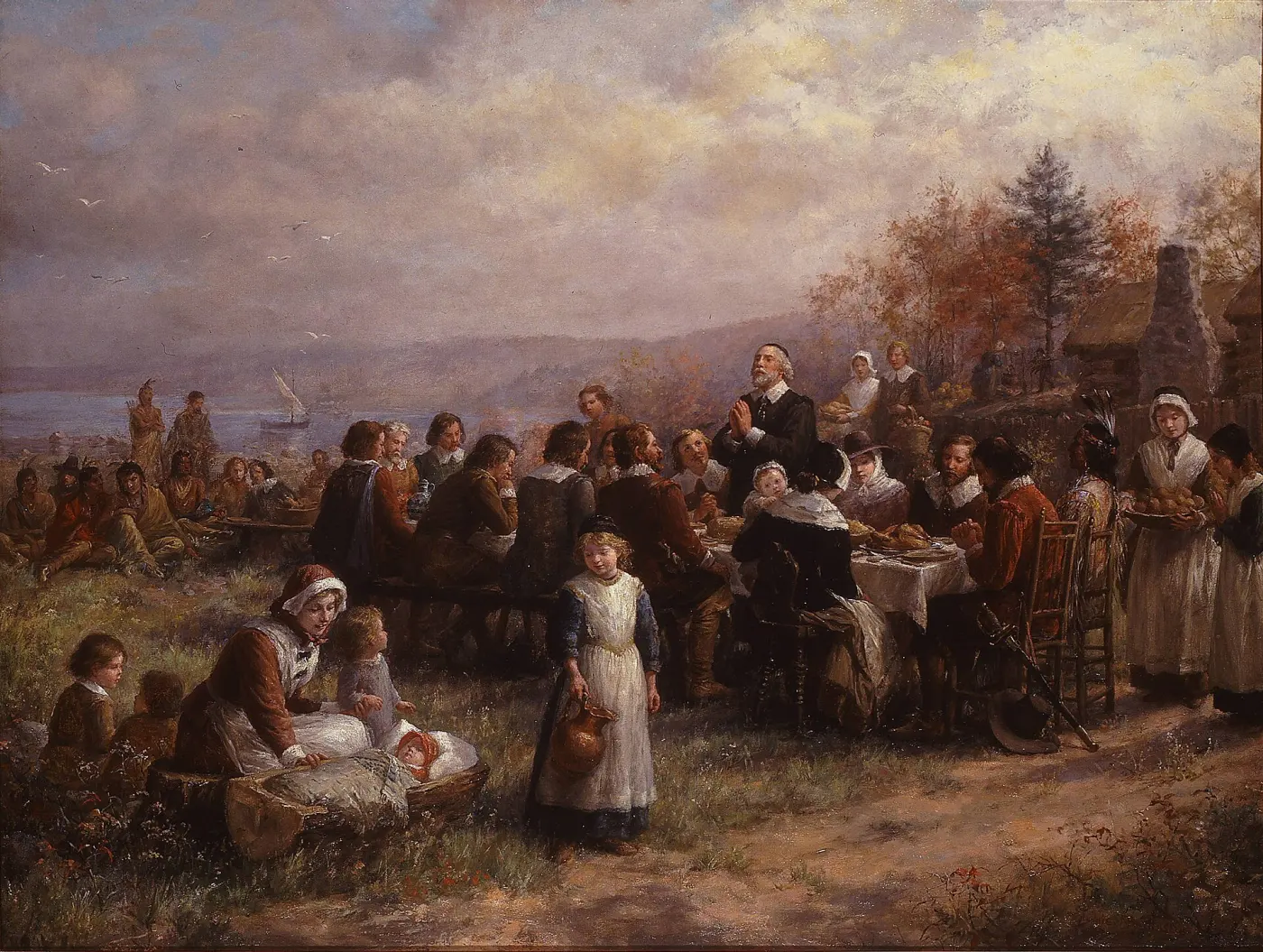
Food and football are basically what Thanksgiving has devolved into, and there is nothing wrong with food and football. Okay? There is also nothing wrong with adding a little reflection, which will definitely deepen the celebration. After all, there is a famine of truth in our land, and Thanksgiving and all of its sacrifices could use a little sprucing up.
So let us try six questions. How did we get here? Who were these people who started all of this? Why did they come? How did it begin? What did they leave behind? And what did they expect to find?
That story could be told very broadly. We are going to narrow it down to two young boys. They lived in completely different epochs, one around 1040 BC and the other 2,630 years later. Both had hard beginnings, and both rose above their circumstances for the same reason: each had a strong focus on God and a deep trust in Him. Were it not for them, we would not be here.
Billy Bradford: An Orphan with a Bible
William Bradford, whom we will call Billy, was baptized on March 19, 1590, the son of William and Alice Bradford of Austerfield in Yorkshire, England. His father died when he was one year old. His grandfather, who took the family in, died when Billy was six. His mother died when he was seven. Billy and his sister were orphans, taken in by an uncle. Life expectancy was short, and whatever medicine existed probably did more harm than good.
You can already see that life expectancy was not long in this time. Billy himself was sickly, and he spent much of his time studying the Bible. These folks were not elites, but they were not serfs either. They owned their land and worked it hard just to survive, and having a Bible in the house in 1590 was a big deal.
As a teenager he began walking to a nearby church, and there he was introduced to the idea of separatism. That idea is the engine that will drive everything that leads to the future of America. The land Billy grew up on is still there, all yupped out, unrecognizable, and for sale for something like two million bucks. The chapel where he worshiped is still standing, dark like everything back then, and God is still worshiped there.
David: The Boy Who Lived with the Sheep
Now let us look at the other young man. David, the son of Jesse, was born in Bethlehem and he started out rough as well.
Jesse was a prominent man, blessed by God with many sons, and in Israel that was a mark of great honor. David's standing was another matter. His mother, by the tradition Chuck teaches here, was Nitzevet, a secondary wife, far below the primary wife who had given Jesse his older sons. That left David's status well beneath his brothers. As a small boy he lived with the sheep, alone in the fields, brought scraps from the family table. He had no fellowship with his brothers, who were embarrassed by him. A shepherd stood on the lowest rung of the employment ladder.
But everything David heard about God, he captured and focused on, and he kept seeing evidence of God in the creation around him.
One day Jesse gave him an errand.
"Take now for your brothers an ephah of this dried grain and these ten loaves, and run to your brothers at the camp. And carry these ten cheeses to the captain of their thousand, and see how your brothers fare, and bring back news of them."
1 Samuel 17:17-18 (NKJV)
Israel was at war with the Philistines, and this was a military camp. And look at those ten cheeses. Each one has to serve a hundred men, so these are big rounds, and they are going to the captain. That is a bribe from a worried father: do not put my sons up where all the heavy fighting is. David hauled all of it to the front, and here is the welcome he received.
Now Eliab his oldest brother heard when he spoke to the men; and Eliab's anger was aroused against David, and he said, "Why did you come down here? And with whom have you left those few sheep in the wilderness? I know your pride and the insolence of your heart, for you have come down to see the battle."
1 Samuel 17:28 (NKJV)
In other words, you have one stupid job to do, and you have ruined that too. The obvious thing would be to say, "Hey, Dad sent me here. Shut up." Nope. David says, "What have I done now?" They are always yelling at him, and he is just doing what he is told.
Five Smooth Stones and the Name of the Lord
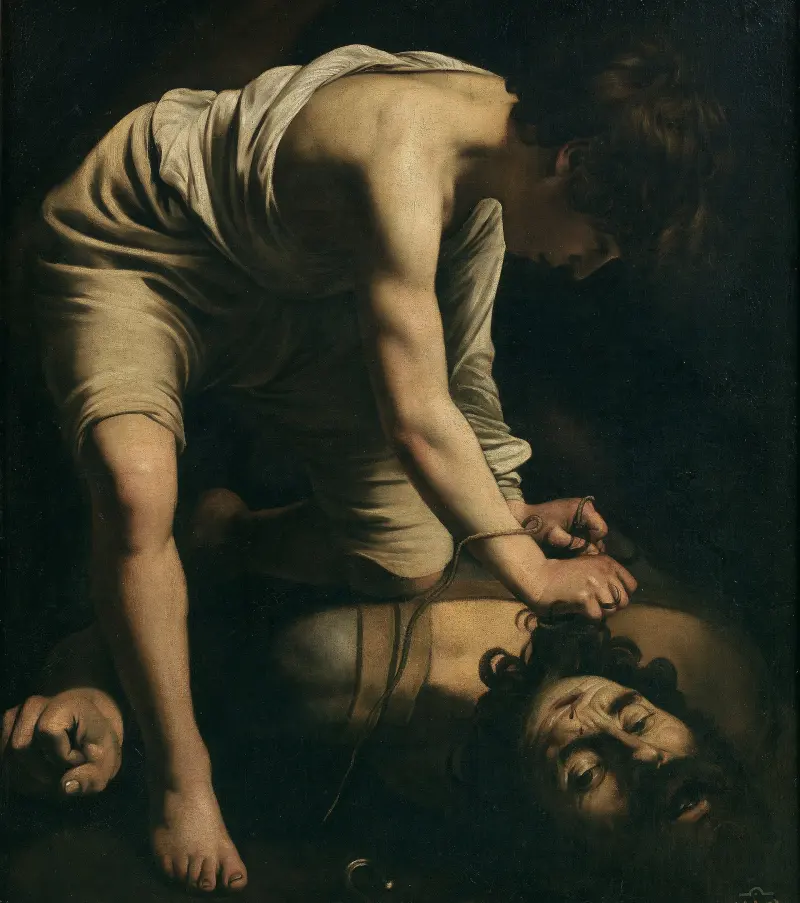
You know what happens next. Goliath came out with the kind of challenge that was common in these standoffs. Pick your best man, we will pick ours, and the loser's side surrenders. Nobody in Israel was volunteering to face a killing machine nearly ten feet tall. David, perhaps twelve or thirteen years old, wondered what was wrong with everybody, and he went to King Saul.
Your servant used to keep his father's sheep, and when a lion or a bear came and took a lamb out of the flock, I went out after it and struck it, and delivered the lamb from its mouth; and when it arose against me, I caught it by its beard, and struck and killed it. Your servant has killed both lion and bear; and this uncircumcised Philistine will be like one of them, seeing he has defied the armies of the living God. Moreover David said, "The Lord, who delivered me from the paw of the lion and from the paw of the bear, He will deliver me from the hand of this Philistine."
1 Samuel 17:34-37 (NKJV)
Saul had no other option. Go ahead, kid. Good luck. He offered his armor, and David said he could not use that stuff. He took what he knew: five smooth stones, a sling, and a shepherd's staff. The Philistine disdained him, for he was only a youth, ruddy and good-looking. And Goliath was not good-looking. David, not losing a step, answered him.
Then David said to the Philistine, "You come to me with a sword, with a spear, and with a javelin. But I come to you in the name of the Lord of hosts, the God of the armies of Israel, whom you have defied. This day the Lord will deliver you into my hand, and I will strike you and take your head from you."
1 Samuel 17:45-46 (NKJV)
And that is what happened.
What Was the Separatist Movement?
Now back to Billy. Was the separatist movement about separating giants' heads from their bodies? In a manner of speaking, yes. It took a long time and a lot of bloodshed, but here is how it started.
King Henry VIII broke with the Pope when the Pope refused to annul his marriage to Catherine of Aragon, and in 1534 he declared himself the supreme head of the Church of England. The new church kept much of the old structure, minus the Pope and the College of Cardinals, and the king's own behavior was hardly a godly example. Across Western and Central Europe, the Reformation was changing the way Christianity was practiced.
The separatists wanted something simpler. They wanted to worship as the Apostle Paul taught, the gospel of Christ and nothing added. They did not want a pope at the head of their church, and they did not want a king there either. They wanted Jesus Christ at the head of their church. Sound familiar? This is where that all kicked off. That separatism is the driver that led these people through danger, violence, and loss to find a place where they could worship. It led to us having the founders, who were all believers, and states formed with believing credentials. Our country was a place where everyone could freely worship, until the pandemic and the move on the church.
Leaving Everything Behind
Separatism was against the law in England, and so was leaving the country for religious reasons. Billy's family was concerned about his views. He booked passage to Holland anyway, and the ship's captain turned him in. He was arrested, and his imprisonment was short. Why would that be? That is the providential hand of God. He wanted Billy and these folks to go to Holland, and then He was going to move them from there.
Along with many from his chapel, Billy made it to Leiden in Holland, where they could worship freely. They had to sell what they owned and move without being caught, to a country where they knew no one. Would you like to do that at Thanksgiving? Pick up, leave everything behind, and go someplace where you do not even speak the language?
And here is another remarkable provision from God: Billy somehow received an inheritance. He used it to build a cute little house in Leiden, which has since been turned into a garage. He lived there for around ten years, married Dorothy, and they had a son named John.
Then came the pressure from another direction. Holland had embraced the Reformation, while Spain under the Catholic crown sought to crush it. They were burning people at the stake, quartering them with horses, putting them on the rack, trying to make it as agonizing and as spectacular as they could to stop Protestantism. The Dutch struggle with Spain is known as the Eighty Years' War, and thank God He nudged these people to go when He did.
The Son They Left Behind
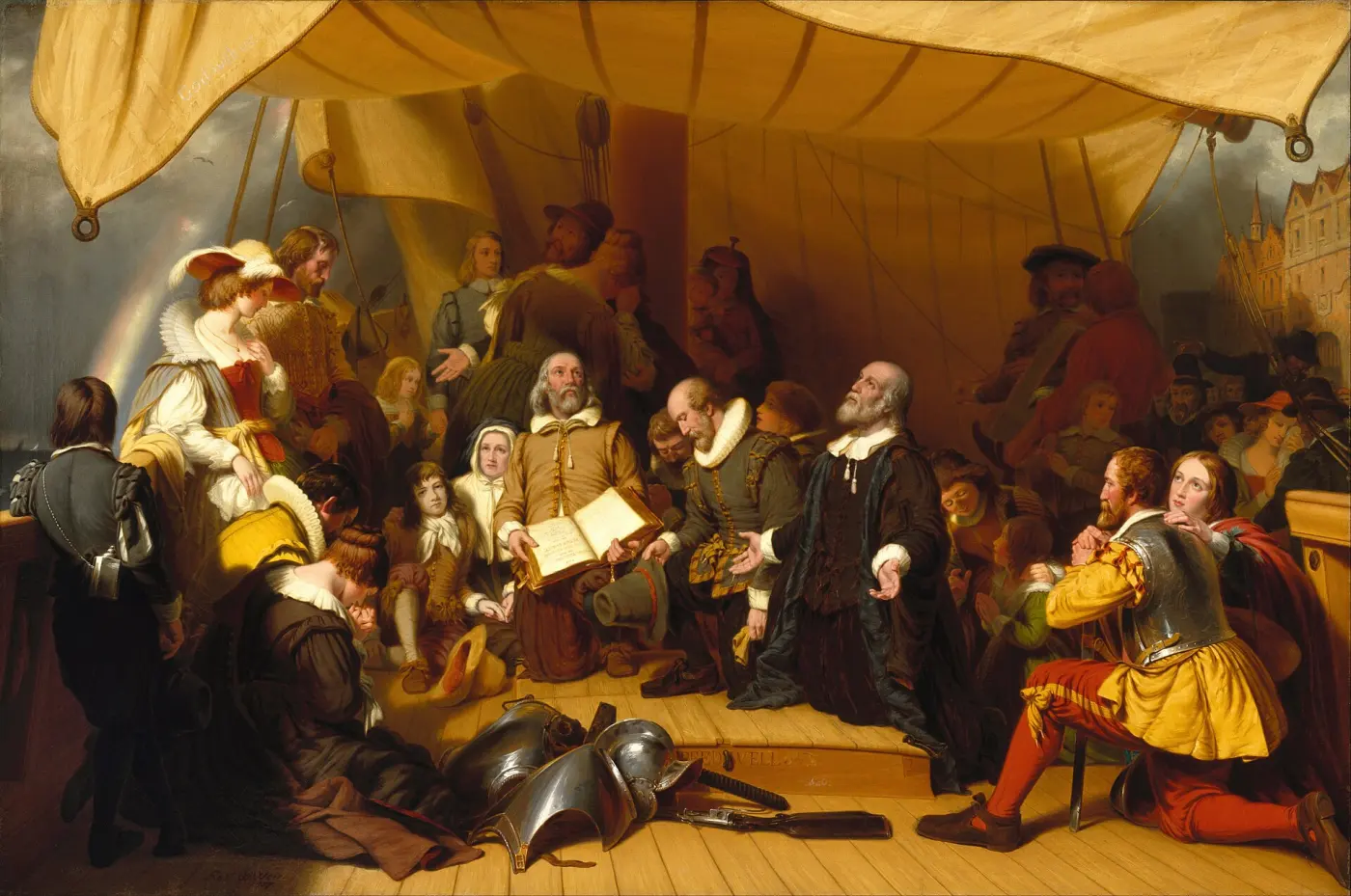
So they made one of the hardest decisions a family can make. They sold their assets and, at great risk, went back to England to find passage to America without being arrested. Billy sold his house. He and Dorothy booked passage on the voyage of the Speedwell and the Mayflower.
They left their young son John behind.
Think about that. The voyage was so dangerous that you would not bring your own child. Imagine saying goodbye to him with no idea whether you would even make it across. Thanksgiving takes on a deeper meaning when we hold that scene in our minds. Two leaky ships headed for the Atlantic, and the hardship was only beginning.
Who Am I, O Lord God?
We close with a prayer, because this is where the two boys meet. David had risen to be the greatest king in the history of Israel, and he felt bad that he lived in a beautiful house while God was still in a tent. He wanted to build God a house. God sent word through the prophet Nathan that He had never asked for one. Instead, God made David a promise: the Messiah would come from David's line, and His throne would never end.
Why does that matter to a Thanksgiving story? Because belief in Jesus Christ is the driver behind all of this action. It is why a sickly orphan risked prison and a mother and father said goodbye to their boy. It is the driver behind the founding fathers fighting for liberty and creating a Constitution, all of it anchored in Christianity. Here is how David answered.
Then King David went in and sat before the Lord; and he said: "Who am I, O Lord God? And what is my house, that You have brought me this far? And yet this was a small thing in Your sight, O Lord God; and You have also spoken of Your servant's house for a great while to come."
2 Samuel 7:18-19 (NKJV)
David never quite shook the feeling that he was not good enough. It started with a boy in the fields being sent scraps, and it was still there on the throne. How could You pick me? And yet You are God, and I have to trust Your judgment.
Therefore You are great, O Lord God. For there is none like You, nor is there any God besides You, according to all that we have heard with our ears. ... For You have made Your people Israel Your very own people forever; and You, Lord, have become their God.
2 Samuel 7:22, 24 (NKJV)
Your very own people forever: that is an open invitation for everyone who accepts Jesus Christ as Lord and Savior to be a part of the new Israel. All are invited and all are welcome, and that is a reason for thanksgiving.
The hardships are only beginning. Part 2, The Voyage, puts us below decks with Billy and Dorothy, and the teaching on the Parables waits for us every Sunday.
Frequently asked
What was the first Thanksgiving?
The first Thanksgiving was a harvest feast in the autumn of 1621, shared by the pilgrims and about 90 Wampanoag men with their chief, Massasoit. The pilgrims called it a harvest celebration. They had nearly starved during their first winter, and this was the first crop they had brought in.
Why did the Pilgrims leave England?
They left to worship freely. The Pilgrims were separatists who wanted Jesus Christ, rather than a pope or a king, at the head of their church. Separatism was illegal in England, and so was leaving for religious reasons, so they fled first to Leiden in Holland and later sailed for America.
Who was William Bradford?
William Bradford was born to a farming family in Austerfield, England, and baptized on March 19, 1590. Orphaned by the age of seven, he spent much of his sickly childhood studying the Bible, joined the separatists as a teenager, and went on to sail on the Mayflower with his wife Dorothy.
What does David have to do with Thanksgiving?
David and William Bradford both began life at the bottom, trusted God, and rose above their circumstances. God's promise that the Messiah would come from David's line points to Jesus Christ, and faith in Him is what drove the pilgrims to cross the ocean.
Did the Pilgrims really leave their son behind?
Yes. William and Dorothy Bradford left their young son John in Leiden when they sailed, because the voyage was so dangerous. They could not know whether they would ever see him again.
How this study was written: it comes from Chuck Frank’s own teaching on this passage. It was put into writing with the help of AI editing tools, then reviewed for faithfulness to his message and to Scripture.
The next part
Be told when each part arrives
Sign up for the Sunday letter from Trust and Obey. Each new part of this series comes to your inbox, and a teaching from Chuck every week after that. Free, and you can leave anytime.