
The Easter story does not begin with Palm Sunday. It begins with the raising of Lazarus, a command spoken into a sealed tomb outside Bethany that set in motion every event we commemorate during Holy Week. In John 11, Jesus performs his most publicly witnessed miracle, and it costs him everything. To understand the cross, you have to understand what happened at that tomb.

Watch the Group Bible Study: Lazarus Come Forth
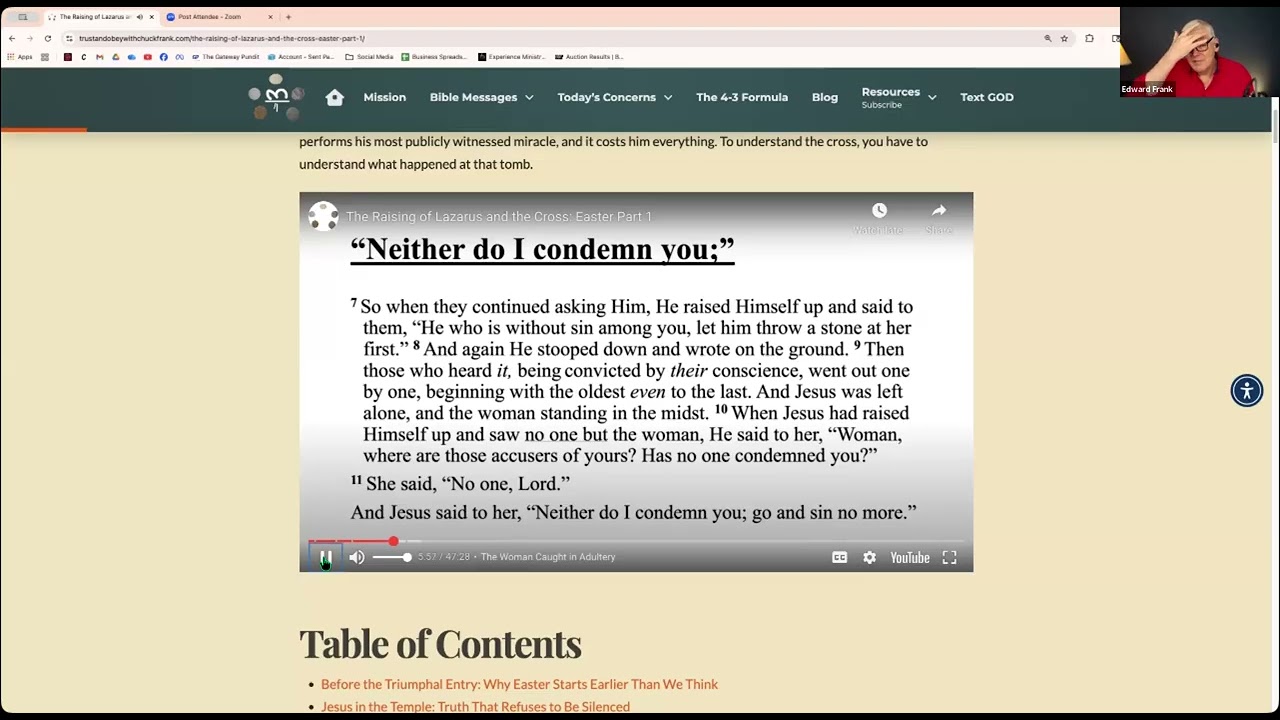
This teaching comes alive in community. In the video below, Chuck Frank leads a small group through the opening chapters of this Easter series, exploring the raising of Lazarus, Martha’s confession of faith, and the Sanhedrin’s response to the miracle that changed everything. The group’s questions and reflections bring out details that reward a second look — including why Matthew and Mark leave Lazarus out entirely, what the rabbinic three-day tradition reveals about Jesus’ timing, and what it means that God’s itinerary for our lives is just as precise as his itinerary for Holy Week. Watch, then read the full study below.
Table of Contents
Before the Triumphal Entry: Why Easter Starts Earlier Than We Think
The raising of Lazarus in John 11 is the direct catalyst for Holy Week. Jesus performed this miracle in full view of hundreds of witnesses just two miles outside Jerusalem, triggering the Sanhedrin’s formal decision to put him to death. The Easter story does not begin on Palm Sunday; it begins at a tomb in Bethany, with a dead man walking out of a cave.
John’s Gospel is the last of the four to be written, likely between AD 90 and 110. That timing matters. Matthew and Mark do not include the Lazarus story for a specific reason: the Sanhedrin was still actively hunting Lazarus to kill him. Every person who heard he had been dead four days and was now walking around became a potential convert. The temple authorities could not afford that.
By the time John writes his account, the Jerusalem temple has been destroyed, the chief priests are gone, and the danger has passed. What John gives us in chapters 8 through 11 is a detailed portrait of institutional opposition to the Son of God, the same pattern that runs through our comprehensive Bible Messages series as it traces God’s people navigating corrupt power structures across every era of Scripture. To understand this Easter, we need to back things up further than Palm Sunday.
Jesus in the Temple: Truth That Refuses to Be Silenced
When Jesus taught in the temple treasury in Jerusalem, the scribes and Pharisees interrupted by dragging in a woman caught in adultery. Their purpose was not justice; it was calculated disruption designed to shatter a sacred teaching moment and trap Jesus in a legal dilemma before a crowd of witnesses.
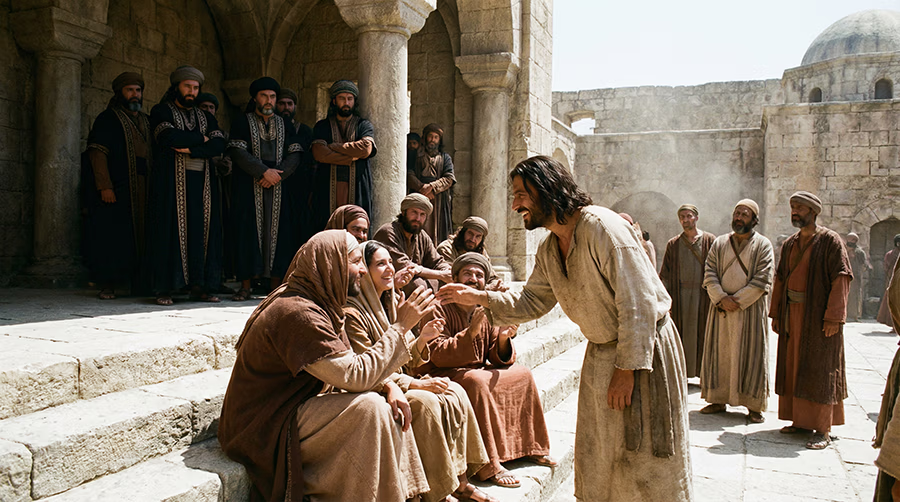
John 8 opens with Jesus arriving early at the temple, entering the women’s hall, a large courtyard the Pharisees had renamed “the treasury” because they had filled it with donation boxes. People gather around him. They want to hear him teach. Then the scribes and Pharisees arrive dragging a terrified woman. The law they invoke is revealing: Mosaic law required both parties to be brought for judgment. She is brought alone. This is not a sincere appeal to Torah. It is a setup.
“Teacher, this woman was caught in adultery, in the very act. Now Moses, in the law, commanded us that such should be stoned. But what do You say?” John 8:4–5 (NKJV)
Jesus does not engage them. He stoops down and writes in the dirt with his finger. When they continue pressing, he raises himself and speaks one sentence that dissolves the entire mob:
“He who is without sin among you, let him throw a stone at her first.” John 8:7 (NKJV)
One by one, beginning with the oldest, they leave. Jesus speaks to the woman simply: “Neither do I condemn you. Go and sin no more.” The deliberate calm he displays, his refusal to be rattled by people driven purely by a lust for power, is a model for anyone who has ever faced an accusation designed to destroy rather than to seek truth.
“Before Abraham Was, I Am”
The confrontation continues. The Pharisees challenge Jesus’ right to speak about himself, and he tells them his Father bears witness alongside his own testimony, two witnesses, which satisfies their own law. They ask where his father is, assuming they know. They think they have him figured out.
“You know neither Me nor My Father. If you had known Me, you would have known My Father also.” John 8:19 (NKJV)
The exchange reaches its crisis when Jesus declares: “Before Abraham was, I AM.” This is not a grammatical error. It is the divine name first revealed to Moses at the burning bush. He is claiming to be the eternal God. They pick up stones immediately. But he passes through the crowd, not through a miraculous disappearance, but through the surging mass of people who open before him and close behind him as he moves forward. God controls the itinerary. His hour has not yet come.

The Divine Delay: Why Jesus Waited Four Days
When Jesus received word that Lazarus was sick, he deliberately waited two additional days before traveling to Bethany. His arrival on the fourth day was not negligence; it was surgical precision rooted in his accusers’ own traditions. Rabbinic teaching held that the soul lingered near the body for three days before departing. By arriving on the fourth day, Jesus made the miracle irrefutable by the standards of Jewish religious law.
When the messenger arrives, Jesus says: “This sickness is not unto death, but for the glory of God, that the Son of God may be glorified through it.” He then waits two more days. When he finally tells the disciples they are heading back to Judea, the fear in the room is immediate. The last time they were near Jerusalem, authorities tried to stone him.
Jesus answers their anxiety directly:
“Are there not twelve hours in the day? If anyone walks in the day, he does not stumble, because he sees the light of this world.” John 11:9 (NKJV)
What he is telling them, and us, is that every human life has a fixed beginning and a fixed ending. God controls the itinerary. Not one moment can be added or taken away by temple hitmen or any other hostile power. This same truth pulses through Jonah’s desperate prayer from inside the fish, explored in our study of Book of Jonah 2: Prayer from the Depths of Death. Whether in the belly of a creature or the shadow of a hostile institution, God’s people are protected by divine timing, not by their own ability to outmaneuver their opponents.
Then Jesus says plainly: “Lazarus is dead. And I am glad for your sakes that I was not there, that you may believe.” Thomas, the same man who will later refuse to believe the resurrection without physical proof, responds with genuine courage: “Let us also go, that we may die with him.” Physical bravery without reasoned, Spirit-grounded conviction, however, is not the same thing as the wisdom this moment requires.
“I Am the Resurrection and the Life”: Martha’s Confession
When Jesus told Martha “I am the resurrection and the life,” he was not offering comfort theology about a future event. He was making a direct personal claim: he himself is the source and power of resurrection. Martha’s response, affirming him as the Christ, the Son of God, is one of the great confessions of faith in all of Scripture, spoken under enormous grief and pressure.
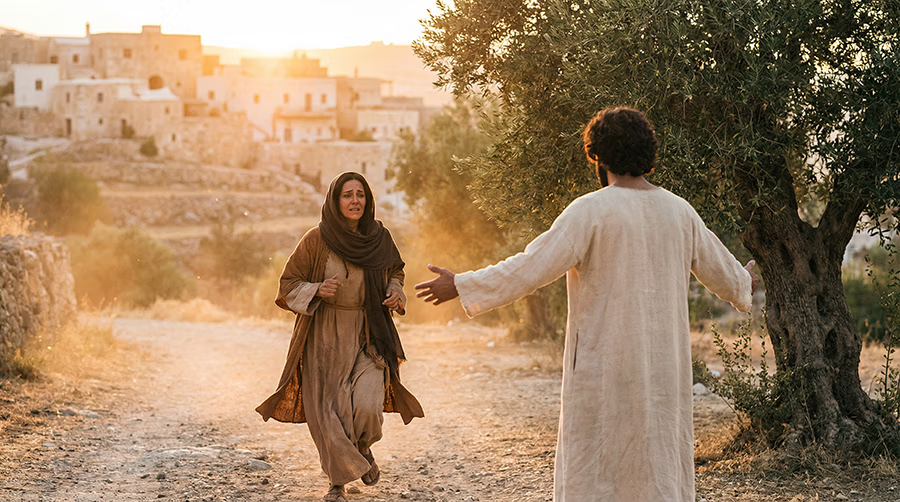
Martha runs out to meet Jesus on the road before he reaches the house, leaving the mourners behind. Some of them are almost certainly reporting back to the temple authorities in Jerusalem two miles away. Her first words hold both faith and anguish:
“Lord, if You had been here, my brother would not have died. But even now I know that whatever You ask of God, God will give You.” John 11:21–22 (NKJV)
Jesus tells her Lazarus will rise again. She responds from sound theological conviction: she knows there will be a resurrection at the last day. But doctrine, in this moment, is not enough. She wants her brother back. And then Jesus says something that reshapes everything:
“I am the resurrection and the life. He who believes in Me, though he may die, he shall live. And whoever lives and believes in Me shall never die. Do you believe this?” John 11:25–26 (NKJV)
Martha cannot answer the question directly; it is simply too large. What she can do is return to her core conviction:
“Yes, Lord, I believe that You are the Christ, the Son of God, who is to come into the world.” John 11:27 (NKJV)
She does not argue about Lazarus anymore. She trusts the Redeemer completely, even when she cannot yet see what he is about to do. The same pattern appears throughout our study of Book of Ruth Chapter 4: God’s people often only partially understand his plan in the moment, but they trust the one executing it.
Lazarus Come Forth: The Miracle That Sealed Their Plot
“Lazarus come forth” is the command that directly triggered the Sanhedrin’s formal decision to kill Jesus. With hundreds of witnesses present, a mix of genuine mourners and temple spies, the miracle was too public and too powerful to suppress or explain away. From that day forward, they plotted to put him to death.
Jesus approaches the tomb, a cave in the Judean hillside with a stone rolled across the entrance. Martha protests that on the fourth day there will be a stench. She is afraid Jesus will be humiliated before this crowd, and every hostile witness will race back to Jerusalem with ammunition.
“Did I not say to you that if you would believe you would see the glory of God?” John 11:40 (NKJV)
The stone is removed. Jesus lifts his eyes and prays aloud, not for his own benefit, but for the crowd’s:
“Father, I thank You that You have heard Me. And I know that You always hear Me, but because of the people who are standing by I said this, that they may believe that You sent Me.” John 11:41–42 (NKJV)
Then, in a loud voice: “Lazarus, come forth!”
There is an echo in that cry of the trumpet that will sound at the final resurrection. Lazarus, bound hand and foot in grave clothes, his face wrapped with a cloth, comes walking out of the tomb. The crowd unravels him. Many believe immediately. But some go directly to the Pharisees to report everything.
Scripture tells us Jesus was “groaning in himself” as he approached the tomb. I believe he knew what he was calling Lazarus back to: a mortal body, a dangerous life, a death sentence that would follow him from that day forward. Lazarus had been in glory. Jesus was calling him out of it for a specific mission at a specific moment. That is not a small ask of a friend.

Caiaphas and the Unintended Prophecy
The chief priests and Pharisees convene an emergency council. Their fear mirrors the tenants of the vineyard in the Parable of the Wicked Husbandmen, who plot to kill the Son so they can seize the inheritance:
“What shall we do? For this Man works many signs. If we let Him alone like this, everyone will believe in Him, and the Romans will come and take away both our place and our nation.” John 11:47–48 (NKJV)
What they are really afraid of is losing their financial base and their institutional power. Caiaphas, the high priest that year, cuts through the hand-wringing: “It is expedient for us that one man should die for the people.” He means it as cold political calculation. God means it as prophecy. John tells us explicitly that Caiaphas did not say this on his own authority; being high priest, he prophesied without knowing it, that Jesus would die not only for the Jewish nation, but to gather all the scattered children of God into one. The man engineering a murder becomes an unwitting mouthpiece for the plan of redemption.
When Power Fears the Truth: Then and Now
The pattern revealed in John 11 is not confined to first-century Jerusalem. Those who hold power through exploitation and institutional cover will always move to eliminate individuals who threaten them by doing extraordinary good. Our Today’s Concerns series applies this exact dynamic to the political and spiritual realities of our own time.
The Book of Esther shows us this same template three thousand years before the cross. Our study of Book of Esther 3 and the conspiracies that rise against God’s people traces a plot driven not by justice, but by wounded pride and a lust for absolute power.
On April 4, 1968, Robert F. Kennedy stood before a crowd in Indianapolis and announced that Martin Luther King Jr. had been killed. He called his country to choose wisdom over bitterness and understanding over revenge. He quoted Aeschylus: that even in sleep, pain falling drop by drop upon the heart can, through the awful grace of God, become wisdom. Sixty days later, Kennedy himself was shot and killed by the same institutional forces that had killed his brother five years before.
As we examine in The Big Lie: When Political Deception Meets Biblical Truth, the tree is always known by its fruit. Caiaphas talked about saving the nation. He was arranging the murder of the Son of God. The demonic spirit behind corrupt political power was real in the temple council, and it remains real today.
Living Without Fear: What Lazarus Teaches Us About Our Days
Because God controls the beginning and ending of every human life, Christians have no reason to be silenced by threats. Jesus’ teaching about the twelve hours in the day means that no hostile council and no assassination attempt can touch any of us outside God’s appointed timing. That freedom is the foundation of bold, faithful Christian witness.
The 4-3 Formula that shapes our discipleship approach is built on this foundation: obedience to God’s call regardless of personal cost, because we actually believe that our days are in his hands. We as Christians need to know the truth, and the truth will set us free. The mission that drives this ministry, rooted in the conviction that a Constitutional Republic can only survive and thrive with a believing populace, requires men and women who do not flinch, because they genuinely believe that death has no final sting. Easter is not just a Sunday. It is a way of living all the days you have been given.
Practical Application
The raising of Lazarus is not only a past miracle to be marveled at; it is a present call to action.
- Examine your silence. If fear is the reason you are not speaking truth about corruption, injustice, or Scripture, let the twelve-hours principle speak to it directly. Your days are fixed. Spend them well.
- Read John 11 slowly this week. Pay attention to the way every “I Am” statement in John 6-11 builds toward the resurrection claim Martha confesses at the tomb.
- Pray with Martha’s honesty. She did not pretend to understand everything Jesus was doing. She confessed what she knew to be true and trusted him with the rest. That is the model.
- Consider what Thomas missed. He had physical courage but lacked the ability to reason through what God was actually doing. Ask God for both.
Conclusion
The Easter story begins before Palm Sunday. It begins with a woman dragged into a courtyard, with an eternal name spoken in a temple treasury, and with a dead man called out of a cave on the fourth day. Lazarus come forth is not simply a stunning miracle. It is the moment that sealed the Sanhedrin’s resolve and set the final stage for the cross and the empty tomb.
Jesus walked into all of it with his eyes fully open, on God’s timetable, for God’s glory. He was not afraid of temple authorities or their hired hitmen. He was following a specific itinerary written before the foundation of the world.
This Easter, let the raising of Lazarus remind you of something foundational: the one who will stand at your tomb on the last day is the same one who stood at Lazarus’ tomb in Bethany and cried with absolute authority. He has already spoken the word that defeats death. Go and sin no more. Walk in the light. Do not be afraid.
The next part of this Easter series will press deeper into Holy Week. These are not easy studies, but the truth in them is worth the weight.
Frequently Asked Questions (FAQs)
Why does John include the story of Lazarus but Matthew and Mark do not?
Matthew and Mark were written while the Sanhedrin was still actively seeking to kill Lazarus, because his resurrection was drawing thousands to faith in Jesus. John wrote his Gospel after the destruction of the Jerusalem temple in AD 70, when the chief priests who had issued the death order were gone. Only then was it safe to include the full account.
What did Jesus write in the ground when the Pharisees brought the woman caught in adultery?
Scripture does not tell us, and that silence has generated centuries of scholarly discussion. What we do know is that the act was deliberate: Jesus refused to engage the hostility of the Pharisees on their terms, redirected the entire scene, and extended both mercy to the accused woman and conviction to her accusers, all without a single argument.
Why did Jesus wait four days before going to Lazarus?
The rabbinic teaching of the day held that the soul of the deceased lingered near the body for three days before departing permanently. By arriving on the fourth day, Jesus ensured that no one could argue Lazarus had simply been unconscious or that his soul had returned to a body it had not yet fully left. The miracle was irrefutable by the standards of their own tradition.
What does “I Am the resurrection and the life” mean for believers today?
It means that resurrection is not simply an event Jesus orchestrates; it is something he himself is. Placing faith in Jesus Christ means being in relationship with the very person who is the source of life over death. For further reflection on applying this truth to daily Christian living, explore our resources for Christian growth and Scripture study.
Further Reading
- John 11 Commentary by David Guzik at Blue Letter Bible
- John 11 Verse-by-Verse Commentary at Enduring Word
- Who Was Lazarus in the Bible at GotQuestions.org
- Lazarus: Story of Hope for Our Loved Ones at The Gospel Coalition
- John 11:25 Greek Text and Commentary at Bible Hub


