
October 26, 2025

Book of Esther 4 reveals Queen Esther’s pivotal decision to risk her life by approaching King Ahasuerus uninvited to save the Jewish people from Haman’s genocidal decree. Through Mordecai’s faith-filled challenge and Esther’s courageous response, we see God’s providence at work through prayer, fasting, and divine timing in history’s darkest moments.
Table of Contents
The Book of Esther 4 stands as one of Scripture’s most powerful testimonies to courage under pressure. When faced with the genocidal decree that Haman manipulated King Ahasuerus into signing, Mordecai and Esther demonstrate what faithful obedience looks like when everything is on the line. This chapter shows us that God’s providence works through human courage, that prayer changes circumstances, and that sometimes we are placed in positions of influence “for such a time as this.”
As we continue our journey through the Book of Esther series, we find ourselves at the crisis point where Esther must choose between her safety and her calling. The lessons from Book of Esther 4 resonate powerfully in our current age, when believers often face the choice between comfort and conviction.
Mordecai’s Public Mourning and Prophetic Warning
When Mordecai learned of Haman’s genocidal decree against the Jews, he tore his clothes, put on sackcloth and ashes, and mourned publicly at the king’s gate. His visible grief was both a traditional Jewish expression of catastrophic loss and a strategic act to draw attention to the injustice threatening God’s people throughout Persia’s 127 provinces.
The opening verses of Book of Esther 4 describe Mordecai’s dramatic response to the edict.
When Mordecai learned of everything that had been done, he tore his clothes, put on sackcloth and ashes, and went out into the midst of the city and wailed loudly and bitterly.
This was not mere emotional reaction but deliberate prophetic witness.
For the Jewish people, there were two traditional ways of mourning before God over terrible calamity: wearing sackcloth or covering oneself with ashes. When facing the worst possible disaster, both practices were combined. Mordecai’s public display of grief served multiple purposes. First, it was genuine mourning over the impending destruction of his people. Second, it was a prayer posture before the Almighty. Third, it was a public witness that drew attention to the injustice.
Archaeological excavations at Susa have revealed the actual king’s gate where Mordecai stationed himself. The pavement outside this impressive structure became his prayer platform. The text tells us that “in each and every province where the command and decree of the king came, there was great mourning among the Jews with fasting, weeping, and mourning rites, and many had sackcloth and ashes spread out as a bed” (Esther 4:3).
This collective response reveals the unity of God’s people in crisis. Throughout the Persian Empire, Jews recognized the existential threat and turned to God through the ancient practices of their faith. The text tells us:
In each and every province where the command and decree of the king came, there was great mourning among the Jews with fasting, weeping, and mourning rites, and many had sackcloth and ashes spread out as a bed.
As we explore in our Bible Messages section, such corporate prayer and fasting has always been God’s prescribed response to national crisis.
Mordecai could not enter the king’s gate dressed in sackcloth, as it would be disrespectful to the king. Yet his very presence at the gate’s entrance, wailing and covered in ashes, created a spectacle impossible to ignore. This was strategic spiritual warfare, combining prayer with prophetic witness.

Esther’s Isolation and Growing Fear
Queen Esther lived in isolation within the Persian palace, unaware of Haman’s decree. When her attendants reported Mordecai’s mourning, she was seized with fear because his public Jewish mourning risked exposing her hidden Jewish identity. She had not seen King Ahasuerus for 30 days, adding to her anxiety about her precarious position.
Then Esther’s attendants and her eunuchs came and informed her, and the queen was seized by great fear.
Esther’s reaction reveals her vulnerable position. Mordecai had instructed her years earlier to keep her Jewish identity secret and to reveal nothing about their family connection. Now he was publicly performing Jewish mourning rites, making his identity obvious to everyone.
Esther’s first instinct was to fix the situation by sending proper clothing to Mordecai, hoping he would remove the sackcloth and stop being such a spectacle. But Mordecai refused the garments. He understood that this was not a problem that could be solved by changing clothes or maintaining appearances.
The text reveals another source of Esther’s anxiety:
I have not been summoned to come to the king for these 30 days.
After the king had fallen in love with her, crowned her queen, and given a great banquet in her honor, he had not called for her in a month. For a woman who knew the king enjoyed a different beautiful woman in his bed every night, this abandonment must have felt ominous.
Esther sent Hathach, one of the king’s eunuchs appointed to attend her, to learn what was troubling Mordecai and why he was mourning. This detail shows both Esther’s isolation within the palace walls and the channels of communication available between the royal court and the outside world. Understanding how God’s providence works through human relationships becomes crucial when we see how information flows at critical moments.

The Revelation of Genocide
Mordecai revealed to Hathach the full scope of Haman’s genocidal plot: a royal decree ordering the annihilation of all Jews throughout the Persian Empire on a specific date. He provided a copy of the edict and the exact amount (10 million talents of silver) Haman promised the king’s treasury, instructing Hathach to show Esther and command her to intervene.
So Hathach went out to Mordecai in the city square in front of the king’s gate. Mordecai told him everything that had happened to him and the exact amount of money that Haman had promised to pay the king’s treasuries for the elimination of the Jews.
The precision of Mordecai’s report is striking. He provided documentary evidence, giving Hathach a copy of the actual edict issued in Susa. He detailed the financial arrangement whereby Haman had promised to pay the equivalent of $20 million in today’s currency to the royal treasury in exchange for permission to exterminate the Jews. This was not rumor or speculation but documented fact.
Mordecai’s instructions were clear:
Show Esther the evidence, inform her of the situation, and order her to go into the king to implore his favor and plead with him for her people.
The language is significant. Mordecai, though Esther’s adopted father and cousin, uses commanding language because he understands the gravity of the situation and Esther’s unique position.
The genocidal nature of Haman’s plot cannot be overstated. The decree called for the destruction of:
All Jews, both young and old, women and little children, in one day.
This was systematic ethnic cleansing on a massive scale, targeting an entire people group across 127 provinces. The injustice was absolute, and the danger was existential.
This mirrors challenges believers face today when standing against injustice and evil. Our Today’s Concerns commentary addresses how Christians must engage with contemporary moral crises with the same clarity and courage demonstrated in Book of Esther 4.
The Law of Death and Esther’s Dilemma
Ancient Persian law decreed automatic death for anyone who approached the king in the inner courtyard without being summoned, unless the king extended his golden scepter. Esther explained this law to Mordecai, noting she had not been summoned for 30 days. Approaching the king uninvited meant almost certain death, making Mordecai’s request extraordinarily dangerous.
Esther’s response through Hathach reveals the deadly risk:
All the king’s servants and the people of the king’s provinces know that for any man or woman who comes to the king in the inner courtyard who is not summoned, he has only one law, that he be put to death, unless the king holds out to him the golden scepter so that he may live.
This was not palace rumor but established Persian law, known throughout the empire. The protocol existed to protect the king from assassins and to maintain the absolute authority of the throne. No one, not even the queen, could presume upon the king’s presence without invitation. The king’s golden scepter served as the symbol of royal favor and the only thing that could reverse the death sentence for an uninvited approach.
Esther essentially told Mordecai: “What you’re asking me to do will most probably result in my death. Do you understand that?” The king’s recent neglect of her added another layer of danger. If Ahasuerus had lost interest in her, appearing uninvited might provoke his anger rather than his mercy.
The painting described in our video transcript captures this moment perfectly: Esther in the throne room, the king leaning forward with his golden scepter, everyone watching anxiously to see whether he will extend it to touch her, granting her life, or whether she will be executed for her presumption. This decidedly British-looking throne room helps us visualize the scene, even if not historically accurate to Persian architecture.

Understanding the constitutional principles at stake, we see parallels to our own mission of applying biblical truth to governance. The absolute power of ancient kings versus the accountable government our founders designed shows why biblical principles matter in political structures.
Mordecai’s Faith-Filled Challenge
Mordecai challenged Esther’s assumption that palace walls could protect her, declaring that if she remained silent, deliverance for the Jews would arise from another place while she and her family perished. His famous words, “who knows whether you have not attained royalty for such a time as this,” pointed to God’s providential placement.
Mordecai’s response to Esther contains some of the most powerful words in Scripture:
Do not imagine that you in the king’s palace can escape any more than all the other Jews. For if you keep silent at this time, liberation and rescue will arise for the Jews from another place, and you and your father’s house will perish. And who knows whether you have not attained royalty for such a time as this.
Several profound truths emerge from this statement:
God’s Sovereignty Despite His Silence
Remarkably, the name of God is not mentioned anywhere in the Book of Esther. Yet God’s providential hand is everywhere evident. When Mordecai says “liberation and rescue will arise for the Jews from another place,” where would that place be? Clearly, he refers to God’s agency. Mordecai demonstrates absolute confidence in God’s covenant faithfulness to preserve His people, regardless of human action or inaction.
No Safety in Silence
Esther could not hide behind palace walls. Her Jewish identity, though concealed, made her as vulnerable as any Jew in the empire. Silence would not save her but condemn her. This principle applies to believers today: remaining silent in the face of evil does not protect us but makes us complicit.
Divine Timing and Purpose
The phrase “for such a time as this” has become proverbial. Mordecai understood that Esther’s seemingly impossible rise from Jewish orphan to Queen of Persia was no accident. God had positioned her precisely where she needed to be to accomplish His purposes. Her influence, her access, her position were all providential gifts meant for kingdom purposes.
Personal Responsibility Within Divine Providence
While Mordecai expressed confidence that God would deliver the Jews through some means, he made clear that Esther’s participation or refusal carried consequences. God’s sovereignty does not eliminate human responsibility. Esther could choose obedience and become part of God’s deliverance, or she could choose self-preservation and perish with her family while God raised up another instrument.
These themes connect deeply with the principles we teach in The 4-3 Formula, our biblical framework for developing obedient, purpose-driven followers of Christ who understand their divine assignment in their generation.
Esther’s Courageous Decision: Prayer, Fasting, and Faith
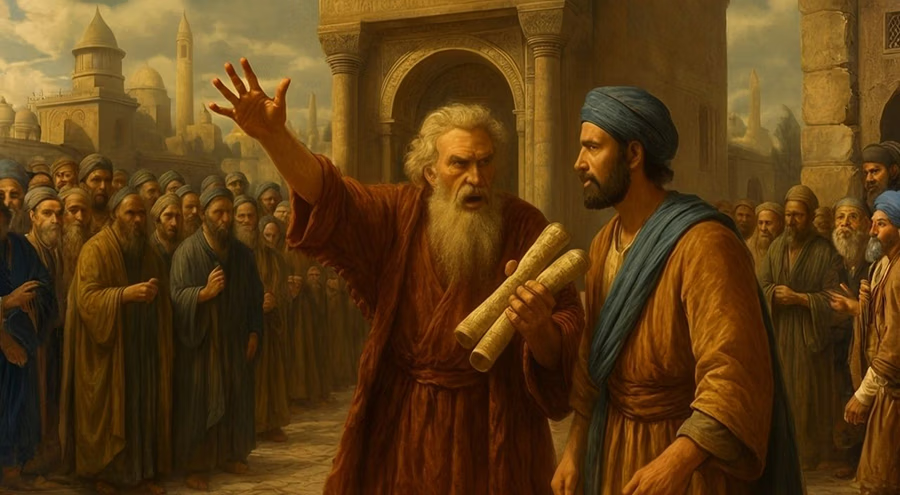
Esther responded to Mordecai’s challenge by requesting that all Jews in Susa fast for her for three days and nights. She and her attendants would do the same. After this period of corporate prayer and fasting, she would approach the king illegally, declaring, “If I perish, I perish.” This showed remarkable spiritual courage and dependence on God.
Esther’s response reveals her transformation from frightened queen to faith-filled leader:
Go, gather all the Jews who are found in Susa and fast for me. Do not eat or drink for three days, night or day. I and my attendants also will fast in the same way. And then I will go in to the king, which is not in accordance with the law; and if I perish, I perish.
This reply demonstrates several crucial spiritual realities:
Corporate Prayer as Spiritual Warfare
Esther’s request for communal fasting was fundamentally an appeal to God. The Jewish community would unite in prayer, seeking divine intervention. This corporate intercession represents biblical pattern for facing overwhelming opposition. Esther understood she could not succeed through political maneuvering or personal charm alone. Only God’s intervention would make the difference.
Personal Spiritual Preparation
Esther did not ask others to do what she was unwilling to do herself. She and her attendants would also fast for three days and nights. This period of spiritual preparation would strengthen her faith, clarify her calling, and enable her to face potential death with resolve.
Absolute Surrender to God’s Will
“If I perish, I perish” represents complete abandonment to God’s purposes. Esther released her grip on self-preservation and embraced her calling regardless of personal cost. This is the essence of discipleship. Jesus said:
Whoever wants to save his life will lose it, but whoever loses his life for me will find it.
Esther embodied this principle.
Courage Rooted in Faith
Esther’s bravery was not reckless courage or foolish presumption. It was faith-filled action based on spiritual preparation. She counted the cost, prepared spiritually, and then acted decisively. This shows us how biblical faithfulness operates in crisis moments.
The three-day period of fasting also carries symbolic significance. Just as Jonah spent three days in the belly of the great fish before being delivered to fulfill his calling, and just as Jesus spent three days in the tomb before resurrection, Esther’s three-day period represents death to self-will and resurrection to divine purpose.

God’s Providence in Book of Esther 4: Faith in Political Crisis
Book of Esther 4 demonstrates God’s unseen providence working through political structures, human courage, and divine timing. Though God’s name never appears in Esther, His hand guides every event. The chapter teaches that believers must engage with governing authorities while ultimately depending on God’s sovereignty, not human power, for deliverance and justice.
The Book of Esther 4 provides profound lessons about faith in the political arena. Haman’s genocidal plot emerged through manipulation of governmental power. A half-drunk king signed legislation that would exterminate an entire people group throughout 127 provinces. The injustice was systemic, legal, and seemingly irreversible according to the laws of the Medes and Persians.
Yet God’s providence transcended human politics. Esther’s position as queen was no accident. Mordecai’s location at the king’s gate was strategic. The timing of events, the flow of information, the preparation of hearts – all reflected divine orchestration behind the scenes.
This reality informs how we approach contemporary political challenges. Our G-Drop series provides timely, Spirit-led reflections on unfolding events, showing how Scripture speaks to modern political realities just as the Book of Esther 4 spoke to ancient Persian politics.
The prayer that President John F. Kennedy offered when establishing the National Day of Prayer echoes Mordecai’s and Esther’s understanding of national crisis requiring divine intervention. Kennedy prayed for the nation, for homes, for citizens, for justice, peace, freedom, and brotherhood under God. His comment before that prayer remains relevant: “Do not pray for easy lives; pray to be stronger people.”
We live in days when government corruption and deception have been exposed at levels many thought impossible. The revelations about President Kennedy’s assassination, which Chuck Frank references in the video transcript recorded in March 2025, represent the kind of systemic evil that Esther faced. When our own government participates in murder and coverup, believers must respond with the same courage and faith that Esther demonstrated.
As God told us, “No stone will remain unturned; all these things will be found out.” We are experiencing what might be called “the great reveal” when decades of government deception are being exposed. This requires believers to maintain faith in God’s justice while actively participating in accountability and restoration, just as Esther participated in reversing Haman’s wicked decree.
Application for Today: Courage When Called
Book of Esther 4 challenges modern believers to embrace their “for such a time as this” moments with faith and courage. When faced with injustice, we must combine prayer with action, trust God’s providence while accepting our responsibility, and choose conviction over comfort, knowing God positions us strategically for His purposes.
The lessons from Book of Esther 4 translate directly to contemporary Christian living:
Recognize Your Divine Positioning
Like Esther, believers today occupy positions of influence not by accident but by God’s providence. Your workplace, your community, your family, your sphere of influence – these are your “palace.” God has placed you there for kingdom purposes. The question is whether you will recognize and embrace that calling.
Choose Courage Over Comfort
Esther could have remained silent and hoped for the best. Instead, she chose costly obedience. Today’s believers face similar choices: speak truth that may cost friendships, take stands that risk career advancement, live distinctively when conformity would be easier. Book of Esther 4 reminds us that safety through silence is an illusion.
Practice Corporate Prayer
Esther’s request for communal fasting demonstrates the power of united prayer. Our Christian Community exists precisely for this purpose – to gather believers who will pray together, bear one another’s burdens, and seek God’s face in challenging times. Isolated Christians are vulnerable Christians.
Prepare Spiritually Before Acting
Esther did not rush impulsively into the king’s presence. She spent three days in prayer and fasting first. Spiritual preparation must precede significant action. This principle applies whether you are confronting workplace injustice, addressing family dysfunction, engaging in political advocacy, or any other courageous stand. Seek God first.
Accept That Faithfulness May Cost Everything
“If I perish, I perish” is the anthem of radical discipleship. Jesus never promised that following Him would be safe or comfortable. He promised that He would be with us and that His purposes would prevail. Esther’s willingness to die for her people reflects Christ’s willingness to die for His people. We are called to the same sacrificial love.
Trust God’s Unseen Providence
Though God is never mentioned by name in Esther, His hand directs every event. Similarly, you may not see or feel God’s presence in your circumstances, but He is working. Trust His providence even when you cannot trace His path. This faith sustains believers through the darkest valleys.
These applications connect with the deeper spiritual disciplines we explore in our Five Smooth Stones series, which provides a toolkit for building strong foundations in faith, obedience, and spiritual authority.
Conclusion: Your “Such a Time as This” Moment
The Book of Esther 4 stands as one of Scripture’s most powerful testimonies to faith under fire. Mordecai’s prophetic challenge, Esther’s courageous response, and the corporate prayer of God’s people combine to show us what biblical faithfulness looks like when everything is on the line.
We live in our own “such a time as this” moment. Western civilization faces moral collapse, government corruption stands exposed, and believers must choose between cultural conformity and costly conviction. Like Esther, we cannot hide behind walls of comfort and safety. The challenges of our age require engagement, courage, and faith.
Book of Esther 4 teaches us that God positions His people strategically for kingdom purposes. Your influence, your platform, your relationships, your resources – none of these are accidents. They are divine trust, meant to be invested for God’s glory and the advancement of His kingdom.
The question Mordecai posed to Esther now comes to each of us: Will we remain silent and perish, or will we speak and act, trusting God for the outcome? Will we recognize that we have been placed in our positions “for such a time as this”?
Let Esther’s example inspire you. Gather your community, seek God through prayer and fasting, prepare your heart spiritually, and then act courageously according to your calling. God does not require success; He requires faithfulness. Whether you perish or prevail in human terms, faithfulness to God’s call is what matters eternally.
As you continue studying Scripture with us, explore our comprehensive Bible Messages and discover how timeless truth applies to contemporary challenges. The God who worked through Esther works through you today.
Frequently Asked Questions (FAQs)
What is the main message of Book of Esther 4?
Book of Esther 4 teaches that God positions believers strategically for critical moments in history. When Mordecai told Esther she had attained royalty “for such a time as this,” he revealed that divine providence prepares us for our callings. The chapter emphasizes courage through faith, the power of corporate prayer, and that silence in the face of evil is neither safe nor faithful.
Why did Mordecai refuse to bow to Haman?
Mordecai refused to bow to Haman because Haman was an Agagite, a descendant of King Agag of the Amalekites, who were historic enemies of the Jewish people. God had commanded Saul to completely destroy the Amalekites for their attack on Israel during the Exodus (1 Samuel 15), but Saul failed. Mordecai’s refusal represented faithful resistance to honoring an enemy of God’s people, demonstrating that believers cannot compromise convictions even under government mandate.
Why does Book of Esther 4 never mention God by name?
Though God’s name never appears in the Book of Esther, His providence is evident throughout. When Mordecai says deliverance will “arise from another place,” he clearly refers to God. This literary approach shows that God works behind the scenes, orchestrating events through natural means, human courage, and divine timing. It teaches believers that God’s absence from our perception does not mean His absence from our circumstances.
What does “for such a time as this” mean for Christians today?
“For such a time as this” means recognizing that God has strategically positioned you in your current circumstances, relationships, and sphere of influence for His purposes. Your career, location, resources, and platform are not random but providential. This phrase challenges believers to embrace their calling courageously, understanding that God prepares us for specific assignments in our generation that require both faith and action.
Further Reading
Enduring Word Bible Commentary: Esther Chapter 4 Comprehensive verse-by-verse commentary on Esther’s courage, Mordecai’s challenge, and the power of corporate prayer and fasting in Book of Esther 4
Matthew Henry Commentary on Esther 4 Classical biblical commentary examining Esther’s bold faith, the “if I perish, I perish” declaration, and God’s providential care
Biblical Archaeology: The Golden Scepter of Ancient Persia Archaeological evidence of Persian royal protocol, including the function and significance of the golden scepter in Xerxes’ court
Jewish Fasting Traditions and Biblical Practice Detailed explanation of Jewish fasting customs, including the three-day fast practices and their spiritual significance in times of crisis
Bible.org: Fasting in the Old Testament Scholarly examination of fasting as mourning, repentance, and prayer in ancient Judaism, with specific application to Esther’s three-day fast
