
Proverbs 13 delivers Solomon’s wisdom like a scalpel cutting through the diseased tissue of our modern culture. These 25 verses expose why America teeters on the edge of collapse – because we’ve abandoned the very principles that sustain a Constitutional Republic. You want to know why our nation is drowning in debt, lies, and moral chaos? Solomon diagnosed it 3,000 years ago: rejected instruction, careless words, celebrated laziness, dishonest wealth, and the complete abandonment of discipline.

Table of Contents
A Constitutional Republic can only survive and thrive with a believing populace that actually applies biblical wisdom to daily life. When people mock correction, worship consumption over labor, elect lying politicians, and refuse to discipline their children, you don’t get freedom – you get tyranny. Through biblical wisdom for daily living, we discover that Proverbs 13 isn’t just ancient literature. It’s a blueprint for national survival or a prophetic indictment of our current trajectory toward destruction.
Teachability or Destruction: The Fork in the Road
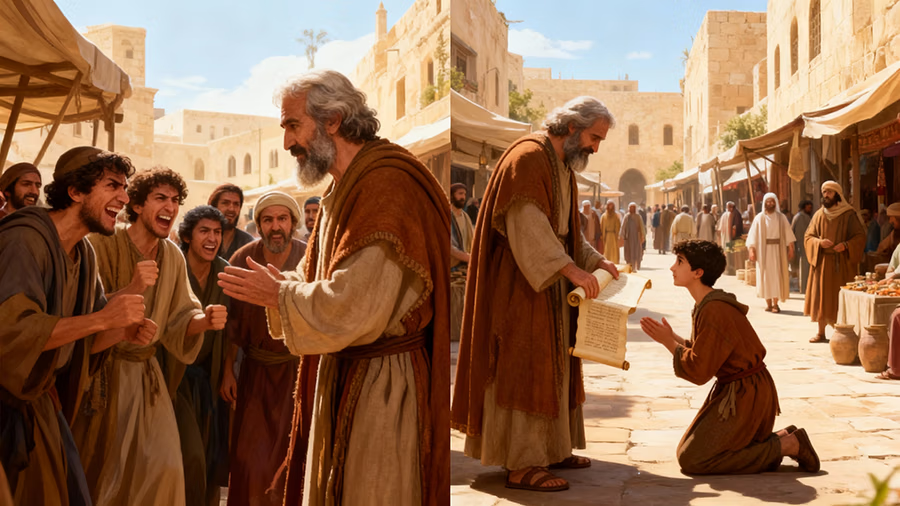
How does Proverbs 13 address instruction and correction? Verse 1 divides humanity into two camps: wise sons who heed instruction versus scoffers who reject all rebuke. This isn’t about personality types – it’s about whether a nation survives or collapses based on its willingness to receive correction and change course.
A wise son heeds his father’s instruction but a scoffer does not listen to rebuke.

Look around. Our entire culture has become a nation of scoffers. Question the transgender madness? You’re a bigot. Challenge election irregularities? You’re a conspiracy theorist. Quote Scripture on sexual morality? You’re hateful. The scoffer’s defining characteristic is complete immunity to correction because accepting rebuke requires admitting error and changing behavior.
This principle extends far beyond family relationships. When a nation’s leaders refuse correction, mock accountability, and dismiss constitutional constraints, you’re watching Proverbs 13:1 play out in real time. The church functions as the conscience of a free society, but only when believers maintain teachable spirits rather than conforming to cultural pressure. Through Today’s Concerns commentary, we track how rejecting godly instruction produces the chaos we’re witnessing daily in our streets, schools, and government halls.
Your Words Are Either Weapons or Wisdom
What does Proverbs 13 teach about speech? Verses 2-3 reveal that words produce fruit we eventually eat ourselves – either satisfaction from truthful speech or violence from destructive communication. In an era of social media censorship and propaganda, guarding your mouth has never been more critical or more dangerous.
A man shall eat well by the fruit of his mouth but the soul of the Unfaithful feeds on violence. He who guards his mouth preserves his life but he who opens wide his lips shall have destruction.
We’re living in a time when the wrong tweet can destroy your career, when speaking biological truth about sex can get you fired, when questioning official narratives labels you an extremist. But here’s what Solomon understood – careless words don’t just damage others, they ultimately destroy the speaker.
The politicians and media figures who built careers on lies are now eating the fruit of their mouths. The propaganda that claimed safe and effective, the conspiracy theories that turned out true, the Russian collusion hoax, the fine people hoax – all of it producing exactly what Proverbs 13 predicted: violence and destruction. Meanwhile, Christians face a choice. Do we guard our mouths out of fear, or do we speak truth carefully, strategically, and boldly despite the consequences?
The connection between Christian living and speech patterns isn’t about being nice. It’s about being truthful while avoiding the trap of reckless provocation that gives enemies ammunition. Self-control in communication demonstrates wisdom that protects your witness while refusing to bow to lies.
The War on Work and the Celebration of Sloth
How does Proverbs 13 contrast diligence with laziness? Verse 4 exposes the fundamental lie destroying America: that you can desire prosperity without earning it, that wealth comes from government redistribution rather than productive labor, that everyone deserves comfort regardless of effort.
The soul of a lazy man desires and has nothing but the soul of the diligent shall be made rich.
This verse demolishes the entire welfare state philosophy. Yes, the lazy man has desires – he wants housing, food, healthcare, student loan forgiveness, and universal basic income. He wants everything the diligent worker has earned, but without the labor that produces it. And what does he get? Nothing. Or more accurately, dependency, resentment, and spiritual poverty masked by government checks.
Diligence isn’t about worshiping work. It’s about understanding that God designed human flourishing to flow through productive labor. When Paul wrote:
If anyone will not work, neither shall he eat.
He wasn’t being cruel – he was describing reality. A nation that subsidizes laziness while punishing productivity through taxation is a nation choosing poverty and tyranny. The diligent worker who keeps 40% of his earnings while supporting those who won’t work isn’t experiencing biblical prosperity – he’s experiencing government-sanctioned theft.
Through Bible study on biblical work ethic, believers discover that faithful labor isn’t just about personal provision. It’s about modeling the dignity of work in a culture that increasingly views productivity as oppression and consumption as a right.
Righteousness as the Only Real Protection
What protection does righteousness provide in corrupt times? Verses 5-6 teach that righteous people hate lying because they understand truth sustains civilization, while wickedness inevitably produces shame and overthrow. In a nation drowning in lies, righteousness isn’t just virtue – it’s survival strategy.
A righteous man hates lying but a wicked man is loathsome and comes to shame. Righteousness guards him whose way is blameless but wickedness overthrows the sinner.
Watch how this plays out. The righteous person doesn’t just avoid lying – he hates it with moral clarity because he recognizes that every lie is a small brick in the tower of Babel humanity keeps building toward its own destruction.
The wicked embrace lies because truth exposes their schemes. They lie about biology, economics, history, science, and Scripture because truth dismantles their power. But here’s the principle they can’t escape – wickedness eventually overthrows the sinner. The protective quality of righteousness isn’t some mystical force field. It’s the natural consequence of building life on reality rather than delusion.
When you refuse to participate in the lies, when you maintain integrity in your business dealings, when you speak truth about marriage and sexuality, when you reject the narratives designed to enslave you – you experience protection that the wicked forfeit. The trust and obey community exists precisely because believers need mutual support to maintain righteous standards when the entire culture celebrates wickedness.
The Wealth Illusion and Coming Redistribution
How does Proverbs 13 define true wealth in a system built on debt? Verses 7 and 11 expose the greatest con in modern history: the illusion that debt-fueled consumption equals prosperity, and that dishonest wealth can be sustained indefinitely without divine judgment.
There is one who makes himself rich yet has nothing and one who makes himself poor yet has great riches. Wealth gained by dishonesty will be diminished but he who gathers by labor will increase.
Solomon saw our future. The person with the luxury car on a seven-year loan, the mansion mortgaged beyond equity, the lifestyle funded by credit cards and government subsidies – he makes himself rich yet has nothing. He’s a slave pretending to be free, a debtor pretending to be wealthy, a fool pretending to be wise.
Meanwhile, the person living simply, avoiding debt, building genuine equity through honest labor appears poor by cultural standards but possesses great riches. He owns his life. He answers to no creditor. He can speak truth without fear of losing what he never truly possessed anyway.
Verse 11’s warning about dishonest wealth carries prophetic weight:
Wealth gained by dishonesty will be diminished.

The Federal Reserve printing money from nothing, politicians trading on inside information, corporations gaming bailout systems, the whole rotten financial structure built on lies – it’s all slated for diminishment. Not maybe. Not if we’re unlucky. The verse doesn’t say “might be diminished” – it says “will be diminished.”
The connection between wealth and righteousness throughout Proverbs teachings isn’t prosperity gospel nonsense. It’s the sober recognition that systems built on lies eventually collapse, and believers who build on truth position themselves to survive the collapse.
Hope, Obedience, and Choosing Your Circle
What does Proverbs 13 teach about waiting, obeying, and companions? Verses 12, 13, and 20 address three critical issues for believers in hostile territory: maintaining faith during delays, fearing God’s word when culture dismisses it, and choosing companions wisely when most people are marching toward destruction.
Hope deferred makes the heart sick but when the desire comes it is a tree of life.
We’re watching this principle unfold as Americans who hoped for honest elections, legitimate justice, and constitutional governance experience the soul-sickness of constantly deferred hope. The prayer warriors who keep praying, the patriots who keep fighting, the parents who keep protecting their children – they’re living in hope deferred. But Solomon promises that when the desire comes, it brings life like a tree in the desert.
He who despises the word will be destroyed but he who fears the Commandment will be rewarded.
This verse separates cultural Christians from actual believers. When Scripture contradicts your political tribe, your economic interests, your sexual desires, or your comfort – do you fear God’s word enough to obey it anyway? Or do you despise it by finding clever ways to dismiss its authority? Through biblical principles of obedience, we discover that fearing God’s commands isn’t about religion – it’s about recognizing reality.
He who walks with wise men will be wise but the companion of fools will be destroyed.
Your closest relationships are either moving you toward wisdom or destruction. If your friends, church, social media feed, and entertainment are all celebrating foolishness, you’re not going to accidentally stumble into wisdom. The faith-centered community matters because iron sharpens iron, but entertainment dulls the blade.
Legacy, Discipline, and the Battle for the Next Generation
How does Proverbs 13 address generational blessing and child discipline? Verses 22 and 24 reveal why the war against the family is the ultimate battlefield – because whoever controls how children are raised controls the future, and whoever abandons discipline abandons the next generation to destruction.

A good man leaves an inheritance to his children’s children but the wealth of the sinner is stored up for the righteous.
This isn’t just about money – though the coming wealth transfer from wicked systems to the righteous isn’t optional, it’s prophetic. This verse addresses the entire legacy question: What are you passing to the next generation? If you’re leaving them debt, confusion, moral compromise, and dependence on government, you’re not leaving an inheritance – you’re leaving a curse.
The good man thinks generationally. He builds equity rather than debt. He teaches truth rather than political correctness. He models faithfulness rather than convenience. He understands that the wealth of sinners – all their ill-gotten gains, their corrupt systems, their godless institutions – will ultimately transfer to the righteous through divine judgment and economic collapse.
He who spares his rod hates his son but he who loves him disciplines him promptly.
Here’s where modern culture completely parts ways with Scripture. The idea that discipline equals love is now considered child abuse, while allowing children to be destroyed by lack of boundaries is called progressive parenting. The father who disciplines promptly loves his son enough to prepare him for a world that won’t coddle him. The father who avoids discipline because it’s uncomfortable hates his son by sending him into life unprepared for reality.
Through biblical teaching on raising children and examining God’s providence in family, we discover that disciplining children isn’t about control – it’s about love. And the culture that abandons discipline is a culture that hates its own children enough to sacrifice them to every destructive ideology that comes along.
Conclusion: Wisdom or Destruction, Choose Now
Proverbs 13 draws a line in the sand. On one side: teachability, truthful speech, diligent work, righteousness, honest wealth, fear of God’s word, wise companions, and loving discipline. On the other side: scoffing, lying, laziness, wickedness, dishonest gain, despising Scripture, foolish friends, and abandoned children.

There’s no middle ground. A Constitutional Republic requires citizens who embrace the first list and reject the second. When a nation celebrates the second list while mocking the first, that nation has chosen destruction. The only question is timing.
For believers, Proverbs 13 isn’t optional advice – it’s survival instruction for hostile territory. Through faithful engagement with verse-by-verse Bible teaching and commitment to applying Scripture regardless of cultural opposition, Christians position themselves not just to survive the coming chaos, but to be the remnant that rebuilds when the current system collapses under the weight of its own foolishness.
Solomon’s wisdom doesn’t age because human nature doesn’t change and God’s principles don’t evolve. What worked to sustain ancient Israel works to sustain modern America. What destroyed ancient civilizations will destroy ours. The only variable is whether enough believers will actually apply Proverbs 13 to their lives, families, churches, and communities before it’s too late.
Further Reading
For deeper exploration of wisdom literature and biblical principles:
- Enduring Word – Proverbs Commentary – Verse-by-verse commentary by David Guzik
- Got Questions – Book of Proverbs – Comprehensive overview and common questions
- Bible Gateway – Proverbs 13 Study Resources – Multiple translations and study tools
- Bible Study Tools – Proverbs Overview – Commentary and cross-references
- The Gospel Coalition – Proverbs Study – 12-week Proverbs course with gospel focus
Frequently Asked Questions (FAQs)
What is the main message of Proverbs 13?
Proverbs 13 teaches that wise living flows from teachability, careful speech, diligent work, righteous conduct, and godly relationships. The chapter contrasts patterns that produce blessing versus destruction, emphasizing how daily choices shape spiritual outcomes and material prosperity.
How does Proverbs 13 apply to modern Christian life?
Proverbs 13 addresses timeless principles relevant to contemporary challenges including communication ethics, work-life balance, financial stewardship, parental discipline, and relationship choices. Believers apply these teachings by guarding speech on social media, working diligently in their vocations, choosing wise companions, and maintaining biblical standards despite cultural opposition.
Why does Proverbs 13 emphasize the power of words?
Words produce consequences we eventually experience ourselves. Careful speech preserves life and builds relationships while careless words destroy reputations, damage connections, and create hostile environments. Proverbs 13 recognizes that speech patterns reveal character and significantly impact our spiritual trajectory and earthly outcomes.
What does Proverbs 13 teach about wealth and poverty?
The chapter distinguishes between genuine wealth and false prosperity, emphasizing that honest labor produces sustainable provision while dishonest gain disappears. True riches include righteousness, wisdom, and spiritual treasures beyond material possessions. Believers who define wealth biblically prioritize eternal investments over temporal accumulation.


