Book of Esther 6 showcases God’s providential timing at its finest as a sleepless king discovers Mordecai’s unrewarded loyalty while Haman arrives seeking permission to execute him. This pivotal chapter in the Book of Esther 6 reveals how divine intervention orchestrates events with perfect precision, turning intended evil into unexpected honor and setting the stage for justice to prevail.
Table of Contents
The Sleepless King and Divine Providence
How does God’s providence work in Book of Esther 6?
Book of Esther 6 demonstrates God’s providence through the king’s insomnia, the specific chronicle reading about Mordecai’s loyalty, and Haman’s arrival at the exact moment the king seeks to honor Mordecai. These seemingly coincidental events in Book of Esther 6 reveal divine orchestration working behind the scenes to protect His people and expose evil.
The chapter opens with a pivotal moment that changes everything. When we examine the intricate narrative threads woven through earlier chapters at our comprehensive study of the Book of Esther series, we discover how each piece of divine providence in the Book of Esther 6 connects to create a masterpiece of redemption.
During that night the king could not sleep. So he gave an order to bring the book of records, the chronicles, and they were read before the king.
Esther 6:1
This simple statement contains layers of divine intervention. King Ahasuerus, troubled and unable to sleep, makes a decision that appears routine but carries eternal significance. Rather than calling for entertainment or wine, he requests the chronicles of his kingdom. This choice alone demonstrates God’s guiding hand, a theme that pervades all of Book of Esther 6.
The timing is remarkable when we recall the events from Book of Esther 4’s courage, faith, and divine timing. Esther had just hosted her first banquet for the king and Haman, leaving the king curious and concerned about her true request. His mind is occupied with questions about why his queen would risk her life merely to invite him and Haman to a meal. Something significant is happening, and he senses it.
During this restless night, as the chronicles are read, the eunuch happens to turn to a specific passage. Not just any passage, but the account of how Mordecai had exposed the conspiracy of Bigthana and Teresh, two of the king’s eunuchs who guarded his bedroom door and plotted his assassination. This is no coincidence. God’s providential hand guides even the turning of scroll pages.
And it was found written what Mordecai had reported concerning Bigthana and Teresh, two of the king’s eunuchs who were doorkeepers, that they had sought to lay hands on King Ahasuerus.
Esther 6:2
The king’s immediate question reveals his character and the magnitude of this oversight:
Then the king said, “What honor or dignity has been bestowed on Mordecai for this?” And the king’s servants who attended him said, “Nothing has been done for him.”
Esther 6:3
Nothing had been done. The man who saved the king’s life had received no recognition, no reward, no honor whatsoever. In a kingdom where protocol and honor were paramount, this was a shocking failure. More significantly, who should have reviewed the records and recommended appropriate recognition? The prime minister, Haman himself. This oversight now appears suspicious to the king, suggesting that perhaps saving the king’s life was not a high priority for his chief advisor.

Haman’s Prideful Arrival and Fatal Assumption
What does Book of Esther 6 reveal about Haman’s character?
Book of Esther 6 exposes Haman’s narcissistic pride and self-deception through a masterful display of dramatic irony. When asked how to honor someone, Haman assumes the king means him and describes extravagant honors that would make the recipient look like royalty. This moment in Book of Esther 6 reveals a hardened heart consumed by ambition, unable to imagine the king honoring anyone else, setting up his catastrophic humiliation.
As the king ponders this injustice, another divinely timed event unfolds:
So the king said, “Who is in the court?” Now Haman had just entered the outer court of the king’s palace in order to speak to the king about hanging Mordecai on the gallows which he had prepared for him.
Esther 6:4
Consider the perfection of this timing. The king discovers Mordecai’s unrewarded loyalty and immediately seeks counsel on how to honor him. At that precise moment, Haman enters the courtyard. But Haman’s purpose could not be more opposite to the king’s intentions. He arrives seeking permission to execute Mordecai on the gallows he had constructed the previous evening after leaving Esther’s first banquet, and having Mordecai disrespect him as he departed the palace which enraged him.
When we study Book of Esther 3’s examination of conspiracies and God’s providence, we see how Haman’s genocidal plot against the Jews was rooted in his hatred of Mordecai. That hatred has now reached its climax, with Haman constructing a seventy-five-foot gallows specifically for Mordecai, intending to make a public spectacle of his enemy’s execution.
And the king’s servants said to him, “Haman is standing in the court.” And the king said, “Let him come in.”
Esther 6:5
The king’s approach to Haman suggests suspicion. They had just enjoyed a pleasant banquet together hours earlier. Yet now, in the middle of the night, the king’s tone is curt and his question abrupt:
So Haman came in, and the king said to him, “What should be done for the man whom the king delights to honor?”
Esther 6:6
This question should have puzzled Haman. Why such formality? Why this strange inquiry? But Haman’s hardened heart and inflated ego prevent him from thinking clearly. His narcissistic personality leads him to an immediate and fatal conclusion:
Now Haman said to himself, “Whom would the king delight to honor more than me?”
Esther 6:6
This internal dialogue reveals the depth of Haman’s self-deception. Despite being summoned at an unusual hour with an unusual question, he cannot imagine the king honoring anyone but himself. This is the danger of pride so thoroughly examined throughout our biblical wisdom for daily living studies. Pride blinds us to reality and sets us up for devastating falls.
Believing the honor is meant for him, Haman describes an elaborate ceremony:
And Haman said to the king, “For the man whom the king delights to honor, let them bring a royal robe which the king has worn, and the horse on which the king has ridden, and on whose head a royal crown has been set; and let the robe and the horse be handed over to one of the king’s most noble officials and let them array the man whom the king delights to honor and lead him on horseback through the city square, and proclaim before him, ‘Thus it shall be done to the man whom the king delights to honor.'”
Esther 6:7-9
Haman’s proposal is remarkable for several reasons. First, he suggests the honored person wear the king’s own robes and ride the king’s own horse with a crown that the king himself had worn. This would make the recipient appear almost indistinguishable from the king. Such honors would feed the king’s existing suspicion that Haman harbored ambitions for the throne. Second, Haman proposes that a noble official, presumably someone like himself as prime minister, should lead the honored person through the city. This public display would demonstrate the king’s favor in the most dramatic way possible.
What Haman envisions is his own coronation parade in everything but name. He sees himself dressed as royalty, riding the king’s horse, being proclaimed throughout Shushan as the one the king delights to honor. This is the culmination of all his ambitions, or so he believes.
The Devastating Reversal
How does Book of Esther 6 demonstrate God’s justice?
Book of Esther 6 demonstrates divine justice through dramatic role reversal. The man who built gallows to execute Mordecai must publicly honor him instead, while Mordecai, marked for death, receives the king’s favor. This stunning reversal in Book of Esther 6 shows how God turns evil schemes back on their authors, vindicating the righteous and humbling the proud in His perfect timing.
The king’s response must have felt like the earth opening beneath Haman’s feet:
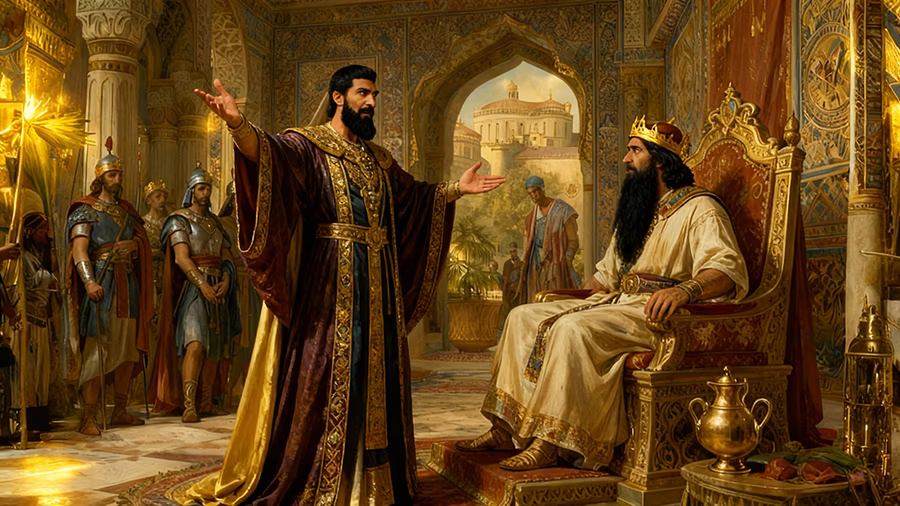
Then the king said to Haman, “Hurry, take the robe and the horse as you have said, and do so for Mordecai the Jew, who sits at the king’s gate; do not fall short in anything of all that you have said.”
Esther 6:10
Can you imagine the cascade of emotions flooding through Haman in this moment? The sudden realization that the king he had not been talking about himself. The shock of hearing Mordecai’s name, the very man he came to request permission to execute. The horror of understanding that he must now personally honor his sworn enemy. The humiliation of recognizing that his own words would be used to exalt the man he despised most.
The king’s command leaves no room for negotiation: “Do not fall short in anything of all that you have said.” Every detail Haman proposed, thinking they were for his own glorification, must now be carried out for Mordecai. The royal robes. The king’s horse. The public proclamation through the city. And Haman himself must be the one to lead Mordecai through the streets of Shushan.
This is more than mere embarrassment. This is complete reversal and public humiliation. Everyone in Shushan knew about the feud between Haman and Mordecai, as explored in our studies of Book of Esther 2’s examination of God’s providence and divine guidance. They all knew that Haman had issued the decree for the genocide of all Jews. They all knew Mordecai was a Jew who refused to bow to Haman.
So Haman took the robe and the horse, and arrayed Mordecai, and led him on horseback through the city square, and proclaimed before him, “Thus it shall be done to the man whom the king delights to honor.”
Esther 6:11
Picture this scene: Haman, the second most powerful man in the Persian Empire, walking on foot through the streets of Shushan, leading by the bridle the horse on which sits his archnemesis Mordecai, dressed in royal garments. Haman is forced to shout repeatedly, “Thus it shall be done to the man whom the king delights to honor,” proclaiming to all that the king favors the very man Haman sought to destroy.
The citizens of Shushan, watching this spectacle, would have immediately understood its significance. They knew the Jews worshiped one God who intervened on their behalf. They would have recognized this dramatic reversal as evidence of divine power. The God of the Hebrews was making a point that could not be missed. Through our examination of Today’s Concerns and biblical reflection on modern culture, we see this same principle at work: God ultimately vindicates His people and exposes those who oppose His purposes.
This public humiliation accomplished several things. It demonstrated the king’s favor toward Mordecai and, by extension, toward the Jewish people. It revealed Haman’s fall from grace in the most dramatic way possible. It showed all of Persia that opposing God’s people leads to judgment. And it set the stage for the complete reversal of Haman’s genocidal plot. The events of Book of Esther 6 became a turning point in the entire narrative.

Haman’s Descent and Prophetic Warning
What prophetic warning appears in Book of Esther 6?
Book of Esther 6 contains a prophetic warning when Haman’s wife and advisors declare that if Mordecai is Jewish, Haman will certainly fall before him and cannot prevail. This recognition in Book of Esther 6 acknowledges God’s protection over His covenant people and foreshadows Haman’s complete downfall, showing even pagans recognized divine favor on the Jews.
After this devastating public humiliation, Haman returns home in shame:
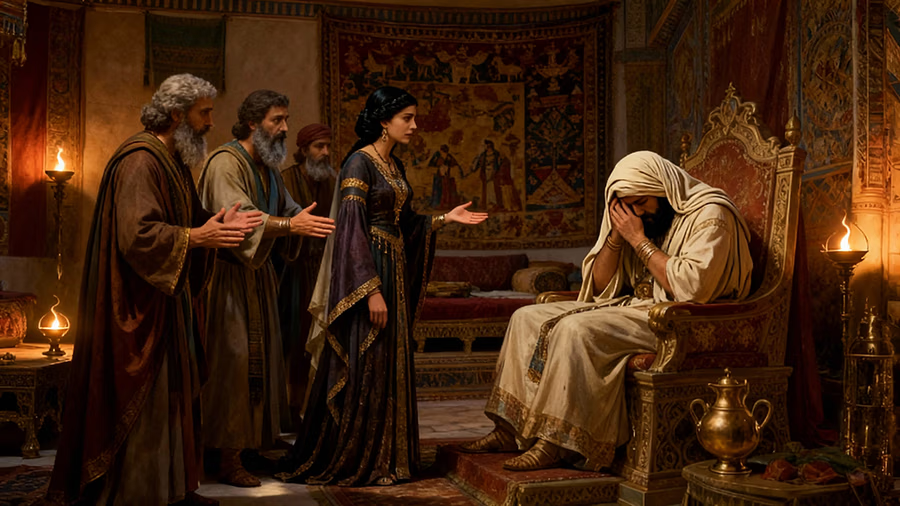
Then Mordecai returned to the king’s gate, but Haman hurried home, mourning, with his head covered.
Esther 6:12
Notice the contrast. Mordecai, having been honored by the king, returns to his post at the gate. He does not let this honor inflate his ego or change his character. He remains faithful to his duties and humble in his position. This response demonstrates the righteousness that made him worthy of honor in the first place.
Haman, however, rushes home with his head covered, the traditional sign of mourning and shame. He knows his position has been irrevocably compromised. How can he continue as prime minister after being forced to publicly honor the man everyone knows he hates? How can he maintain authority after being so thoroughly humiliated? His mind must have been racing with the implications of what just happened.
And Haman recounted to Zeresh his wife and all his friends everything that had happened to him. Then his wise men and Zeresh his wife said to him, “If Mordecai, before whom you have begun to fall, is of Jewish origin, you will not prevail against him, but will surely fall before him.”
Esther 6:13
This response from Haman’s wife and advisors is remarkable. Rather than offering comfort or strategizing ways to recover, they immediately recognize the situation as hopeless. Their words contain prophetic insight: “If Mordecai, before whom you have begun to fall, is of Jewish origin, you will not prevail against him, but will surely fall before him.”
These pagan advisors acknowledge what history had repeatedly demonstrated: those who oppose the Jewish people face divine judgment. They recognize that Haman’s downfall has already begun and that it will continue to its inevitable conclusion. The phrase “you have begun to fall” indicates they see this public humiliation not as an isolated incident but as the first stage of complete destruction.
Their warning echoes the ancient promise God made to Abraham:
I will bless those who bless you, and I will curse him who curses you.
Genesis 12:3
Even pagans recognized that opposing God’s covenant people brought calamity. Our study of the 4-3 Formula biblical framework for growth demonstrates how God’s promises and principles operate with absolute reliability throughout history. Those who align with God’s purposes are blessed; those who oppose them face judgment.
The text emphasizes that Haman’s advisors understood this principle. They do not say “you might fall” or “you could fall.” They say emphatically that he will “surely fall before him.” There is no escape, no way to reverse what has begun. God’s justice is set in motion, and Haman’s complete downfall is now inevitable.
This recognition by pagans serves an important theological purpose in the narrative. It demonstrates that God’s protection of His people and judgment of their enemies is so obvious that even those outside the covenant recognize it. The evidence of divine providence working on behalf of the Jews is undeniable.
The Summons to Judgment
How does Book of Esther 6 set up the next phase of God’s plan?
Book of Esther 6 ends with the king’s servants urgently escorting Haman to Esther’s second banquet, creating dramatic tension and preventing any escape. This swift summons after his humiliation in Book of Esther 6 ensures Haman has no time to plot, while the king’s apparent urgency suggests growing suspicion, positioning all players for the revelation and judgment coming in chapter seven.
Even as Haman’s advisors are delivering this grim prophecy, another element of divine timing unfolds:
While they were still talking with him, the king’s eunuchs arrived and hastily brought Haman to the banquet which Esther had prepared.
Esther 6:14
The text emphasizes the urgency: they “hastily brought” Haman to the banquet. Why the rush? The king had already told Esther that both he and Haman would attend her second banquet. Yet now the king’s servants arrive with urgency to ensure Haman’s attendance.
This suggests several possibilities. First, the king may have sensed that Haman might try to flee or hide after the morning’s humiliation. The command to “hastily” bring Haman indicates the king did not want to give him time to escape or plot. Second, the king’s suspicions about Haman were likely growing. The failure to honor Mordecai, Haman’s obvious designs on appearing like royalty, and the general sense that something significant was happening all contributed to the king’s desire to have Haman under close watch.
Through our exploration of G-Drop spontaneous scriptural commentary on current events, we see how God often uses authorities to execute His justice. The king, though he does not yet know the full story, is being positioned by divine providence to serve as the instrument of judgment against Haman.
The timing creates maximum dramatic tension. Haman has just experienced the worst humiliation of his life. His wife and advisors have just told him he is doomed. He has no time to process these events, no opportunity to formulate a response or plan an escape. He is immediately thrust into another encounter with the king and queen, knowing that something significant is about to be revealed but having no idea what it is or how to prepare for it.
Consider how different this is from Haman’s emotional state at the first banquet. Then, he left feeling honored and privileged, invited to an exclusive event with the king and queen. He boasted to his wife about his position and influence. Now, less than twenty-four hours later, he arrives at the second banquet having been publicly humiliated, prophetically condemned by his own advisors, and hastily summoned by the king’s servants.
This rapid descent from the heights of power and pride to the depths of humiliation and fear demonstrates how quickly God can overturn the schemes of the wicked. Our study of Proverbs 18’s wisdom for words and relationships reminds us that “pride goes before destruction, and a haughty spirit before a fall.” Haman’s pride has been thoroughly exposed, and his destruction is imminent.
The chapter ends with this urgent summons, leaving readers in suspense. What will happen at this second banquet? How will Esther finally reveal her request? How will the king respond when he learns of Haman’s genocidal plot? The stage is set, all the players are in position, and divine justice is about to be fully revealed.
Lessons from Divine Providence in Book of Esther 6
What practical lessons can Christians learn from Book of Esther 6?
Book of Esther 6 teaches Christians that God’s timing is perfect, that pride leads to devastating falls, that God protects His people even when He seems hidden, and that apparent coincidences often reveal divine orchestration. The narrative of Book of Esther 6 provides a masterclass in recognizing God’s hand at work. Believers should trust God’s providence in dark times, resist pride’s deceptions, remain faithful regardless of circumstances, and recognize that justice may unfold gradually but always arrives.
The theological and practical implications of Book of Esther 6 are profound for believers today. The lessons from Book of Esther 6 extend far beyond ancient Persia and speak directly to contemporary challenges. Through our engagement with our Christian community fellowship, we discover how these ancient truths apply to contemporary challenges.
God’s Timing Is Perfect
The sequence of events in this chapter demonstrates divine choreography with split-second precision. The king’s insomnia, the specific passage read from the chronicles, Haman’s arrival at exactly the right (or wrong) moment, the immediate summons to the second banquet – nothing happens by accident. Every element of Book of Esther 6 works together to accomplish God’s purposes.
This truth provides tremendous comfort when we face difficult circumstances. Even when we cannot see God’s hand at work, even when events seem random or tragic, divine providence is orchestrating outcomes according to eternal purposes. The challenge for believers is to maintain faith during the waiting period when God’s plan is not yet visible.
Pride Always Leads to Destruction
Haman’s downfall was self-inflicted through his own pride. He assumed the honor was for him because he could not imagine the king honoring anyone else. This narcissistic blindness led him to propose his own humiliation. The account in Book of Esther 6 provides Scripture’s most vivid illustration of Proverbs’ repeated warnings that pride goes before destruction.
Modern believers face similar temptations to pride, especially in a culture that celebrates self-promotion and personal achievement. The antidote is the humility demonstrated by Mordecai, who returned to his post after being honored, unchanged by the king’s favor. True godly character remains consistent regardless of circumstances.
God Protects His Covenant People
Even Haman’s pagan advisors recognized that opposing the Jews was futile because of divine protection. Throughout history, nations and individuals who have persecuted God’s people have faced judgment. This principle extends to the Church, the spiritual inheritors of God’s covenant promises. Those who oppose God’s kingdom will ultimately fail, regardless of their apparent power or success.
This truth provides hope for believers facing persecution or opposition. We may appear weak and vulnerable, but we serve the God who controls all events and defends His people. Our task is not to defend ourselves through human means but to remain faithful and trust God to vindicate His name and protect His purposes.
Apparent Coincidences Reveal Divine Control
Every “coincidence” in this chapter was actually God working behind the scenes. The king’s insomnia was not random. The specific passage read from the chronicles was not chance. Haman’s arrival was not accidental. When we train ourselves to recognize God’s hand in events, we develop stronger faith and deeper peace.
This perspective transforms how we interpret circumstances. Rather than seeing life as a series of random events, we recognize that God is actively working to accomplish His purposes. This does not mean everything that happens is good, but it does mean that God can work all things together for good for those who love Him and are called according to His purpose.
The Wicked Set Their Own Traps
Haman constructed the gallows for Mordecai but would end up hanging there himself. He proposed honors that he thought were for himself but ended up having to bestow them on his enemy. He orchestrated his own destruction through his evil schemes. Scripture teaches this principle repeatedly: the wicked fall into the pit they dig for others.
This truth should comfort believers who face opposition from those in power. We do not need to plot revenge or scheme to bring down our enemies. God’s justice operates with perfect efficiency, often using the wicked’s own plans against them. Our responsibility is to remain faithful and righteous, trusting God to handle justice in His time and way.
Through accessing resources for Christian growth and study, believers can deepen their understanding of how God’s providence operates throughout Scripture and in contemporary life. The Book of Esther provides a masterclass in recognizing divine action even when God’s name is never mentioned.

Applying Book of Esther 6 to Modern Life
How should Christians respond to Book of Esther 6’s teachings today?
Christians should apply Book of Esther 6 by maintaining faith during seemingly impossible situations, rejecting pride’s deceptions, trusting God’s perfect timing without demanding immediate answers, remaining faithful in difficult positions like Mordecai at the gate, and recognizing that current circumstances do not determine ultimate outcomes. The enduring relevance of Book of Esther 6 becomes clear when we face contemporary challenges. God’s justice may be delayed but never denied.
The principles demonstrated in Book of Esther 6 speak directly to challenges believers face in contemporary society. The timeless wisdom contained in Book of Esther 6 transcends cultural and temporal boundaries. When we examine current events through the lens of Scripture in series like G-Riff reflective commentary on Scripture and QOHELETH ancient wisdom for modern living, we discover that human nature and divine principles remain constant.
Trust God’s Timing in Dark Seasons
When circumstances appear hopeless, remember that God is working behind the scenes. At the end of Esther 5, Haman had constructed a seventy-five-foot gallows to execute Mordecai. The decree for Jewish genocide was still in effect. Esther had risked her life but had not yet revealed her request. Everything looked dire. Yet within hours, as Book of Esther 6 demonstrates, the situation completely reversed.
Believers facing difficult circumstances can take comfort from this pattern. God often works most powerfully in moments that seem darkest. The challenge is to maintain faith without seeing the outcome, to trust God’s character when His purposes are hidden, to remain obedient even when obedience seems pointless.
Recognize Pride’s Subtle Deceptions
Haman’s pride seems obvious in hindsight, but pride always appears justified to those experiencing it. He had legitimate reasons for his self-assessment: he was prime minister, he had been invited to exclusive events with the king and queen, he had power and influence. Yet this pride blinded him to reality and set him up for catastrophic failure.
Modern believers face similar deceptions. Success in career, ministry, or personal achievement can subtly shift our hearts toward pride. We begin to believe our own press, to think we deserve the blessings we have received, to see ourselves as superior to others. The antidote is constant humility before God, recognizing that every good gift comes from Him and that we are stewards, not owners, of everything we possess.
Remain Faithful in Your Post
Mordecai’s response to being honored is instructive: he returned to his post at the gate. He did not let temporary favor change his character or his faithfulness. He understood that external circumstances, whether negative or positive, should not determine our obedience to God.
This principle applies to believers in every area of life. We are called to be faithful in our marriages, jobs, ministries, and callings regardless of whether we receive recognition or face opposition. Like Mordecai, we should continue doing what is right simply because it is right, trusting God to handle outcomes in His time and way.
Recognize Divine Providence in Daily Events
Training ourselves to see God’s hand at work in ordinary circumstances strengthens faith and provides peace. The king’s insomnia seemed like a random occurrence but was actually divine intervention. The specific passage read from the chronicles appeared coincidental but was divinely orchestrated. Haman’s arrival at that exact moment looked like bad luck but was perfect timing. These elements of Book of Esther 6 train believers to recognize God’s active presence.
When we develop eyes to see God’s providence in daily life, we become more confident in His sovereignty and more peaceful in difficult circumstances. This does not mean we should see every event as miraculous, but it does mean we should recognize that God is actively engaged in the details of our lives, working all things according to His purposes.
Our mission to illuminate current events with biblical truth flows from this understanding. We live in a time when many people see only chaos and random events. As believers, we can point to the enduring truth that God governs all things and that His purposes will ultimately prevail, regardless of current circumstances or apparent opposition.
A Prayer for Trusting Divine Providence
As David prayed in Psalm 140, which Chuck Frank used to close this study:
Deliver me, O Lord, from evil men; preserve me from violent men, who plan evil things in their hearts; they continually gather together for war. They sharpen their tongues like a serpent; the poison of asps is under their lips. Keep me, O Lord, from the hands of the wicked; preserve me from violent men, who have purposed to make my steps stumble.
Psalm 140:1-4
This ancient prayer perfectly captures the situation in Book of Esther 6. Mordecai and the Jewish people faced “evil men” and “violent men” who had “planned evil things in their hearts.” Haman had indeed “purposed to make their steps stumble” through his genocidal decree. Yet God preserved them through His providential intervention as demonstrated throughout Book of Esther 6.
The psalm continues:
I said to the Lord: “You are my God; hear the voice of my supplications, O Lord. O God the Lord, the strength of my salvation, You have covered my head in the day of battle.”
Psalm 140:6-7
This declaration of trust in God’s protection and deliverance is exactly what the situation in Esther required. Even when facing a decree that seemed irrevocable and an enemy who seemed invincible, God’s people could trust that He remained their strength and salvation.
I know that the Lord will maintain the cause of the afflicted, and justice for the poor. Surely the righteous shall give thanks to Your name; the upright shall dwell in Your presence.
Psalm 140:12-13
This confidence in God’s justice is the foundation of faith in difficult times. We may not see how justice will be accomplished, but we know that God maintains the cause of the afflicted and that righteousness will ultimately prevail. Book of Esther 6 provides a vivid demonstration of these eternal truths.
Through confidential prayer and encouragement support, believers can find community and strength during their own difficult seasons, trusting that the God who protected Mordecai and vindicated the Jews in ancient Persia remains the same yesterday, today, and forever.
Conclusion: The God Who Works While We Wait
Book of Esther 6 stands as one of Scripture’s most dramatic demonstrations of divine providence. In a single night described in Book of Esther 6, God transformed a death sentence into a royal honor, turned an executioner into a herald of blessing, and began the complete reversal of a genocidal plot. All of this happened through events that appeared coincidental but were actually divinely choreographed with perfect precision.
The chapter teaches us that God is most active when He appears most absent. The king’s insomnia, the specific chronicle reading, Haman’s perfectly timed arrival – these seemingly random events revealed the hand of a sovereign God orchestrating justice for His people. Even when God’s name is never mentioned, His presence permeates every verse.
For believers today, this chapter provides both comfort and challenge. The comfort comes from recognizing that God controls all circumstances, that He protects His people, and that His justice, though sometimes delayed, is absolutely certain. The challenge comes in trusting these truths during dark seasons when God’s purposes are hidden and circumstances appear hopeless.
Like Mordecai, we are called to remain faithful in our assigned positions, unchanged by either honor or opposition, trusting God to vindicate righteousness in His perfect timing. Like the Jews of Shushan, we can have confidence that those who oppose God’s purposes will ultimately fail, no matter how powerful they may appear. Like the king’s servants who witnessed these events, we can learn to recognize divine providence at work in circumstances that others dismiss as coincidence.
Frequently Asked Questions (FAQs)
What is the main message of Book of Esther 6?
Book of Esther 6’s main message is that God’s providential timing is perfect and His justice is certain. When the king cannot sleep and discovers Mordecai’s unrewarded loyalty at the exact moment Haman arrives seeking to execute him, divine orchestration becomes undeniable. This chapter demonstrates that God works behind the scenes to protect His people, vindicate the righteous, and bring down the proud through their own schemes.
Why is timing so important in Book of Esther 6?
Timing is crucial in Book of Esther 6 because multiple events must converge at the precise moment to accomplish God’s purposes. The king’s insomnia, the specific chronicle reading, Haman’s arrival, and the subsequent banquet summons all work together with split-second precision. This perfect timing reveals divine control over circumstances and demonstrates that what appears coincidental is actually providential, showing God actively protects His people even when He seems absent.
How does Haman’s pride lead to his downfall in Book of Esther 6?
Haman’s pride causes him to assume the king’s question about honoring someone must refer to himself. This narcissistic blindness leads him to describe elaborate honors that he then must perform for his enemy Mordecai. His pride prevented him from considering any other possibility, causing him to design his own humiliation. This demonstrates Scripture’s repeated warnings that pride goes before destruction and illustrates how self-deception leads to catastrophic consequences.
What does Book of Esther 6 teach about God’s protection of His people?
Book of Esther 6 teaches that God protects His covenant people through providential intervention even when His presence is not explicitly mentioned. The chapter shows divine orchestration of circumstances to vindicate Mordecai and expose Haman’s evil. Even pagan advisors recognize that opposing the Jews is futile because of divine protection, acknowledging that Haman will surely fall before Mordecai, demonstrating that God’s defense of His people is so obvious that even unbelievers recognize it.
Further Reading and Resources
- Blue Letter Bible – Esther 6 Commentary – Detailed verse-by-verse commentary on Esther 6 exploring divine providence and narrative structure
- Bible Gateway – Esther 6 Multiple Translations – Compare various Bible translations of Esther 6 for deeper textual understanding
- Ligonier Ministries – The Providence of God – R.C. Sproul’s teaching on understanding God’s providential control over all events
- Bible Project – Esther Overview – Visual overview of the entire Book of Esther providing context for chapter 6


